
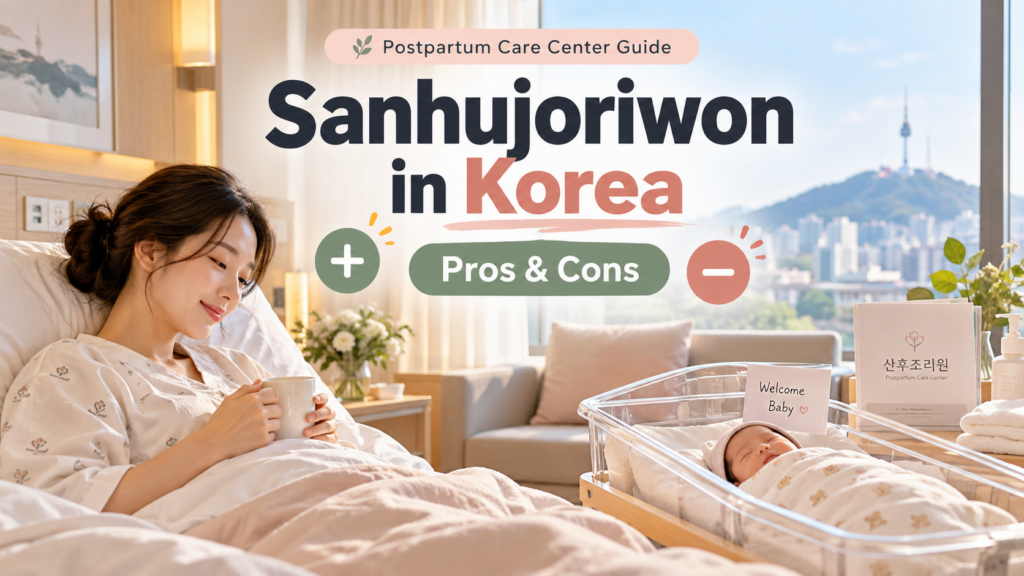
Imagine you are expecting a baby in South Korea.
Your Korean friends tell you to reserve a sanhujoriwon as soon as possible. Someone recommends a luxury postpartum care center in Seoul, while another suggests hiring a caregiver at home.
Then you see the prices: several million Korean won for approximately two weeks.
If you are unfamiliar with Korean childbirth culture, you may wonder why so many families spend this much money on postpartum care.
Is a sanhujoriwon really necessary? And what happens if you decide not to use one?
The answer is simpler than you might expect.
A sanhujoriwon is not a medical requirement. However, it can provide valuable support when a mother needs rest, newborn care assistance, and help managing everyday responsibilities.
For foreign parents, choosing one involves several additional considerations: language support, booking availability, partner access, feeding preferences, and government assistance eligibility.
Here is what you should know before spending your money.
Sanhujoriwon in Korea: The Essentials
| Question | Quick Answer |
|---|---|
| What is it? | A residential postpartum care center for mothers and newborns |
| Is it mandatory? | No |
| Typical stay | Approximately 2 weeks |
| Nationwide average listed price | KRW 3.72 million for a standard room, 14 days, based on second-half 2025 data |
| Seoul prices | Often higher, especially in premium districts |
| When to start searching | As early as 8–12 weeks of pregnancy for popular locations |
| Can foreigners use one? | Generally yes, subject to facility admission policies |
| Is English support guaranteed? | No |
| Is government home-care support available? | Only to eligible families; foreign residents face additional conditions |
Price information is based on published facility data available in 2026. Actual booking quotes may differ.
1. What Is a Sanhujoriwon?
A sanhujoriwon (산후조리원) is a specialized postpartum care center where mothers recover after childbirth while receiving practical assistance with newborn care.
The name comes from two Korean words:
- Sanhu (산후): After childbirth
- Jori (조리): Rest, care, and recovery
Together, sanhujori describes the traditional Korean practice of supporting a mother during the postpartum recovery period.
In modern Korea, sanhujoriwon facilities provide an organized version of this tradition.
What services are included?
Most centers provide some combination of:
- A private room for the mother
- Prepared meals and snacks
- Newborn nursery services
- Feeding assistance
- Basic newborn care education
- Laundry and housekeeping
- Opportunities for maternal rest
Some facilities also offer massage, exercise programs, lactation consultations, and other services.
However, not everything shown in promotional materials is necessarily included in the basic package.
A sanhujoriwon is not the same as a maternity hospital. It primarily provides residential recovery support rather than medical treatment.
Why are postpartum care centers so common in Korea?
Korean childbirth culture has traditionally emphasized protecting the mother’s recovery time.
Practices such as eating nutritious meals, resting, and receiving help from family members have long been associated with sanhujori.
Seaweed soup, called miyeok-guk (미역국), is particularly well known as a traditional postpartum meal.
As Korean households have become smaller and extended families increasingly live separately, commercial postpartum care centers have become a common alternative to traditional family assistance.
According to the Ministry of Health and Welfare’s 2024 Postpartum Care Survey, published in February 2025:
- 85.5% of surveyed mothers reported using a postpartum care center.
- The average stay at a center was 12.6 days.
- 70.9% identified postpartum care centers as their preferred recovery location.
The survey included 3,221 mothers who gave birth in 2023.
These figures help explain why booking a sanhujoriwon has become a familiar part of childbirth preparation in Korea.
2. How Much Does a Sanhujoriwon Cost in Korea in 2026?
Cost is usually one of the first concerns for foreign parents.
The important thing to understand is that the national average and the actual price of a center in Seoul can be very different.
Nationwide postpartum care center prices
According to the Ministry of Health and Welfare’s published facility data for the second half of 2025, reported by Hankook Ilbo in March 2026, the average listed price for a standard room was approximately:
KRW 3.72 million for a 14-day stay.
This was based on published standard-room prices from 460 facilities.
Source: Hankook Ilbo — Nationwide Postpartum Care Center Pricing, March 13, 2026
This represents advertised facility rates, not necessarily the final amount paid by every family.
The government’s earlier postpartum survey reported average actual spending of KRW 2.865 million among respondents who used postpartum care centers after giving birth in 2023.
The two figures cover different periods and measurement methods, so they should not be interpreted as a direct year-over-year price increase.
Seoul and Gangnam: Why prices can be much higher
Gangnam provides a useful example of the price differences foreign parents may encounter.
According to the Gangnam Public Health Center’s official price information dated April 24, 2026:
| Postpartum Care Center | Standard Room, 2 Weeks |
|---|---|
| Hanareum Postpartum Care Center | KRW 4.70 million |
| Trinity Postpartum Care Center, Samsung Branch | KRW 6.64 million |
| Heritage Postpartum Care Center, Central Branch | KRW 17.00 million |
| Drama Global Postpartum Care Center | KRW 29.00 million |
Source: Gangnam Public Health Center — Postpartum Care Center Prices
These examples are not representative of every Korean city, or even every center in Seoul.
They illustrate the substantial difference between standard and premium facilities.
Published prices may also change because of promotions, room types, and optional programs.
What about other regions?
Facilities outside central Seoul or premium urban districts may be considerably cheaper.
However, location alone does not determine price.
A well-known center in a suburban area may still cost more than a smaller facility in Seoul.
Instead of relying on broad regional assumptions, compare at least three nearby facilities using the same conditions:
- 13 nights and 14 days
- Standard room
- One mother and one newborn
- Same included services
- Same treatment of optional charges
Hidden costs to ask about
Before making a reservation, request a written quotation.
Check whether these items are included:
- Partner meals and overnight accommodation
- Postpartum massage
- Breastfeeding consultations
- Breast pump equipment
- Additional newborn charges for twins
- Special room upgrades
- Extra nights
- Laundry and personal supplies
Practical tip: Compare the total contract price, not simply the advertised price per package.
3. When to Book a Sanhujoriwon in Seoul or Gyeonggi
One of the biggest practical mistakes is starting the search too late.
In popular residential areas of Seoul and Gyeonggi, some postpartum care centers receive bookings very early in pregnancy.
Families interested in specific facilities may begin inquiries around 8–12 weeks of pregnancy, after confirming their pregnancy with an obstetrician.
This is an early-planning recommendation, not an official booking deadline.
Availability depends on the center, due-date month, location, and remaining room capacity.
Not every facility fills up by week 12, and later reservations may still be possible.
Recommended Sanhujoriwon Booking Timeline
| Pregnancy Stage | Recommended Action |
|---|---|
| Weeks 8–12 | Research nearby centers and ask about available rooms |
| Weeks 12–16 | Compare facilities, arrange tours, and review contracts |
| Second trimester | Confirm reservations if not already booked |
| 2–4 weeks before delivery | Reconfirm admission details and prepare belongings |
| After childbirth | Inform the center of the delivery date and hospital discharge schedule |
Why early booking matters
Unlike a hotel reservation, a sanhujoriwon booking depends on an uncertain delivery date.
A baby may arrive earlier or later than expected.
Centers therefore need to manage overlapping delivery schedules and room availability.
Before paying a deposit, ask:
- How is my room assigned if I deliver early?
- What happens if my delivery is delayed?
- Can I change my admission date?
- What happens if no room is available when I leave the hospital?
- What happens if my baby needs neonatal intensive care?
A NICU (Neonatal Intensive Care Unit) is a hospital unit that provides specialized medical care for premature or seriously ill newborns.
If your baby requires NICU treatment, routine sanhujoriwon admission may not be possible on the original schedule.
The center’s cancellation and rescheduling policies can therefore be extremely important.
4. Advantages of a Sanhujoriwon
Advantage 1: More time for mother recovery
Recovering from childbirth takes time.
Mothers may experience postpartum bleeding, physical discomfort, hormonal changes, breastfeeding difficulties, and interrupted sleep.
Recovery after a cesarean section may involve additional limitations while the surgical incision heals.
A sanhujoriwon reduces some daily responsibilities by providing meals, housekeeping, and newborn care assistance.
This can be especially helpful when grandparents or other relatives are not available.
However, the facility itself does not guarantee faster physical recovery.
Medical follow-up and adequate rest remain important regardless of where a mother stays.
Advantage 2: Help with newborn care
First-time parents often have many practical questions.
How do you hold a newborn safely?
How frequently should a baby feed?
What should you do when your baby cries after feeding?
Many postpartum care centers provide guidance on:
- Diaper changing
- Bathing
- Burping
- Breastfeeding and bottle-feeding
- General newborn hygiene
- Recognizing potential health concerns
For parents unfamiliar with Korean hospitals and childcare practices, practical demonstrations can be especially useful.
But ask whether you will actually practice these skills or simply watch staff perform them.
Advantage 3: Meals and household work are handled
It may sound simple, but regular meals and clean laundry can make a meaningful difference during postpartum recovery.
Many centers provide prepared meals, snacks, and basic laundry services.
Some mothers appreciate not having to organize food or manage daily household tasks during their first weeks after childbirth.
Advantage 4: A transition between hospital and home
A sanhujoriwon can act as a temporary bridge between hospital discharge and independent newborn care.
Parents have time to learn routines and prepare for life at home.
This may be particularly valuable for foreign families without relatives nearby.
5. Disadvantages Foreign Parents Should Understand
The disadvantages are not limited to cost.
Several everyday rules can significantly affect the experience.
Disadvantage 1: Partner access may be restricted
Some facilities have strict rules about partners entering, leaving, or staying overnight.
For example, a center may allow a partner to stay but restrict repeated entry after commuting to work.
Other facilities may allow visits only during specific hours.
These rules often relate to infection prevention.
They are not identical across all sanhujoriwon facilities.
Before booking, confirm whether your partner can:
- Stay overnight
- Commute to work
- Leave and re-enter
- Eat meals at the facility
- Participate in newborn care classes
For foreign mothers whose partners are their main source of support in Korea, these policies can make a major difference.
Disadvantage 2: English communication may be limited
Finding an English-speaking sanhujoriwon in Seoul is not always straightforward.
Some centers may offer English consultation during booking but have limited English-speaking staff during everyday care.
Imagine waking up at night with breastfeeding pain or concerns about your baby’s feeding.
Using a translation app might work for basic questions, but more complicated discussions can become stressful.
Ask whether English communication is available for:
- Feeding instructions
- Newborn care education
- Emergency situations
- Medical referral arrangements
- Discharge preparation
If the center cannot provide fluent English support, ask whether translation applications or a partner interpreter can be used.
Disadvantage 3: Mother and baby may spend time apart
Some centers use a centralized nursery system.
Under this arrangement, staff provide newborn care in a separate room while mothers rest.
This can create opportunities for sleep, but parents who prefer continuous contact with their baby may find it uncomfortable.
In Korea, moa-dongsil (모자동실) refers to mother–baby rooming-in.
The World Health Organization recommends supporting mothers and newborns to remain together and practice rooming-in when medically appropriate.
Source: WHO — Creating an Environment That Supports Breastfeeding
Before booking, ask:
Can my baby stay in my room whenever I want, including overnight?
Also check whether the center encourages direct breastfeeding or relies on scheduled nursery feeding.
Disadvantage 4: Feeding expectations may not match your preferences
Some parents want exclusive breastfeeding.
Others prefer combination feeding, expressed breast milk, or formula.
A facility’s feeding culture may not perfectly match your expectations.
For example, staff may encourage frequent direct breastfeeding, which some mothers find helpful and others experience as pressure.
It is better to discuss your feeding preferences before admission.
Ask how the center handles:
- Direct breastfeeding
- Pumped breast milk
- Formula feeding
- Combination feeding
- Nighttime feeding
- Lactation consultations
A supportive center should provide accurate information and respect informed parental decisions.
Disadvantage 5: Korean postpartum traditions may feel unfamiliar
Certain Korean postpartum practices may be different from those in your home country.
Examples include:
- Keeping rooms relatively warm
- Encouraging warm meals and beverages
- Serving seaweed soup frequently
- Advising mothers to avoid unnecessary physical strain
These customs are part of Korean postpartum culture.
However, not every traditional practice is a medical requirement.
A foreign mother who prefers a cooler room, different food, or another recovery routine should be able to discuss these preferences.
Cultural traditions can be respected without treating every custom as compulsory medical advice.
Disadvantage 6: Emotional isolation is possible
A comfortable room does not automatically prevent loneliness.
Some foreign mothers may feel isolated when family members live overseas and most staff communicate in Korean.
Postpartum emotional difficulties also deserve attention.
The Ministry of Health and Welfare’s 2024 survey found that 68.5% of respondents reported experiencing depressive feelings after childbirth.
That figure refers to self-reported depressive feelings, not diagnosed postpartum depression.
Postpartum depression (PPD) is a medical condition that can involve persistent sadness, anxiety, hopelessness, or difficulty functioning.
If emotional distress persists or becomes severe, seek professional support.
The most important question is not whether a center looks luxurious.
It is whether you will feel safe, supported, and comfortable asking for help.
6. Four Things Foreign Parents Must Check Before Signing
1. Partner Entry Rules
Confirm overnight stays, visiting hours, commuting, and re-entry restrictions.
Do not assume that a partner can come and go freely.
2. Language Support
Ask who can communicate in English during the day and overnight.
Confirm how staff explain emergencies and newborn care procedures.
3. Cancellation and Refund Terms
Check the written refund policy for:
- Cancellation before admission
- Early delivery
- Delayed hospital discharge
- Miscarriage or stillbirth
- NICU admission
- Maternal medical complications
- Early departure from the center
The Korea Fair Trade Commission publishes a standard contract for postpartum care centers, known as the Sanhujoriwon Standard Terms and Conditions (산후조리원 표준약관).
Source: Korea Fair Trade Commission — Postpartum Care Center Standard Contract
The published standard contract provides a reference for reviewing consumer contract terms.
However, do not assume that every contract automatically provides a full refund under every circumstance.
Ask the facility to explain its applicable cancellation terms in writing before paying.
4. Your Feeding and Rooming-In Preferences
Confirm whether your preferred feeding arrangement is supported and whether the baby can stay in your room.
These daily arrangements are often more important than luxury amenities.
7. Sanhujoriwon vs. Home-Based Postpartum Care
A residential postpartum care center is not the only recovery option available in Korea.
Some families prefer hiring a caregiver at home.
Others use government-supported home-visit services, provided they meet eligibility requirements.
Postpartum Care Options Compared
| Feature | Sanhujoriwon | Private Home Caregiver | Government-Subsidized Home Care |
|---|---|---|---|
| Location | Residential care center | Your home | Your home |
| Cost | Usually high | Depends on hours and provider | Lower personal cost if eligible |
| Meals | Usually provided | Depends on contract | Maternal meal preparation may be included |
| Newborn support | Staff assistance | Agreed caregiver services | Defined maternal and newborn care services |
| Overnight support | Nursery services vary by center | Only if contracted | Usually scheduled home visits |
| Partner involvement | Subject to facility rules | Generally flexible | Generally flexible |
| Foreigners | Usually able to book private services | Usually able to hire privately | Visa and eligibility restrictions |
| Main advantage | Structured recovery environment | Personalized care at home | Subsidized professional assistance |
| Main drawback | High cost and facility restrictions | Service quality and availability vary | Application and qualification requirements |
What about public postpartum care centers?
Some local governments operate public postpartum care centers or support designated facilities.
These can have substantially different prices and admission priorities from private luxury centers.
For example, Seoul provides information about its Seoul-Type Safe Postpartum Care Center (서울형 안심 산후조리원) program, including designated facilities and eligibility-based payment arrangements.
Source: Seoul Pregnancy and Birth Information Center — Seoul-Type Safe Postpartum Care Centers
Foreign families should confirm the specific program’s residency, registration, and eligibility conditions rather than assuming that a local subsidy automatically applies.
8. Government Postpartum Home-Care Support for Foreigners
South Korea operates the Maternal and Newborn Health Management Support Program.
Its Korean name is:
산모·신생아 건강관리 지원사업
This program helps eligible families receive home visits from trained postpartum caregivers.
Services may include:
- Maternal recovery support
- Newborn feeding assistance
- Basic newborn care
- Maternal meal preparation
- Laundry related to mother and baby
However, the standard service does not automatically include full housekeeping for the entire family or childcare for older siblings.
Important: Visa rules for foreign couples
This is one of the most important details for foreign residents.
According to the Ministry of Health and Welfare’s published eligibility rules, families with Korean resident registration or foreigner registration may apply.
However, if both spouses are foreign nationals, each must hold an eligible residence status:
- F-2: Resident
- F-5: Permanent Resident
- F-6: Marriage Migrant
This means a couple in which both spouses hold other visa categories, such as E-series employment visas, may not qualify for this government program under the published rule.
Having National Health Insurance does not automatically override the immigration-status requirements.
Eligibility also depends on household circumstances and applicable income or local exception rules.
Official Source: Ministry of Health and Welfare — Pregnancy and Childbirth Support
When can you apply?
The Ministry’s published general application window is:
From 40 days before the expected delivery date until 60 days after childbirth.
The service duration can range from 5 to 40 days depending on family circumstances and the approved service arrangement.
Special circumstances, such as a baby’s extended hospitalization, may affect applicable procedures and service validity.
Can foreigners apply online?
Not always.
For example, Seoul’s official guidance states that households with a foreign-national family member may need to apply directly at their local public health center rather than through the ordinary online application process.
Before applying, contact your local bogeonso (보건소), meaning public health center.
Ask about your household’s exact visa category, registration documents, National Health Insurance assessment, and application method.
Important: Do not reserve a government-supported caregiver on the assumption that you qualify for a subsidy. Obtain an eligibility decision first.
9. Useful Korean Phrases for Sanhujoriwon Reservations
If you cannot communicate comfortably in Korean, save the following phrases on your phone.
You can show them directly to staff during a consultation.
Asking About Availability
Korean:
안녕하세요. 출산 예정일이 [MM]월 [DD]일인데 예약 가능한 방이 있나요?
English:
Hello, my due date is [MM/DD]. Do you have an available room?
Asking About English Support
Korean:
외국인인데 영어나 번역기로 소통이 가능한가요?
English:
I am a foreigner. Can we communicate in English or using a translation app?
Asking About Partner Access
Korean:
배우자가 함께 입실하거나 출퇴근이 가능한가요?
English:
Can my partner stay overnight or commute to work from the center?
Asking About Mother–Baby Rooming-In
Korean:
아기와 모자동실을 자유롭게 할 수 있나요? 야간에도 가능한가요?
English:
Can my baby stay in my room whenever I want, including overnight?
Asking About Feeding Preferences
Korean:
모유수유, 혼합수유, 분유수유 중 원하는 방식을 선택할 수 있나요?
English:
Can I choose breastfeeding, combination feeding, or formula feeding?
Asking About Refunds
Korean:
조산이나 입원 지연으로 입실하지 못하면 환불 규정은 어떻게 되나요?
English:
What is the refund policy if premature delivery or delayed hospital discharge prevents admission?
Asking About Government Support
Korean:
부부 모두 외국인인데 산모·신생아 건강관리 지원사업 신청 자격이 있는지 확인하고 싶습니다.
English:
Both spouses are foreigners. I would like to check whether we qualify for the maternal and newborn home-care support program.
10. What to Bring to a Sanhujoriwon
Each facility has its own packing list.
Some provide nearly everything, while others require mothers to bring personal supplies.
A practical starting checklist is:
| Category | Items to Confirm or Prepare |
|---|---|
| Documents | Passport or residence card, hospital discharge documents, reservation details |
| Mother’s clothing | Comfortable pajamas, underwear, socks, nursing bras if needed |
| Personal care | Toiletries, skincare, personal medication approved by your doctor |
| Feeding | Breast pump accessories or personal feeding supplies if required |
| Electronics | Phone charger, suitable power adapters |
| Baby | Going-home outfit and any specific items required by the facility |
| Other | Personal comfort items and important emergency contacts |
Ask the center whether it provides breast pads, diapers, wipes, maternity pads, breast pump equipment, and bottle-cleaning supplies.
Also confirm which hospital records are required when the baby is discharged.
Tip: Pack according to the actual facility checklist rather than buying additional supplies unnecessarily.
11. How to Choose a Good Sanhujoriwon
A luxurious room is not necessarily the best indicator of quality.
For foreign parents, I would prioritize the following five factors.
1. Safety and Infection Prevention
Ask about:
- Staff hygiene procedures
- Cleaning and disinfection
- Nursery management
- Visitor restrictions
- Procedures for suspected newborn infections
- Emergency hospital transfer
Korean postpartum care center operators have responsibilities under the Maternal and Child Health Act, including infection prevention and responding appropriately when a mother or newborn may require medical attention.
Source: Korean National Law Information Center — Maternal and Child Health Act
2. Communication
Can you comfortably communicate your concerns?
A center with simple facilities but reliable English support may be preferable to a luxury center where communication is difficult.
3. Feeding and Newborn Care Policies
Confirm whether staff respect your feeding preferences and provide opportunities for hands-on parenting education.
4. Distance From Home and Hospital
Consider transportation after childbirth, particularly following a cesarean delivery.
A center far from your hospital or home may create unnecessary stress.
5. Contract Transparency
A good center should clearly explain:
- Total costs
- Included and excluded services
- Deposit conditions
- Cancellation policies
- Medical admission restrictions
- Emergency procedures
If important questions receive vague answers, consider another facility.
12. Is a Sanhujoriwon Worth the Money?
The answer depends on what problem you are trying to solve.
From a practical perspective, postpartum recovery involves several limited resources:
Time, sleep, physical energy, money, and available family support.
A sanhujoriwon reduces some of the daily work involved in caring for a newborn.
But it does so at a financial cost.
Consider two hypothetical families.
Family A: First Baby, No Relatives Nearby
Both parents work in Korea.
Their relatives live overseas, and they have little experience with newborn care.
For this family, a sanhujoriwon may offer meaningful benefits through meals, structured newborn care support, and opportunities for maternal rest.
If the family can afford the fees and finds a suitable facility, the service may be worthwhile.
Family B: Experienced Parents With Reliable Home Support
The parents already have a child and feel confident managing newborn care.
One partner can take extended leave, and the family prefers being together at home.
For this family, spending several million won on a sanhujoriwon may offer less additional value.
A private home caregiver or family-supported recovery could be a better fit.
A Third Option: Combining Both
Some families may prefer:
Short sanhujoriwon stay → Home-based caregiver support → Independent newborn care
This approach may provide initial support without paying for a full-length premium stay.
However, shorter packages, caregiver availability, and total costs must be confirmed individually.
The key is to compare the actual assistance each arrangement provides.
13. Frequently Asked Questions
Do all Korean mothers use a sanhujoriwon?
No.
Postpartum care centers are common, but some families recover at home with help from relatives, partners, or caregivers.
The Ministry of Health and Welfare’s 2024 survey reported an 85.5% postpartum care center usage rate among its respondents.
How long do mothers stay at a sanhujoriwon?
Approximately two weeks is common.
The 2024 government survey reported an average center stay of 12.6 days.
Individual packages and medical circumstances vary.
How much does a Korean postpartum care center cost in 2026?
Published nationwide standard-room prices averaged approximately KRW 3.72 million for 14 days based on second-half 2025 facility data.
Premium facilities in Seoul can cost substantially more.
Check current facility quotes before making a reservation.
When should I book a sanhujoriwon?
For popular facilities in Seoul or Gyeonggi, starting inquiries around 8–12 weeks of pregnancy is a cautious planning strategy.
This is not an official nationwide deadline.
Availability differs by center and expected delivery month.
Can foreigners use a sanhujoriwon in Korea?
Generally, foreign parents can book private postpartum care centers.
However, admission requirements, medical policies, language support, and necessary documents vary.
Confirm everything directly with the facility.
Are there English-speaking sanhujoriwon facilities in Seoul?
Some facilities may offer English consultations or interpretation support.
However, English availability can differ between consultation staff and daily care staff.
Ask specifically about overnight communication and emergency situations.
Can my husband or partner stay with me?
Policies vary.
Some centers allow overnight stays, while others limit visits or repeated entry.
Ask about the exact rules before booking.
Does Korean National Health Insurance cover sanhujoriwon fees?
Routine private postpartum care center accommodation is generally not covered as an ordinary National Health Insurance medical benefit.
Certain local financial support programs may help eligible families with postpartum-related expenses.
However, eligibility and permitted uses vary by program, and a subsidy should not be assumed to cover a private center bill.
Can foreign couples receive government-supported postpartum home care?
Some foreign families qualify.
Under the Ministry of Health and Welfare’s published general rule, where both spouses are foreign nationals, each must have F-2, F-5, or F-6 residence status.
Additional income, registration, and household requirements may apply.
What if I do not want to breastfeed?
Discuss your feeding preferences before admission.
Ask how staff handle expressed breast milk, combination feeding, and formula feeding.
Parents should be able to make informed decisions with appropriate feeding support.
Can I recover at home instead?
Yes.
Home recovery can be appropriate when the mother receives necessary support and appropriate medical follow-up.
The World Health Organization’s postnatal care recommendations cover both facility-based and community-based care.
Source: WHO — Recommendations on Maternal and Newborn Care for a Positive Postnatal Experience
Final Thoughts: Do You Really Need a Sanhujoriwon in Korea?
A sanhujoriwon is one of the most distinctive aspects of Korean childbirth culture.
For many families, its appeal is straightforward: fewer household responsibilities, regular meals, newborn care assistance, and opportunities for maternal rest.
However, the benefits depend on the quality of the center and whether its daily policies match your family’s needs.
Foreign parents should pay particular attention to English communication, early booking, feeding preferences, partner access, and cancellation terms.
Do not assume that an expensive center is automatically better.
And do not feel pressured to choose a sanhujoriwon simply because many Korean families use one.
The most practical approach is to compare the support you would receive at a center with what you could realistically arrange at home.
The best postpartum recovery plan is not necessarily the most expensive one. It is the one that gives the mother and newborn appropriate care, sufficient support, and a comfortable environment during a demanding period.
Official Sources and References
The following sources were used to verify the factual information in this guide. Prices, policies, and eligibility conditions should be checked again before making a reservation or application.
1. Ministry of Health and Welfare — 2024 Postpartum Care Survey Results
Published: February 5, 2025
Official survey of 3,221 mothers who gave birth in 2023, covering postpartum care center usage, average length of stay, actual spending, recovery experiences, and maternal emotional well-being.
View Official Postpartum Care Survey Results
2. Gangnam Public Health Center — Postpartum Care Center Price Information
Price reference date: April 24, 2026
Official listing of postpartum care centers in Gangnam, including standard-room and special-room prices for two-week stays.
View Official Gangnam Postpartum Care Center Prices
3. Hankook Ilbo — Nationwide Postpartum Care Center Prices
Published: March 13, 2026
News reporting based on the Ministry of Health and Welfare’s publicly released nationwide postpartum care center facility data for the second half of 2025.
Read the Nationwide Pricing Report
4. Ministry of Health and Welfare — Pregnancy and Childbirth Support
Official guidance regarding maternal and newborn home-visit services, eligibility rules, residence status requirements, application periods, and service arrangements.
View Pregnancy and Childbirth Support Information
5. Seoul Pregnancy and Birth Information Center — Maternal and Newborn Health Management Support
Official Seoul Metropolitan Government information concerning postpartum home-care vouchers, application procedures, eligibility conditions, and service charges.
View Seoul Maternal and Newborn Care Support
6. Korea Fair Trade Commission — Postpartum Care Center Standard Terms and Conditions
Standard contract No. 10070, revised December 23, 2022.
Provides a reference for reviewing postpartum care center agreements, including cancellation and refund-related terms.
View Postpartum Care Center Standard Contract
7. Korean National Law Information Center — Maternal and Child Health Act
Relevant provisions cover postpartum care center operation, health management, infection prevention, emergency procedures, and required service and fee disclosures.
View the Maternal and Child Health Act
8. World Health Organization — Postnatal Care Recommendations
Published: March 30, 2022
International recommendations covering maternal recovery, newborn health, family support, and appropriate postpartum healthcare.
Read WHO Postnatal Care Recommendations
9. U.S. Centers for Disease Control and Prevention — Urgent Maternal Warning Signs
Medical guidance on symptoms requiring urgent evaluation during pregnancy and after childbirth.
Read CDC Urgent Maternal Warning Signs
Disclaimer
This article provides general educational information for foreign residents and families preparing for childbirth in South Korea.
It is not a substitute for medical advice, professional healthcare, or individualized legal and financial guidance.
Postpartum care center prices, availability, staffing, infection prevention procedures, partner access policies, language services, and contract terms may change without notice.
Government-supported postpartum care programs have specific eligibility and application requirements. Foreign residents should verify their individual circumstances with the relevant public health center or government agency before relying on financial assistance.
If you experience severe postpartum bleeding, chest pain, difficulty breathing, a severe or worsening headache, fever, or thoughts of harming yourself or your baby, seek immediate medical attention. A newborn with a fever or other serious symptoms also requires prompt medical assessment.
Information reviewed: October 2026.