
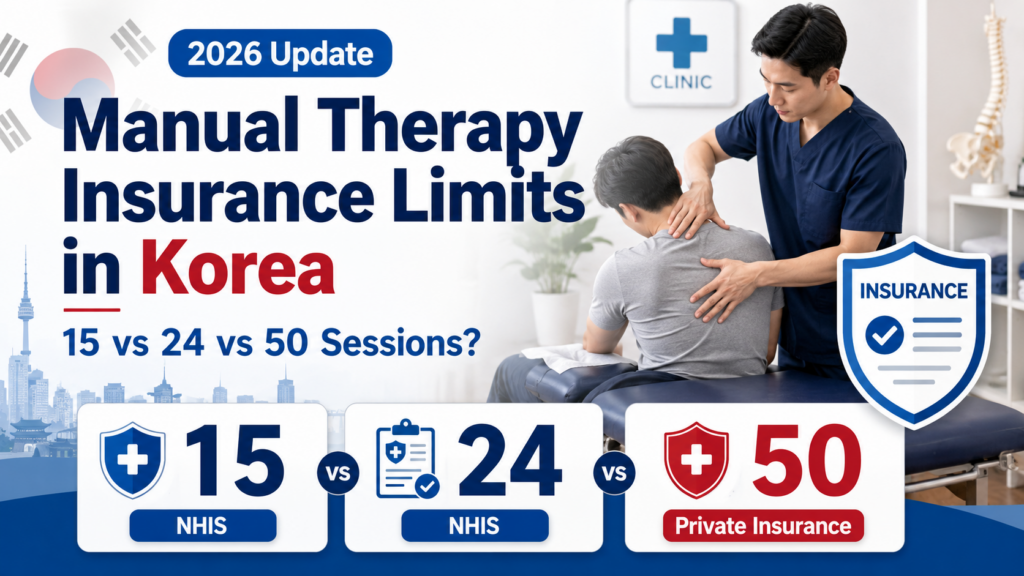
Foreign residents in Korea often receive conflicting answers about manual therapy insurance coverage.
You may hear that:
- Manual therapy is covered only 15 times.
- Some insurance policies allow up to 50 sessions.
- Patients must pay 95% of the treatment cost.
- Fifth-generation private insurance does not cover manual therapy.
- Basic physical therapy must be tried before manual therapy.
These statements are not necessarily contradictory. They refer to different parts of Korea’s healthcare and insurance system.
The most important distinction is between:
- National Health Insurance, commonly called NHIS
- Private indemnity medical insurance, called silson insurance or 실손보험 in Korean
Since July 1, 2026, qualifying manual therapy has been classified as a managed benefit under Korea’s National Health Insurance system.
The nationally controlled fee is KRW 43,850 per session, and the patient generally pays 95% of that fee. Treatment is normally limited to two sessions per week and 15 sessions per year, with a limited exception allowing up to 24 sessions for certain patients with clearly documented joint contracture or stiffness after surgery or a fracture.
Private insurance reimbursement is a separate issue. It depends on the patient’s exact insurance contract, policy generation, riders, deductibles, exclusions, and claim review.
Engineer Dad’s rule of thumb
Think of Korean medical insurance as a two-layer system.
The first layer asks, “How does NHIS classify and price this treatment?”
The second layer asks, “Will my private insurer reimburse any of the amount I paid?”
Manual Therapy Rules at a Glance
| Question | General rule from July 1, 2026 |
|---|---|
| Official Korean term | 도수치료 (dosu chiryo) |
| NHIS classification | Managed benefit, or 관리급여 |
| Official treatment fee | KRW 43,850 per session |
| Patient copayment | 95% of the manual therapy fee |
| Approximate patient payment | About KRW 41,700 for the therapy fee alone |
| Weekly limit | Up to two sessions |
| Normal annual limit | 15 sessions |
| Exceptional annual limit | Up to 24 sessions |
| Typical minimum treatment time | At least 30 minutes in principle |
| Body-part rule | The annual limit applies across all treated body parts |
| Private insurance | Depends on the individual policy |
| Fifth-generation insurance | Manual therapy is generally not reimbursed |
The consultation fee, diagnostic tests, imaging, injections, medication, and other physical therapy may be billed separately from the manual therapy fee.
What Is Manual Therapy in Korea?
Manual therapy is called 도수치료 in Korean.
It is a hands-on medical treatment used for certain musculoskeletal problems involving the muscles, joints, spine, movement, or physical function.
A treatment session may include:
- Joint mobilization
- Soft-tissue techniques
- Assisted stretching
- Movement correction
- Posture training
- Mobility exercises
- Functional rehabilitation
Manual therapy is commonly provided at:
- Orthopedic clinics
- Rehabilitation medicine clinics
- Pain medicine clinics
- Hospitals with rehabilitation departments
- Specialized musculoskeletal rehabilitation centers
A clinic in Korea is usually a smaller outpatient medical facility called a uiwon (의원). Many people visit a local orthopedic or rehabilitation clinic without first going to a large hospital.
Manual therapy is generally performed by a physical therapist or another qualified professional as part of a physician-directed treatment plan.
Manual Therapy Is Not the Same as a Massage
A relaxation massage is primarily intended for comfort or general wellness.
Manual therapy is medical treatment for a diagnosed or evaluated physical problem. It should be connected to a physician’s assessment, treatment goal, and medical record.
Some techniques may feel similar to massage, but the purpose and billing classification are different.
Under the current HIRA criteria, massage treatment included as part of manual therapy cannot be billed separately as an additional covered service.
Manual Therapy vs. Physical Therapy
The term physical therapy covers a broad range of rehabilitation treatments.
Basic physical therapy in Korea may include:
- Heat treatment
- Electrical stimulation
- Therapeutic ultrasound
- Simple exercise therapy
- Range-of-motion training
- Strength and balance exercises
These treatments are often performed with equipment or through a standardized rehabilitation program.
Manual therapy is more hands-on and usually requires direct, one-on-one treatment time.
| Basic physical therapy | Manual therapy |
|---|---|
| Often uses heat, electricity, ultrasound, or exercise equipment | Primarily uses hands-on techniques |
| Usually shorter and more standardized | Often longer and more individualized |
| Commonly used as an initial treatment | Usually considered after basic treatment is insufficient |
| May have a lower patient cost | Subject to the managed-benefit fee and 95% copayment |
| Can be provided to several patients in sequence | Usually requires individual therapist time |
NHIS and Private Insurance Are Different Systems
Many insurance misunderstandings occur because people use the word “covered” without explaining which insurance system they mean.
| National Health Insurance—NHIS | Private indemnity insurance—실손보험 |
|---|---|
| Public health insurance system | Optional private insurance contract |
| Determines official medical classification | Determines whether a patient can claim reimbursement |
| Sets the managed-benefit treatment fee | Applies policy-specific deductibles and limits |
| Sets weekly and annual treatment criteria | Reviews medical necessity and claim documents |
| Applies the 95% patient copayment | May reimburse part of the patient’s payment |
| Rules are broadly standardized nationally | Terms vary by insurer, product, and purchase date |
| The clinic submits treatment information to HIRA | The patient normally files a claim after paying |
NHIS recognition does not automatically mean that private insurance will reimburse the treatment.
At the same time, an older private policy mentioning 50 treatments does not automatically give the patient the right to receive 50 NHIS-recognized sessions.
HIRA Manual Therapy Guidelines
The Health Insurance Review & Assessment Service, commonly known as HIRA, is the Korean agency that reviews healthcare billing and applies detailed National Health Insurance standards.
The current HIRA manual therapy guidelines establish several important conditions.
Eligible Medical Conditions
Managed-benefit manual therapy is intended for musculoskeletal conditions involving continuing:
- Functional limitation
- Pain
- Restricted movement
- Joint or soft-tissue problems
The physician must determine that manual therapy is medically appropriate.
Treatment Duration
A manual therapy session should generally last at least 30 minutes.
This is a treatment standard rather than a promise that every patient will receive exactly the same techniques or schedule.
Basic Treatment Must Usually Be Tried First
For managed-benefit recognition, the patient should normally receive basic physical therapy or simple rehabilitation treatment for at least:
- Two weeks
- Four sessions
Manual therapy is recognized when the patient does not show sufficient improvement after this initial treatment period.
This rule is intended to prevent more intensive manual therapy from automatically becoming the first treatment for every minor musculoskeletal complaint.
Weekly and Annual Limits
The normal limit is:
- Up to two sessions per week
- Up to 15 sessions per calendar year
The limit applies regardless of which body part is treated.
For example, a patient cannot automatically receive:
- 15 sessions for the neck, plus
- Another 15 sessions for the lower back
The sessions are counted together under the same annual limit.
Exceptional 24-Session Limit
Up to 24 total sessions per year may be recognized when there are clear clinical findings of joint contracture or stiffness related to:
- Surgery
- A fracture
- A comparable medical condition accepted under the criteria
The 24-session maximum includes the original 15 sessions. It does not mean 15 normal sessions plus 24 additional sessions.
The exception depends on a physician’s medical judgment and documented clinical findings. Continuing pain alone does not automatically qualify a patient for 24 sessions.
HIRA Treatment Records
Medical institutions must submit relevant manual therapy information through the HIRA manual therapy management system.
The system allows clinics to:
- Check how many recognized sessions a patient has received
- Record relevant treatment information
- Submit the information required for NHIS billing
- Apply the annual limit across medical institutions
Changing clinics does not normally reset the annual session count.
What Does a 95% Copayment Mean?
A copayment is the part of a medical bill paid by the patient.
For ordinary NHIS-covered services, National Health Insurance may pay a substantial portion of the official fee.
Manual therapy is different. It is classified as a managed benefit with a 95% patient copayment.
The official manual therapy fee is KRW 43,850. The patient’s share of that therapy fee is therefore approximately KRW 41,700.
The final amount paid at the clinic may be higher because the bill can also include:
- A physician consultation
- X-rays or other imaging
- Basic physical therapy
- Injections
- Medication
- Medical documents or certificates
The 95% rule applies to the designated manual therapy fee, not necessarily to every item on the clinic bill.
Why Is It Called a Managed Benefit?
The Korean term is 관리급여, which can be translated as managed benefit.
It sits within the National Health Insurance framework but is controlled more strictly than ordinary covered treatment.
For manual therapy, the government controls:
- The official treatment fee
- The patient copayment rate
- Clinical eligibility
- Treatment duration
- Weekly frequency
- Annual frequency
- Medical documentation
- HIRA reporting
Before July 1, 2026, manual therapy was commonly provided as a non-covered service, meaning clinics could set their own prices.
The Ministry of Health and Welfare reported that the previous average price was approximately KRW 110,000 per session, with significant differences among medical institutions. The managed-benefit system introduced a nationally standardized fee of KRW 43,850.
The new system reduces price variation, but it does not make manual therapy inexpensive in the same way as an ordinary low-copayment NHIS service. Patients still pay 95% of the standardized fee.
Is the Limit 15, 24, or 50 Sessions?
The correct answer depends on which rule is being discussed.
| Number | Meaning | Main condition | Insurance system |
|---|---|---|---|
| 15 sessions | Normal annual treatment limit | Qualifying musculoskeletal condition, up to twice per week | NHIS managed benefit |
| 24 sessions | Exceptional total annual limit | Clear joint contracture or stiffness after surgery, fracture, or another qualifying condition | NHIS managed benefit |
| 50 sessions | Historical maximum in certain older private insurance contracts | Depends on policy generation, rider, medical effectiveness, and contract wording | Private indemnity insurance |
The 15-Session Limit
This is the ordinary annual maximum under the current National Health Insurance managed-benefit criteria.
It is a public insurance treatment rule.
The 24-Session Limit
This is a limited exception for qualifying patients with clear medical findings.
It is not automatically granted because the patient continues to feel pain.
The 50-Session Limit
The number 50 comes from certain older private insurance products.
It does not replace the current NHIS limit.
It also does not guarantee that a private insurer will approve 50 claims after manual therapy has been converted to a managed benefit.
How Private Indemnity Insurance Works
Private indemnity medical insurance is called:
- 실손보험
- 실손의료보험
- Silson insurance
- Private medical expense insurance
- Private indemnity insurance
The patient usually:
- Receives treatment.
- Pays the medical institution.
- Obtains a receipt and itemized statement.
- Submits a claim to the private insurer.
- Receives reimbursement if the expense is eligible.
Private insurance may apply:
- A fixed deductible
- A percentage copayment
- A per-visit deduction
- An annual payment limit
- A treatment-frequency limit
- Medical necessity requirements
- Document requirements
- Policy exclusions
The clinic does not make the final insurance decision. The insurance company does.
Manual Therapy Coverage by Insurance Generation
Korean private indemnity insurance is often divided into generations according to when the policy was issued.
The generation is useful as a starting point, but it is not enough to determine the final claim result.
First- and Second-Generation Policies
Older first- and second-generation policies can have significantly different contract terms.
Some may provide relatively broad coverage, but there is no single session limit or reimbursement percentage that safely applies to every older contract.
Coverage may depend on:
- The insurer
- The original policy wording
- Renewal or re-enrollment provisions
- Selected riders
- Exclusions
- Outpatient limits
- Per-visit deductions
Policyholders should ask the insurer specifically how managed-benefit manual therapy received after July 1, 2026 is handled.
Third-Generation Policies
Third-generation products introduced a separate special rider for:
- Manual therapy
- Extracorporeal shockwave therapy
- Prolotherapy
The official product structure provided a combined annual maximum of:
- 50 sessions
- KRW 3.5 million
The 50-session figure applied to the combined treatment category, not necessarily to 50 manual therapy sessions plus separate limits for the other treatments.
Because manual therapy is now classified as a managed benefit rather than an ordinary non-covered treatment, the actual claim process should be confirmed with the insurer under the exact contract.
Fourth-Generation Policies
Under the original fourth-generation structure, manual therapy performed for a disease or injury could be covered up to 50 times per year.
However, the policy required confirmation of symptom relief or another treatment effect after each group of 10 sessions before additional sessions could continue to qualify, up to the contractual maximum.
The 50-session figure is a private policy ceiling. It is not the same as the current NHIS treatment limit.
After the July 1, 2026 change, fourth-generation policyholders should not assume that all 50 sessions will automatically be reimbursed. The insurer must determine how the managed-benefit expense is processed under the applicable contract.
Fifth-Generation Policies
Fifth-generation private indemnity insurance was launched on May 6, 2026.
Under the standard fifth-generation structure, musculoskeletal physical therapy—including manual therapy—is generally excluded from reimbursement because of concerns about excessive or unnecessary use.
Official fifth-generation guidance states that musculoskeletal physical therapy, including manual therapy, is not covered by the private policy regardless of whether it is classified as an NHIS-covered or non-covered treatment.
Therefore, when manual therapy is processed as a managed benefit, the patient may receive the standardized NHIS price but generally cannot claim the remaining 95% patient payment from a standard fifth-generation policy.
Private Insurance Summary
| Policy generation | General manual therapy position |
|---|---|
| First generation | Contract terms vary widely; check the original policy |
| Second generation | Contract terms, deductibles, and outpatient limits vary |
| Third generation | Historically up to 50 combined sessions and KRW 3.5 million under the relevant rider |
| Fourth generation | Historically up to 50 sessions, with treatment-effect confirmation every 10 sessions |
| Fifth generation | Manual therapy is generally excluded from reimbursement |
This table is a general explanation, not a coverage guarantee.
Two people with policies from the same generation may receive different claim results because of different insurers, riders, renewal terms, and contract wording.
A 50-Session Policy Limit Is Not a Treatment Entitlement
This distinction is important.
A private insurance policy limit describes the maximum amount the insurer might reimburse when all contract conditions are satisfied.
It does not mean:
- A physician must prescribe 50 sessions.
- HIRA must recognize 50 managed-benefit sessions.
- A clinic can ignore the NHIS annual limit.
- Every session is medically necessary.
- Every claim will be approved.
- The patient will pay nothing.
The current NHIS rules and the private insurance contract must be checked separately.
Five-Step Manual Therapy and Insurance Process
Step 1: Receive Basic Physical Therapy
In ordinary managed-benefit cases, the patient first receives basic physical therapy or simple rehabilitation treatment for at least two weeks and four sessions.
Step 2: Receive a Physician’s Assessment
A physician evaluates whether the patient has continuing pain, functional impairment, or another qualifying musculoskeletal problem.
The physician then determines whether manual therapy is medically appropriate.
Step 3: Check the HIRA Session Count
The clinic checks the manual therapy management system to confirm:
- Previous sessions received during the year
- Remaining recognized sessions
- Whether the weekly limit has been reached
- Whether the ordinary or exceptional criteria apply
Step 4: Receive Treatment and Medical Documents
The patient receives treatment within the recognized limits and requests:
- Medical receipt
- Itemized medical expense statement
- Diagnosis or diagnosis code, when required
- Treatment record
- Medical certificate or physician’s note, when requested by the insurer
Step 5: Submit a Private Insurance Claim
Patients with eligible older private insurance submit the documents through the insurer’s:
- Mobile app
- Website
- Customer service center
- Insurance agent
- Branch office
The insurer then reviews the claim under the exact policy terms.
What Foreigners Should Ask the Clinic
Is This Being Processed as a Managed Benefit?
도수치료가 관리급여로 처리되나요?
Is this manual therapy being processed as a managed benefit?
Do I Meet the Managed-Benefit Criteria?
도수치료 관리급여 인정 기준에 해당하나요?
Do I meet the eligibility criteria for managed-benefit manual therapy?
How Many Sessions Do I Have Left?
올해 도수치료 인정 횟수가 몇 회 남았나요?
How many recognized manual therapy sessions do I have left this year?
What Will the Total Visit Cost Be?
도수치료 외에 진찰료나 다른 비용이 추가되나요?
Are there consultation fees or other charges in addition to manual therapy?
Can I Receive a Receipt and Itemized Statement?
진료비 영수증과 진료비 세부내역서를 받을 수 있나요?
Can I receive a medical receipt and an itemized medical expense statement?
Can You Provide Documents for My Insurance Claim?
실손보험 청구에 필요한 서류를 발급해 주세요.
Please issue the documents required for my private insurance claim.
What to Ask Your Private Insurer
Contact the insurer before beginning a long treatment plan.
Provide:
- Your policy number
- The policy purchase date
- The name “manual therapy” or 도수치료
- The expected treatment classification
- The diagnosis, when available
- The expected price
- The planned number of sessions
Ask the insurer:
“Is manual therapy billed as an NHIS managed benefit after July 1, 2026 reimbursable under my exact policy?”
Korean phrase:
2026년 7월 1일 이후 관리급여로 시행한 도수치료의 본인부담금이 제 실손보험에서 보상되나요?
Whenever possible, obtain the answer through:
- The insurer’s app
- Online customer service
- A recorded customer service inquiry
A written or traceable response is safer than relying only on a verbal explanation from a clinic employee.
Can the Clinic Guarantee Insurance Reimbursement?
No.
The clinic can:
- Diagnose the patient
- Recommend treatment
- Check the HIRA session count
- Provide medical records
- Issue receipts and itemized statements
- Explain its billing classification
The clinic cannot make the final decision for a private insurer.
Be cautious when a medical institution says:
- “Insurance will cover everything.”
- “You can receive all 50 sessions.”
- “There will be no real out-of-pocket cost.”
- “Everyone with silson insurance is reimbursed.”
Those statements may not apply to your policy.
Example Scenario
Suppose a foreign resident visits an orthopedic clinic because of persistent lower-back pain.
The physician initially recommends basic physical therapy.
The patient receives four sessions over two weeks but continues to experience pain and limited movement.
The physician then decides that manual therapy meets the clinical criteria.
The clinic checks the HIRA management system and confirms that the patient has not received manual therapy elsewhere during the year.
The patient may generally receive:
- Up to two sessions per week
- Up to 15 sessions during the year
- Treatment lasting at least 30 minutes in principle
- A standardized manual therapy fee of KRW 43,850
- A patient payment of approximately KRW 41,700 for the therapy fee
Now consider two patients receiving the same treatment at the same clinic.
Patient A: Fourth-Generation Policy
Patient A may be able to submit a claim, depending on the exact contract and how the insurer processes managed-benefit manual therapy.
Patient B: Fifth-Generation Policy
Patient B generally cannot receive private reimbursement for manual therapy under the standard fifth-generation structure.
The medical treatment is the same, but the private insurance outcome is different.
What Happens After 15 or 24 Sessions?
Once the applicable annual limit has been reached, additional manual therapy may no longer qualify under the NHIS managed-benefit criteria.
This does not necessarily mean that all rehabilitation must stop.
The physician may consider:
- Basic physical therapy
- Therapeutic exercise
- Home exercise education
- Medication
- Injection treatment
- Further diagnostic testing
- Reassessment of the diagnosis
- Referral to a rehabilitation specialist
- A different treatment approach
Before receiving additional manual therapy, ask the clinic:
- How will the service be classified?
- What is the legal billing basis?
- What will the patient pay?
- Will HIRA recognize the session?
- Has the private insurer confirmed reimbursement?
Do not assume that private insurance can override the NHIS frequency criteria.
Practical Checklist
Before beginning manual therapy in Korea:
- Confirm that a physician has evaluated your condition.
- Ask whether the treatment is being processed as a managed benefit.
- Confirm whether the basic-treatment requirement has been satisfied.
- Ask the clinic to check your annual HIRA session count.
- Confirm whether you qualify for the 15- or 24-session limit.
- Request a full estimate that includes consultation and other treatments.
- Find your private insurance generation.
- Read the relevant rider and exclusions.
- Contact the insurer directly.
- Keep all receipts and itemized statements.
- Ask how treatment effectiveness will be measured.
- Reassess the treatment plan if symptoms are not improving.
Frequently Asked Questions
Is manual therapy covered by Korean National Health Insurance?
Qualifying manual therapy is included in the NHIS framework as a managed benefit.
However, the patient pays 95% of the nationally controlled manual therapy fee. It should not be understood as ordinary low-copayment NHIS treatment.
How many manual therapy sessions are allowed?
The ordinary limit is up to two sessions per week and 15 sessions per year.
Up to 24 total annual sessions may be recognized for certain patients with clear joint contracture or stiffness after surgery, a fracture, or another qualifying condition.
Can I receive 15 sessions for my neck and another 15 for my back?
No.
The annual limit applies regardless of the treated body part. Neck, shoulder, back, hip, and other manual therapy sessions are counted together.
Does changing clinics reset the session count?
No.
Clinics use the HIRA manual therapy management system to check and submit treatment information. Receiving treatment at another clinic does not normally create a new annual allowance.
Must I receive basic physical therapy first?
Under the managed-benefit criteria, basic physical therapy or simple rehabilitation treatment should normally be provided for at least two weeks and four sessions without sufficient improvement before manual therapy is recognized.
Why do some insurance policies mention 50 sessions?
Certain third- and fourth-generation private insurance products historically provided a maximum of up to 50 sessions under their contract terms.
That private insurance ceiling is different from the current NHIS limit of 15 or 24 sessions.
Does a fourth-generation policy guarantee 50 sessions?
No.
The original fourth-generation terms required evidence of symptom relief or another treatment effect after every 10 sessions, and all other contract conditions still applied.
The 2026 change in the public insurance classification also means policyholders should confirm current claim processing directly with their insurer.
Does fifth-generation private insurance cover manual therapy?
Generally, no.
Official fifth-generation guidance excludes musculoskeletal physical therapy, including manual therapy, regardless of whether the treatment is classified as covered or non-covered under NHIS.
Will an older private policy reimburse the 95% patient payment?
It may, but there is no universal answer.
Reimbursement depends on the exact contract, riders, policy generation, deductible, exclusions, medical documentation, and insurer review.
Ask specifically about managed-benefit manual therapy performed after July 1, 2026.
Is manual therapy the same as physical therapy?
Manual therapy is one form of physical or rehabilitation treatment, but it is more hands-on and individualized than basic heat, electrical, or equipment-based physical therapy.
Is manual therapy the same as a massage?
No.
Manual therapy is medical treatment linked to a diagnosis and rehabilitation plan. A general wellness or relaxation massage is not normally treated as insured medical care.
Can foreigners use the same managed-benefit rules?
The clinical and frequency rules generally depend on the treatment and the patient’s medical condition, not nationality.
Foreign residents must be properly enrolled in NHIS to receive treatment under the ordinary National Health Insurance process.
Do I need private insurance to receive manual therapy?
No.
Private insurance is not required to receive treatment. However, without eligible private insurance reimbursement, the patient must personally pay the applicable clinic bill.
Key Takeaway
Remember these three numbers:
- Two sessions per week
- 15 sessions per year in ordinary cases
- Up to 24 total sessions in limited qualifying cases
Also remember that 50 sessions refers to historical limits in certain private insurance contracts, not the current NHIS treatment allowance.
The safest process is:
- Confirm the diagnosis and treatment criteria with the physician.
- Ask the clinic how the treatment will be classified.
- Check the remaining HIRA session count.
- Request a complete cost estimate.
- Contact the private insurer using your exact policy number.
- Keep every receipt and medical expense statement.
Official Sources
- Ministry of Health and Welfare announcement on the July 1, 2026 introduction of managed-benefit manual therapy, the KRW 43,850 fee, 95% copayment, and treatment limits.
- Ministry of Health and Welfare guidance on treatment duration, annual frequency, and the requirement to try basic physical therapy first.
- Health Insurance Review & Assessment Service detailed manual therapy eligibility and frequency criteria.
- Financial Services Commission materials on third- and fourth-generation private insurance coverage structures.
- Financial Services Commission guidance on fifth-generation private indemnity insurance and the exclusion of musculoskeletal physical therapy.
Disclaimer
This article provides general information about healthcare and insurance in South Korea as of July 25, 2026. It is not medical, legal, or insurance advice.
Medical eligibility depends on the patient’s condition, clinical findings, and the physician’s judgment.
Private insurance reimbursement depends on the exact policy, purchase date, riders, deductibles, exclusions, renewal terms, supporting documents, and insurer review. Insurance products and government rules may change.
Before receiving treatment, confirm the current billing classification and expected cost with the medical institution. Confirm private insurance reimbursement directly with your insurer using your exact policy information.