
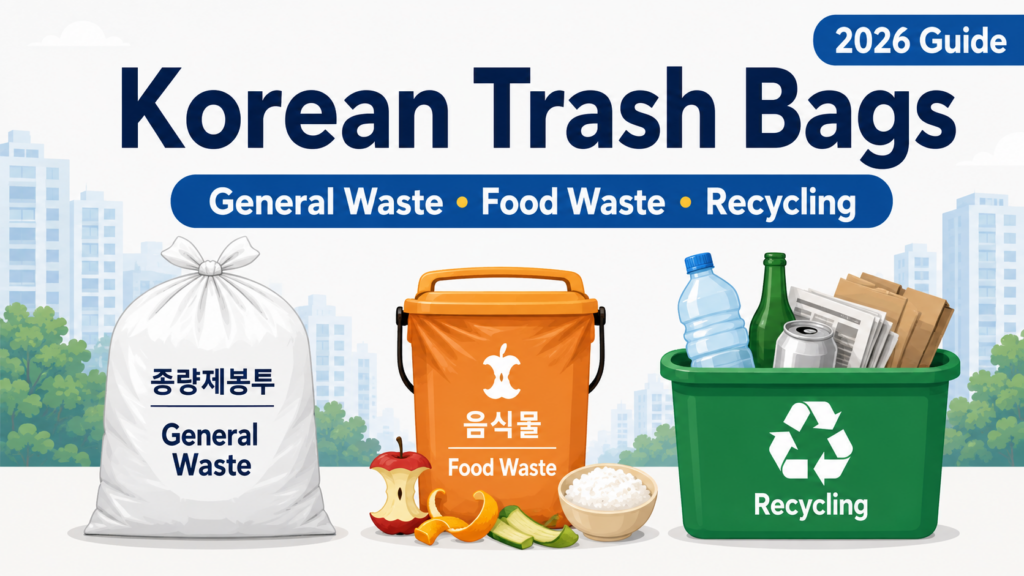
Throwing away household waste in Korea can be confusing when you first arrive.
You usually cannot put everything into an ordinary plastic bag and leave it outside. Korea uses a pay-as-you-throw system based on official garbage bags, separate food waste collection, and material-based recycling.
The national principles are broadly consistent, but the practical rules are local. Your bag design, food waste system, collection schedule, and recycling location may depend on your city, district, neighborhood, and building.
The 30-Second Answer
- General waste: Use an official local standard garbage bag called a jongnyangje bongtu.
- Food waste: Use the designated food waste bag, container, payment chip, or RFID machine assigned to your address.
- Recyclables: Separate clean materials and place them in your building’s bins or follow your district’s collection schedule.
- Bulky or hazardous waste: Use a separate reporting or collection system.
Never identify a Korean garbage bag by color alone. Read the printed waste type and municipality name.
Separate collection of recyclables and volume-based fees for general and food waste are central features of Korea’s waste-management system.
Korean Waste & Recycling Assistant
Food Waste (음식물) vs. General Waste (일반)
A rough shortcut—not an official rule—is that hard shells, bones, pits, and non-food objects usually belong in General Waste. Local municipal rules always take priority. Search or select an item below for common guidance.
This tool provides general guidance only. Bag designs, accepted items, payment methods, and collection schedules can differ by gu, si, and building. Always verify the printed bag label and local instructions.
Essential Korean Waste Terms
| Korean term | Romanization | Meaning in daily life |
|---|---|---|
| 종량제봉투 | jongnyangje bongtu | Official pay-as-you-throw garbage bag |
| 일반쓰레기 | ilban sseuregi | General, non-recyclable household waste |
| 음식물쓰레기 | eumsikmul sseuregi | Food waste accepted by the local treatment system |
| 음식물쓰레기봉투 | eumsikmul sseuregi bongtu | Designated food waste bag |
| 재활용품 | jaehwaryongpum | Recyclable materials |
| 분리배출 | bulli baechul | Separating waste before disposal |
| 배출요일 | baechul yoil | Designated disposal day |
| 배출시간 | baechul sigan | Designated disposal time |
| 납부칩 | napbu chip | Prepaid chip used with a food waste container |
| RFID 종량기 | RFID jongnyanggi | Machine that identifies and weighs food waste |
| 대형폐기물 | daehyeong pyegimul | Bulky waste such as furniture |
| 관리사무소 | gwanri samuso | Apartment or building management office |
The word jongnyangje means that the disposal fee is linked to the amount of waste produced. Part of the collection and treatment cost is included in the price of the official bag or food waste payment system.
1. Korea’s Three Main Household Waste Categories
Most household waste should first be divided into three groups.
General waste
General waste is household waste that cannot be recycled and is not accepted as food waste.
It normally goes into an official local standard garbage bag.
Food waste
Food waste is collected separately because it may be processed into resources such as animal feed, compost, or biogas.
Depending on your address, you may use:
- a designated food waste bag;
- a small container with a prepaid chip;
- a shared collection container;
- an RFID weighing machine; or
- another system selected by the municipality.
Official local guidance recognizes designated bags, payment-chip systems, and RFID systems as different ways of charging residents according to how much food waste they discard.
Recyclables
Recyclable materials are separated from both general waste and food waste.
Common categories include:
- paper and cardboard;
- plastic containers;
- transparent PET bottles;
- glass bottles;
- metal cans;
- vinyl packaging;
- Styrofoam; and
- beverage cartons.
The exact categories and collection methods can differ by building and municipality.
2. What Is a Korean Standard Garbage Bag?
A Korean standard garbage bag is an officially approved bag used for general household waste.
You may see it described in English as:
- a standard garbage bag;
- a volume-based waste bag;
- a pay-as-you-throw bag; or
- a jongnyangje bag.
An ordinary shopping bag, delivery bag, or black plastic bag does not normally replace an official general waste bag.
Where can you buy Korean garbage bags?
Authorized bags are commonly sold at:
- convenience stores;
- supermarkets;
- neighborhood grocery stores; and
- other designated vendors.
Seoul’s 2026 foreign-resident guide states that standard garbage bags can be purchased at supermarkets and convenience stores and that their prices vary by district.
At a store, you can say:
종량제봉투 주세요.
Jongnyangje bongtu juseyo.
“Please give me standard garbage bags.”
To request a size:
종량제봉투 10리터 주세요.
Jongnyangje bongtu sip riteo juseyo.
“Please give me 10-liter standard garbage bags.”
Available sizes vary locally. Some municipalities sell 5-, 10-, 20-, 30-, 50-, or larger bags, but you should not assume that every size is available everywhere.
Check the label before paying
Confirm these details:
- Municipality name: Look for the correct city, county, or district.
- Waste type: General waste and food waste bags are different.
- Purpose: Household, business, reusable shopping, and special sacks may be separate products.
- Capacity: Check the number of liters.
- Special instructions: Some bags are for incinerable or non-incinerable waste.
Critical Warning: Do Not Choose a Bag by Color
Food waste bags are not always yellow, and general waste bags do not have one nationwide color.
Bag colors, sizes, designs, and printed information vary by municipality. A bag that is valid in one city or district may not automatically be accepted in another.
3. What Goes into General Waste?
General waste usually includes small household items that are neither recyclable nor accepted by the local food waste system.
Common examples include:
- used tissues;
- wet wipes;
- disposable diapers;
- heavily contaminated paper;
- receipts and coated paper that are not locally recyclable;
- chewing gum;
- rubber gloves;
- non-recyclable household packaging;
- animal bones;
- fish bones;
- eggshells;
- shellfish shells;
- hard nut shells;
- large fruit stones;
- onion and garlic skins;
- tea bags and tea grounds; and
- other small non-food objects.
Seoul’s food waste standard excludes hard shells, large fruit stones, animal bones, fish bones, eggshells, tea grounds, fibrous vegetable skins, plastic, foil, toothpicks, glass, metal, and other foreign objects from food waste collection.
How to dispose of general waste
- Remove accepted recyclables.
- Remove food waste.
- Place the remaining waste in the correct local bag.
- Tie or close the bag securely.
- Put it in the designated collection area.
- Follow the local day and time.
Apartment residents usually use a collection area inside the complex. Residents of villas, studios, multi-family buildings, and detached houses may need to place bags in front of the property or at a designated neighborhood point.
Items that may need a special sack
Do not assume that all small household waste belongs in an ordinary general waste bag.
Items such as the following may require a special non-incinerable sack or separate instructions:
- broken glass;
- ceramics and dishes;
- tiles;
- bricks;
- soil;
- plant pots; and
- small construction debris.
For example, Gangdong-gu distinguishes ordinary combustible waste from ceramics, broken glass, bricks, and soil, which must be placed in a special municipal sack.
Check your district’s rules before handling sharp or heavy materials.
4. How Food Waste Disposal Works
A common misunderstanding is that every Korean household buys the same food waste bag.
In reality, Korea uses several different collection methods.
Method A: Designated food waste bags
Some districts require residents to buy small official food waste bags.
Typical steps are:
- Drain liquid from the food.
- Remove bones, shells, plastic, foil, and other excluded items.
- Place accepted scraps in the designated bag.
- Tie the bag securely.
- Put it in the assigned food waste container or collection point.
At a store, ask:
음식물쓰레기봉투 주세요.
Eumsikmul sseuregi bongtu juseyo.
“Please give me food waste bags.”
Confirm the municipality and bag type before purchasing.
Method B: Container with a prepaid chip or tag
Some municipalities provide a small food waste container.
You may need to purchase a napbu chip, sticker, or tag and attach it to the container before collection. The chip functions as proof that the disposal fee has been paid.
Method C: RFID food waste machine
Many apartment complexes and some residential areas use RFID machines.
RFID stands for radio-frequency identification. In practical terms, the system may work like this:
- Tap an approved card or household key.
- Wait for the lid to open.
- Empty the food waste into the machine.
- Close the lid.
- Check the recorded weight or fee.
RFID systems can identify the household, measure the discarded weight, and calculate a charge based on the amount disposed.
Payment may be handled through:
- the apartment management bill;
- a transportation card;
- a building-issued card;
- a compatible payment card; or
- another system selected locally.
Method D: Shared apartment container
Some apartment complexes use large shared containers instead of individual bags or household RFID billing.
The fee may be divided among residents or included in the monthly apartment maintenance charge, known as gwanlibi.
Food Waste Check Before You Throw It Away
Before using a food waste bag or machine:
- remove all plastic, foil, toothpicks, and packaging;
- remove bones, hard shells, eggshells, and large pits;
- drain soup, sauce, and excess water;
- check whether your building requires a card, chip, bag, or container;
- do not place the carrying plastic bag inside an RFID machine unless the posted instructions specifically allow it.
5. What Counts as Food Waste?
The most important principle is not simply whether an item came from a kitchen.
Food waste generally means organic material that the local treatment system can safely process. Hard, sharp, highly fibrous, poisonous, or non-food materials are often excluded.
Commonly accepted as food waste
Subject to local rules, these items are commonly accepted:
| Item | Typical classification | Preparation |
|---|---|---|
| Cooked rice | Food waste | Drain excess liquid |
| Noodles and bread | Food waste | Remove packaging |
| Leftover vegetables | Food waste | Remove hard roots or stalks |
| Fruit flesh | Food waste | Remove large hard stones |
| Banana peels | Food waste | Drain moisture |
| Watermelon rind | Food waste | Cut large pieces if required |
| Meat scraps without bones | Food waste | Remove bones and packaging |
| Fish flesh | Food waste | Remove bones |
| Leftover side dishes | Food waste | Remove foreign objects |
| Kimchi | Food waste | Seoul recommends reducing excess salt and seasoning |
Commonly treated as general waste
| Item | Why it is usually excluded |
|---|---|
| Chicken, pork, and beef bones | Hard and difficult to process |
| Fish bones | Sharp and unsuitable for standard processing |
| Clam and oyster shells | Hard mineral shells |
| Crab and lobster shells | Hard crustacean shells |
| Eggshells | Hard shells unsuitable for food waste processing |
| Walnut and chestnut shells | Very hard shells |
| Peach and persimmon stones | Large, hard fruit stones |
| Onion and garlic skins | Dry and highly fibrous |
| Corn husks and stalks | Long and fibrous |
| Tea bags and tea grounds | Fibrous material and possible foreign objects |
| Toothpicks and wooden skewers | Non-food objects |
| Plastic, foil, rubber, or glass | Foreign material that can damage equipment |
These classifications reflect Seoul’s standardized recommendation, but another municipality may provide slightly different instructions.
The “Can an Animal Eat It?” Rule Is Only a Rough Shortcut
You may hear people say:
“If an animal cannot eat it, it is general waste.”
This can help you remember that bones and hard shells are often excluded, but it is not an official legal test.
Food waste may be processed into compost or biogas rather than animal feed, and local treatment standards still decide the correct category. When uncertain, follow your municipality’s published list.
Korean Waste & Recycling Assistant
Use the tool below to search common food items, compare practical bag sizes, and review typical rules by housing type.
The results are general guidance. Your municipal and building instructions always take priority.
The companion assistant was reviewed to remove nationwide claims based only on one district’s bag color, collection time, or housing practice.
6. How to Prepare Food Waste Correctly
Follow this routine before disposal.
Remove foreign objects
Take out:
- plastic wrap;
- foil;
- bottle caps;
- disposable cutlery;
- toothpicks;
- rubber bands;
- stickers;
- paper;
- glass; and
- metal.
Drain excess liquid
Do not pour an entire bowl of soup or stew into a food waste bag or RFID machine.
Separate the solid ingredients and drain as much liquid as reasonably possible. This reduces leakage, odor, unnecessary weight, and contamination.
Reduce excess salt when instructed
Seoul’s food waste standard recommends rinsing highly salty foods such as kimchi, soybean paste, and gochujang before disposal. It also recommends cutting very large vegetables into smaller pieces when they could interfere with equipment.
Do not flush solid food waste
Do not use a toilet or sink as an alternative waste-disposal system. Remove solids and follow your building’s designated method.
7. How Recycling Works in Korea
Recyclables normally belong in neither the general waste bag nor the food waste system.
Basic recycling process
- Empty the container.
- Remove food and liquid.
- Rinse it when reasonably possible.
- Allow it to drain.
- Separate detachable parts when instructed.
- Place it in the correct bin, transparent bag, or tied bundle.
- Follow the building or district collection schedule.
A Recyclable Material Is Not Always a Recyclable Item
A plastic or paper item may need to go into general waste when it is:
- heavily contaminated;
- covered in food or oil that cannot be removed;
- made from several inseparable materials;
- too small for the local sorting process; or
- specifically excluded by local guidance.
Clean and separate first. When cleaning is impractical, check the local rule.
Delivery food containers
For a typical delivery meal:
- Move accepted leftovers to the food waste system.
- Put bones and shells in general waste.
- Drain sauces and liquids.
- Rinse the container.
- Separate film, lids, and detachable parts where required.
- Recycle only clean, locally accepted materials.
A badly contaminated container may need to go into general waste even when it has a recycling symbol.
8. Why District Rules Matter
Waste collection is managed locally.
You may encounter these administrative terms:
- Si: City
- Gu: District
- Gun: County
- Dong: Neighborhood-level administrative area
- Community service center: Local administrative office that can explain municipal services
Local authorities and building managers may determine:
- bag designs;
- bag prices;
- available sizes;
- food waste collection methods;
- recycling categories;
- disposal days;
- disposal hours;
- collection locations; and
- enforcement procedures.
The difference can be substantial even within the same city. Seoul’s 2026 guide notes that its 25 districts have separate collection schedules and that detailed regulations may vary by district.
For example, Gangdong-gu currently instructs residents to dispose of ordinary waste during a specific overnight window and separately designates a day for waste vinyl and transparent PET bottles. That schedule should not be treated as a nationwide rule.
9. Apartment, Villa, Officetel, and Detached House Differences
Apartment complex
An apartment complex often has a central waste and recycling area.
You may find:
- general waste containers;
- recycling stations;
- RFID food waste machines;
- shared food waste containers;
- transparent PET bottle bins;
- battery collection boxes; and
- fluorescent lamp collection points.
Food waste charges may be included in gwanlibi, charged by weight, or handled using a card.
Ask the management office before buying food waste bags. Your complex may not use them.
Villa or small multi-family building
A Korean villa usually means a low-rise multi-family residential building, not a luxury detached home.
Residents may need to:
- place standard garbage bags outside on designated days;
- use a neighborhood food waste container;
- buy designated food waste bags;
- use a prepaid chip;
- separate recyclables in transparent bags; or
- leave tied cardboard at a designated point.
The landlord’s explanation is helpful, but posted municipal instructions should take priority.
Officetel
An officetel is a building that may contain small residences, offices, or both.
Some officetels operate like apartment complexes with managed waste rooms. Others require residents to follow street-level district collection rules.
Ask the management office:
쓰레기 버리는 곳이 어디예요?
Sseuregi beorineun gosi eodiyeyo?
“Where is the waste disposal area?”
Detached house
Residents of detached houses usually follow a municipal street-collection schedule.
The collection point may be:
- in front of the property;
- beside a designated utility pole;
- at a neighborhood collection area; or
- at another location assigned by the district.
Do not assume that every district uses the same evening hours.
10. Can You Use Bags from Another District?
As a general rule, buy the bag approved for the area where the waste will be collected.
Rules for unused bags after moving are not uniform. Depending on the municipality, you may be able to:
- use a limited number of old bags;
- receive certification stickers;
- exchange the bags;
- request a refund; or
- use only newly issued local bags.
For example, Gwangju City in Gyeonggi Province allows incoming residents to receive certification stickers for up to 20 bags purchased in their previous municipality. This is a local policy, not a nationwide guarantee.
Before discarding unused bags, contact your new community service center.
Useful question:
이사 전에 산 종량제봉투를 사용할 수 있어요?
Isa jeone san jongnyangje bongtureul sayonghal su isseoyo?
“Can I use standard garbage bags that I bought before moving?”
11. Fines and Enforcement
Improper disposal can lead to:
- refused collection;
- warning stickers;
- complaints from neighbors or building management;
- investigation of illegal dumping; or
- an administrative fine.
Seoul Fine Warning
Seoul’s 2026 foreign-resident guide states that violating waste regulations or illegally disposing of waste may result in a fine of up to KRW 1 million. Mixing general waste and food waste can also result in fines, with details varying by district.
This amount should not be treated as the automatic fine for every mistake or as a nationwide fixed penalty. The applicable rule depends on the location and violation.
Correct disposal is not only about sorting the contents. Using the wrong bag, location, day, or time may also violate a local rule.
12. Common Mistakes Foreign Residents Make
Using an ordinary black bag
General household waste normally requires the official local bag.
Buying a bag based on color
Colors vary. Read the municipality and waste type printed on the bag.
Putting all kitchen scraps into food waste
Bones, eggshells, shellfish shells, onion skins, large pits, and tea grounds are commonly excluded.
Throwing the plastic carrier bag into an RFID machine
Many machines accept only the food waste. Empty the contents and dispose of the carrier bag separately unless the machine says otherwise.
Leaving soup inside the food waste
Drain liquid before disposal.
Recycling dirty delivery containers
Remove food and sauce first. If the container cannot be cleaned sufficiently, it may be general waste.
Following a friend’s district schedule
A rule from another neighborhood may not apply to your home.
Buying food waste bags before checking the building system
An apartment with RFID machines or shared containers may not require individual food waste bags.
Throwing away furniture with ordinary trash
Furniture normally requires a bulky-waste report and payment confirmation.
Putting ceramics or large broken glass into the normal bag
Some districts require a special municipal sack.
13. A Simple Waste Decision Tree
Use these questions in order.
Step 1: Is it a locally accepted recyclable?
If it is clean and accepted, separate it for recycling.
Step 2: Is it accepted food waste?
If yes, use your designated food waste bag, container, chip, or RFID machine.
Step 3: Is it small general household waste?
Use the correct local standard garbage bag.
Step 4: Is it sharp, heavy, ceramic, glass, or construction-related?
Check whether your district requires a special sack.
Step 5: Is it furniture or another large item?
Report it as bulky waste.
Step 6: Is it a battery, fluorescent lamp, medicine, or electronic device?
Use a dedicated collection point or service.
14. Real-World Example: Korean Fried Chicken Delivery
Imagine that you have finished a fried chicken delivery meal.
Here is how the waste may be separated:
| Item | Likely category |
|---|---|
| Remaining chicken meat | Food waste |
| Chicken bones | General waste |
| Pickled radish pieces | Food waste |
| Pickled radish liquid | Drain separately |
| Clean plastic radish container | Plastic recycling |
| Clean chicken container | Recycling if locally accepted |
| Greasy paper liner | General waste |
| Clean cardboard box | Paper recycling |
| Empty, clean sauce film | Vinyl recycling where accepted |
| Sauce packet with residue | General waste if it cannot be cleaned |
| Wooden toothpick | General waste |
This example demonstrates why one delivery order can produce food waste, general waste, and several types of recycling.
15. How to Find the Exact Rules for Your Address
Search your municipality name together with one of these Korean phrases:
- 생활쓰레기 배출방법 — household waste disposal method
- 종량제봉투 판매소 — standard garbage bag seller
- 종량제봉투 가격 — standard bag price
- 음식물쓰레기 배출방법 — food waste disposal method
- 재활용품 배출요일 — recycling collection day
- 대형폐기물 신고 — bulky waste report
- 불연성 폐기물 마대 — special sack for non-incinerable waste
Example:
하남시 음식물쓰레기 배출방법
“Hanam City food waste disposal method”
For apartment residents, also check:
- the management office;
- the collection-area signs;
- the resident application;
- the building notice board; and
- move-in instructions.
Useful Korean sentence:
쓰레기는 언제 어디에 버리면 돼요?
Sseuregineun eonje eodie beorimyeon dwaeyo?
“When and where should I take out the trash?”
Final Checklist
Before taking out your waste, confirm:
- Is this general waste, food waste, recycling, or a special item?
- Am I using the correct bag for my current municipality?
- Does my building use bags, chips, shared containers, or RFID?
- Have I removed liquid and foreign objects from food waste?
- Are the recyclables sufficiently empty and clean?
- Is this the correct collection point?
- Is this the correct day and time?
- Does this item require a bulky-waste report or special sack?
Once you learn the rules for your address, Korea’s waste system becomes much easier to manage.
Frequently Asked Questions
Can I use a normal shopping bag for general waste?
Generally, no. Ordinary shopping and delivery bags do not replace an official standard garbage bag. Buy a jongnyangje bongtu approved for your municipality.
Can I buy Korean garbage bags at any convenience store?
Many convenience stores and supermarkets sell them, but individual stores may not carry every type or size. Stores close to your home are more likely to stock bags for the correct municipality.
Are food waste bags and general waste bags the same?
No. They are separate products. In addition, some buildings do not use food waste bags because they operate RFID machines, shared containers, or prepaid-chip systems.
Are Korean garbage bags the same color nationwide?
No. Colors and designs vary. Always read the printed label.
Are eggshells food waste in Korea?
Eggshells are commonly classified as general waste. Seoul’s standardized recommendation specifically excludes egg, duck, quail, and ostrich eggshells from food waste.
Are chicken bones food waste?
No in most local guidance. Animal bones are commonly treated as general waste.
Are fish bones food waste?
Fish bones are commonly excluded from food waste because they are hard and sharp.
Are onion and garlic skins food waste?
Their dry outer skins are commonly treated as general waste. Softer edible vegetable pieces may be food waste.
Are banana peels food waste?
Soft banana peels are commonly accepted as food waste, but local guidance should still be checked.
Is coffee waste food waste?
Household coffee grounds are often treated as general waste, although some municipalities or businesses operate separate coffee-ground recycling programs. Check the instructions for your address.
Should I rinse kimchi before disposal?
Seoul recommends washing excess salt and seasoning from salty foods such as kimchi before food waste disposal. Other municipalities may phrase their guidance differently.
Can I put a plastic bag into an RFID food waste machine?
Usually, only the food waste should enter the machine. Empty the contents and remove the plastic carrier unless the posted instructions specifically allow it.
Do all apartments use RFID machines?
No. Apartments may use RFID machines, shared containers, designated bags, prepaid chips, or another system.
Can I throw away waste at any time?
Not necessarily. Street-level collection often has designated days and hours. Apartment collection areas may offer broader access, but building rules still apply.
Can I use old garbage bags after moving?
Possibly. Some municipalities provide exchange, refund, or certification-sticker systems. Contact the new community service center before using the old bags.
Where do I throw away furniture?
Furniture is normally bulky waste. Report it through the local government or approved application, pay the required fee, and follow the assigned collection instructions.
Where do batteries and fluorescent lamps go?
Use dedicated collection boxes provided by apartment complexes, community service centers, or other designated facilities. Do not mix them with ordinary household waste.
Disclaimer
This article provides general information about household waste disposal in Korea.
Bag types, colors, prices, available sizes, accepted food waste items, recycling categories, collection schedules, payment methods, penalties, and bulky-waste procedures can differ by municipality, district, neighborhood, building, and property type.
Always confirm the current instructions with:
- your municipal or district government;
- your community service center;
- your apartment or building management office;
- your landlord; or
- the signs posted at the actual collection area.
Local official instructions take priority over this general guide and the interactive assistant.
Last updated: July, 2026
Official Sources Consulted
- Korea’s national environmental ministry — Land and waste-management overview.
- Seoul Metropolitan Government — 2026 Guidebook for Living in Seoul.
- Seoul Metropolitan Government — Food Waste Separation and Disposal Standard Recommendation.
- Guri City — Food waste bag, prepaid-chip, and RFID systems.
- Gangdong-gu — Current district-level waste and recycling instructions.
- Gwangju City, Gyeonggi Province — Limited use of garbage bags purchased before moving.