
If you live in Korea long enough, someone will eventually tell you:
“Go to the 주민센터.”
For a foreign resident, that can be confusing.
Is it an immigration office? A city hall? A welfare office? A place to get certificates?
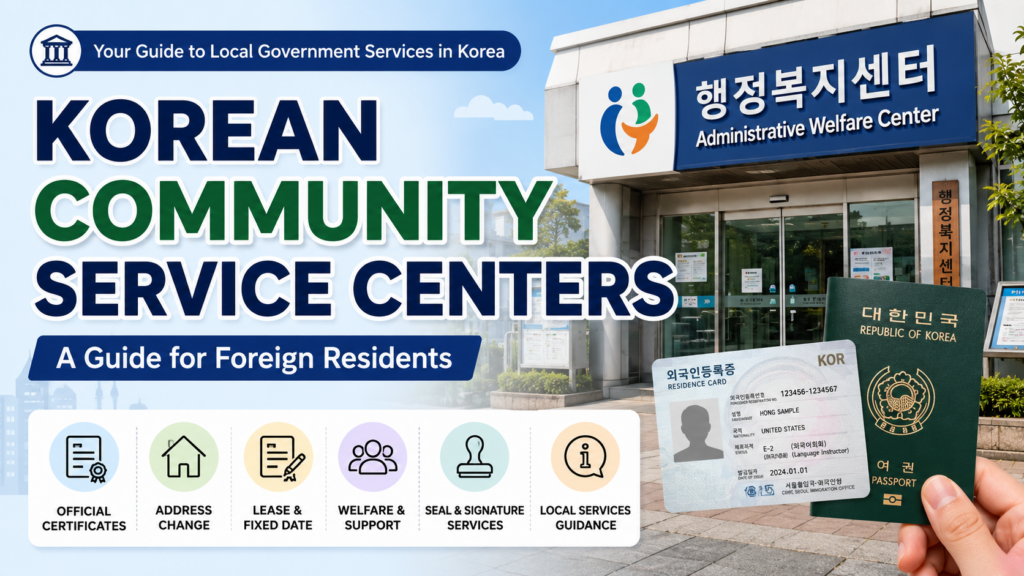
A Korean community service center is the neighborhood government office that handles many everyday administrative tasks.
You may see several Korean names for it:
| Korean | Meaning |
|---|---|
| 행정복지센터 | Administrative welfare center; a common current official name |
| 주민센터 | Resident/community service center; commonly used in everyday speech |
| 동사무소 | Older name that many Koreans still use |
In urban areas, the office usually serves a dong (동) neighborhood. In smaller towns or rural areas, the equivalent local office may be an eup (읍) or myeon (면) office.
For a foreign resident, the easiest way to understand the system is:
Use the community service center for everyday local administration.
Use immigration or HiKorea when you need to manage your immigration status.
Use Government24 when the same certificate or service is available online.
What Can Foreign Residents Do at a Community Service Center?
The exact services can vary by municipality and by the applicant’s legal status, but these are some of the most useful functions for foreign residents.
| Task | Community Service Center? |
|---|---|
| Certificate of Foreign Resident Registration | Usually yes |
| Certificate of Entry and Exit | Usually yes |
| Report a new place of stay | Yes |
| Ask about housing lease reporting or fixed-date procedures | Often yes |
| Local welfare consultation | Yes |
| Personal seal or signature-related certificates | Possible if eligible |
| First Residence Card application | No |
| Visa extension or visa-status change | No |
| Immigration permission | No |
| Vaccination or local health screening | Go to a public health center or medical provider |
The important point is that a community center is not simply a “small immigration office.”
Some foreign-resident services overlap with immigration administration, but legal immigration status itself remains under the Korea Immigration Service.
Two Useful Certificates for Foreign Residents
Two documents are especially useful to know.
Certificate of Foreign Resident Registration
The Korean name is:
외국인등록사실증명
This document confirms registered information about a foreign resident in Korea.
It is sometimes requested by banks, employers, schools, public agencies, housing-related institutions or other organizations that need official proof of your registered status or address.
For many foreign residents, this document plays a role similar to the kinds of resident-status documents Korean citizens obtain from the local administration system.
You may be able to obtain it through a community service center or through an eligible online government service.
If an institution simply tells you:
“Bring a 주민등록등본.”
do not assume that exact Korean-citizen document is necessarily what they really need.
Ask:
저는 외국인인데, 주민등록등본 대신 외국인등록사실증명을 제출해도 되나요?
I am a foreign resident. Can I submit a Certificate of Foreign Resident Registration instead?
That question can save a lot of unnecessary confusion.
Certificate of Entry and Exit
The Korean name is:
출입국에 관한 사실증명
This document shows entry and departure history for a requested period.
It may be needed for administrative, tax, school, residence or other official purposes.
Foreign residents can generally request this certificate through several government channels, including local administrative offices and eligible online services.
You usually do not need to visit an immigration office just to obtain the certificate itself.
Reporting a New Address
One of the most important reasons a foreign resident may visit a community service center is to report a move.
For registered foreign residents, the procedure is generally called:
체류지 변경 신고 — report of change of place of stay
This is different from the Korean-citizen expression:
전입신고 — move-in report
The two procedures serve a similar practical purpose—updating where you live—but foreign residents should use the correct foreign-resident procedure.
A registered foreign resident generally needs to report the new place of stay within 15 days of moving.
A community service center with jurisdiction over the new address can usually handle the report.
Bring your Residence Card or other accepted identification and proof of the new residence.
If your own name is not written on the lease, additional proof of accommodation may be required.
The exact documents can differ depending on whether you live in a normal rental home, company housing, a dormitory, or another person’s home.
So if the housing arrangement is unusual, call the office before visiting.
Can I Change My Address Online?
Some foreign-resident address procedures can also be handled through eligible online immigration services.
That is where HiKorea becomes relevant.
This article does not need to repeat the full online immigration process, because address reporting is only one function of HiKorea.
If you prefer the online route, use the separate How to Use HiKorea for Immigration Services in Korea guide.
For a straightforward in-person move, however, the neighborhood community center is often the easiest place to ask what must be updated.
Housing Administration: Lease Report and Fixed Date
Community service centers are also involved in some housing-related administration.
Depending on the rental and reporting requirements, you may encounter:
주택 임대차 신고 — housing lease report
and
확정일자 — fixed date
These are not the same thing as your foreign-resident address report.
That distinction matters.
Changing your registered place of stay does not automatically mean every housing-related procedure has also been completed.
If you rent a home, ask the counter whether a separate lease report applies and whether a fixed date is being assigned through the same process.
A useful question is:
체류지 변경 신고 외에 임대차 신고나 확정일자도 확인해야 하나요?
Besides the address change report, do I also need to check the lease report or fixed date?
For detailed deposit-protection rules, it is better to use a separate housing guide rather than trying to learn Korean lease law from a community-center article.
If You Just Moved
For most foreign residents, the practical sequence is simple:
bring your Residence Card and proof of residence → report the change of place of stay within the required period → ask whether any separate lease-report or fixed-date procedure applies
If the office says another institution or online system handles a specific step, ask for the exact Korean service name before leaving.
That makes the next step much easier.
Welfare and Local Services
Community service centers are also the front line for local welfare administration.
Depending on your household and municipality, staff may be able to explain programs related to childcare, families, housing, disability, elderly care, low-income support or other local services.
But this is an area where foreign residents should avoid assuming that one person’s experience applies to everyone.
Eligibility can depend on:
- nationality or residence status,
- household composition,
- income or assets,
- where you live,
- and the specific program.
A useful way to use the community center is not:
“Which benefits can foreigners get?”
but:
“I live in this district and have this residence status. Is there any national or local program that applies to my household?”
The employee can then tell you whether the service is handled at the local level, through another government agency, or not available under your circumstances.
Personal Seal or Signature Certificate
Korea still uses 인감 — registered personal seals in some administrative and private transactions.
Foreign residents who meet the relevant requirements can also use the seal-registration system.
But do not register a seal simply because someone casually says:
“You need an 인감.”
First ask what document the receiving institution actually accepts.
Korea also has the:
본인서명사실확인서 — Certificate of Personal Signature
This can be used in many situations instead of an official seal certificate.
So before going through the seal-registration process, ask:
인감증명서 대신 본인서명사실확인서도 가능한가요?
Can I use a Certificate of Personal Signature instead of a seal certificate?
That may be simpler.
Can a Foreigner Get a 주민등록등본?
This is one of the most confusing parts of Korean administration.
A 주민등록등본 is a resident registration record associated with Korea’s resident-registration system.
Foreign residents are not automatically treated exactly the same as Korean citizens within that system.
However, foreigners can appear on or access resident-registration information in certain legally permitted family or household situations.
So the correct rule is not:
“Foreigners can never get a 등본.”
and it is also not:
“Every foreign resident can get one just like a Korean citizen.”
Instead:
Access depends on the person’s household and legal relationship to the resident-registration record.
For many ordinary foreign-resident transactions, the document the institution actually needs may instead be:
외국인등록사실증명 — Certificate of Foreign Resident Registration
If someone tells you only “등본 필요해요,” ask exactly whose record they need and whether a foreign-resident certificate is acceptable.
Community Service Center, Immigration, or Somewhere Else?
This distinction solves many administrative problems before they happen.
| What You Need | Where to Start |
|---|---|
| Certificate of Foreign Resident Registration | Community center or eligible online service |
| Certificate of Entry and Exit | Community center or eligible online service |
| Report a new registered address | Community center, immigration, or eligible online route |
| Local welfare consultation | Community service center |
| Housing lease/fixed-date question | Community center or relevant housing service |
| First Residence Card | Immigration office |
| Visa extension | Immigration / HiKorea |
| Change of visa status | Immigration / HiKorea |
| Vaccination or local health program | Public health center / medical institution |
The easiest dividing line is:
Local administration → community center
Legal immigration status → immigration
A community center employee may be able to point you in the right direction, but they cannot approve a visa extension simply because you live in that neighborhood.
What About a First Residence Card?
Your first Residence Card is an immigration matter.
The same is true for procedures such as:
visa extension,
change of status,
some employment permissions,
and other immigration approvals.
Those belong to the Korea Immigration Service and, where available, HiKorea.
That is why the separate Korean Residence Card Explained and How to Use HiKorea guides should handle those procedures in detail.
Keeping those subjects separate also prevents one administrative article from becoming unnecessarily huge.
Government24 or Community Center?
Many Korean administrative services are also available through Government24 (정부24).
If the document can be issued online and you can complete the required identity verification, that may be faster than visiting an office.
But foreign-resident access is not identical for every Government24 service.
Before traveling to a community center, search the exact Korean service name on Government24.
If it is available online, you may be able to complete it there.
If not, the Government24 page often helps identify the correct issuing authority and required documents.
For a detailed explanation of certificates, authentication and foreign-resident access, use the separate How to Use Government24 in Korea for Certificates and Public Documents guide.
What Should You Bring?
Do not carry every document you own to the community center.
For most services, start with:
valid identification, such as your Residence Card or passport,
plus the document related to the service you need.
For example:
address change → proof of residence
lease procedure → lease contract
representative application → authorization/relationship documents
The exact requirements depend on the procedure.
Before visiting, the most useful thing you can do is identify the exact Korean name of the service.
A vague request such as:
“I need a residence document.”
can mean several different things.
A request such as:
외국인등록사실증명 발급
is much easier for staff to understand immediately.
How Do I Find the Right Community Service Center?
Search:
[your dong name] 행정복지센터
For example, if you know your administrative neighborhood name, adding 행정복지센터 will usually bring up the relevant office.
One important detail:
The physically closest center is not always the office with jurisdiction over your registered address.
That matters particularly for procedures tied to your place of residence.
If jurisdiction matters, check the official municipal website or call before going.
Also check the office’s current operating hours and whether the specific service is available at that location.
Will the Staff Speak English?
Maybe, but do not assume it.
English-speaking staff are not guaranteed at neighborhood offices.
The easiest preparation is to save the exact Korean service name on your phone.
You do not need to explain your entire situation in fluent Korean if you can show the staff exactly what you are trying to do.
Three useful phrases cover many visits.
외국인등록사실증명 발급하고 싶어요.
I’d like to get a Certificate of Foreign Resident Registration.
체류지 변경 신고하러 왔어요.
I’m here to report a change of place of stay.
이 업무는 여기서 처리할 수 있나요?
Can this service be handled here?
If the answer is no, ask:
어디로 가야 하나요?
Where should I go?
That is often all you need.
Frequently Asked Questions
Can foreign residents use Korean community service centers?
Yes.
Foreign residents can use community service centers for many local administrative services, although the exact service available depends on the person’s status and the type of request.
Can I report my new address there?
Usually yes.
Registered foreign residents can generally report a change of place of stay at the appropriate local administrative office for the new address.
The normal reporting deadline is 15 days after moving.
Can I get a 주민등록등본 as a foreigner?
Not automatically in the same way as a Korean citizen.
Foreigners can be included in or access resident-registration records in certain legally defined situations.
For many ordinary foreign-resident transactions, a Certificate of Foreign Resident Registration may be the more appropriate document.
Can I extend my visa at a community service center?
No.
Visa extension and changes to immigration status are handled by the Korea Immigration Service or eligible HiKorea services.
A community service center cannot approve your immigration status.
Can I use Government24 instead of visiting?
Sometimes.
Many certificates and civil services are available online, but foreign-resident access and identity-verification requirements vary by service.
Check the specific Government24 service before visiting in person.
Final Takeaway
A Korean community service center is best understood as your neighborhood administrative office.
It is useful for everyday tasks such as certificates, foreign-resident address changes, local welfare questions and some housing-related administration.
It is not your immigration office.
The easiest rule to remember is:
Local administration → community service center
Immigration status → immigration / HiKorea
Online certificates → check Government24 first
And if someone tells you to bring a document with a Korean name you do not recognize, do not guess.
Ask for the exact Korean document name.
That one habit makes dealing with Korean administration much easier.
Last reviewed: September 2026