
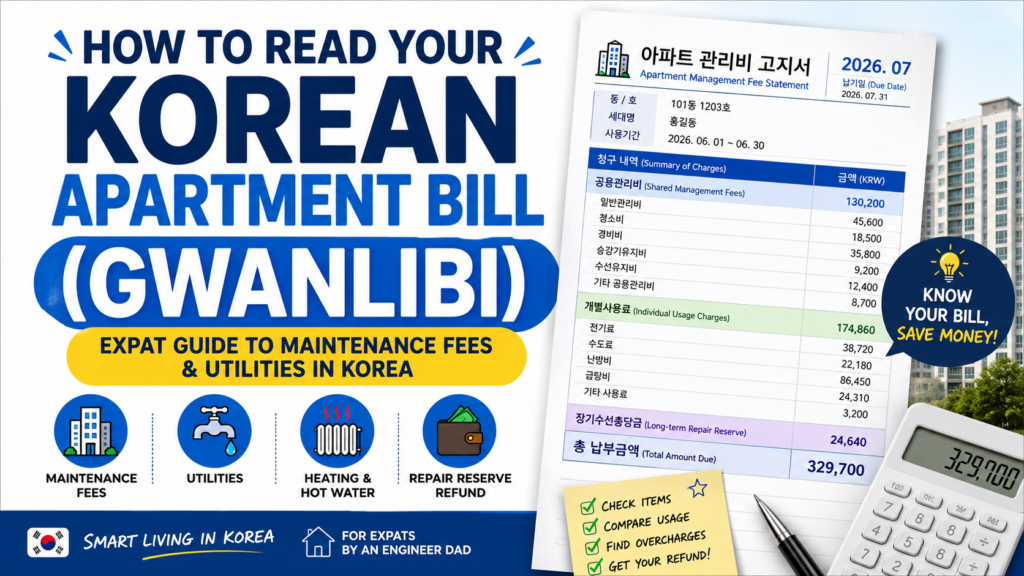
What Is Gwanlibi?
If you live in a Korean apartment, you will usually receive a monthly bill called gwanlibi (관리비).
It is often translated as maintenance fee, but that translation can be confusing.
In Korea, one apartment bill may include both:
- costs for running the apartment complex, and
- utilities used by your household.
That means your gwanlibi can include cleaning, security, elevator maintenance, electricity, water, heating, hot water, and other charges on the same statement.
It is normally separate from your rent.
A simple way to understand the bill is to divide it into three groups:
| Category | Korean | What it means |
|---|---|---|
| Shared management costs | 공용관리비 | Costs for operating shared areas and services |
| Individual usage charges | 개별사용료 | Electricity, water, heating, hot water, and similar household costs |
| Long-term repair reserve | 장기수선충당금 | Money reserved for major future repairs |
K-apt, Korea’s official apartment management information system, also separates common management costs from usage charges and long-term repair-related items when presenting apartment management data.
Engineer Dad Approach
Do not start with the final total. First separate the bill into fixed shared costs and usage-based costs. If the total suddenly increases, check heating, hot water, electricity, water, and the billing period before focusing on small management items.
What Do the Main Gwanlibi Charges Mean?
You do not need to memorize every line on a Korean apartment bill.
These are the items you are most likely to see.
Shared Management Costs
| Korean term | English explanation |
|---|---|
| 일반관리비 | General management and administration |
| 청소비 | Cleaning of shared areas |
| 경비비 | Security services |
| 소독비 | Pest control and disinfection |
| 승강기유지비 | Routine elevator maintenance |
| 수선유지비 | Ordinary repairs and maintenance |
These costs are shared by residents because they support the apartment complex as a whole.
For example, you may still pay elevator or security-related costs even if you rarely use those services personally.
Household and Utility Charges
Common usage-based items include:
| Korean term | English explanation |
|---|---|
| 전기료 | Electricity |
| 수도료 | Water |
| 가스사용료 | Gas |
| 난방비 | Space heating |
| 급탕비 | Hot-water heating |
Whether all of these appear on the apartment bill depends on the building.
For example, an apartment with an individual gas boiler may send the main gas and heating cost through a separate city-gas bill instead of the gwanlibi statement.
How to Read a Korean Apartment Bill in 5 Steps
A long Korean bill becomes much easier to understand if you check it in the same order every month.
Step 1: Confirm the Unit and Billing Period
First, check:
- 동: building number
- 호: unit number
- 부과년월: billing month
- 사용기간: usage period
- 납기일: payment deadline
The billing month and the actual utility usage period may not be identical.
For example, a bill issued in March may contain electricity or water usage measured partly during February.
Step 2: Find the Amount You Actually Need to Pay
Look for terms such as:
- 당월 부과액: amount charged this month
- 납부금액: amount to pay
- 합계: total
- 총 납부금액: total payment amount
Korean apartment statements often contain several subtotals.
Do not assume the largest number on the page is automatically the final amount due.
Step 3: Check for Previous Unpaid Charges
Look carefully for:
- 미납액: unpaid amount
- 체납액: overdue amount
- 전월 미납: unpaid amount from last month
- 연체료: late fee
This is especially important after moving into a new apartment.
Move-in warning
If your first bill includes charges from before your move-in date, ask the management office to identify the billing period before paying the amount.
Useful Korean:
이전 거주자의 미납 관리비가 있는지 확인해 주세요.
Please check whether the previous resident has unpaid management fees.
And:
제 입주일 기준으로 관리비를 구분해 주세요.
Please separate the charges based on my move-in date.
Do not assume that every balance printed on the first statement belongs to you.
Step 4: Check the Usage-Based Charges
If your bill suddenly increased, compare:
- electricity
- water
- heating
- hot water
- gas, if included
You may also see meter information such as:
- 전월지침: previous meter reading
- 당월지침: current meter reading
- 사용량: usage
- 단가: unit price
A higher bill does not always mean utility rates increased.
The reason may simply be:
- higher usage,
- a longer billing period,
- colder weather,
- more hot-water use, or
- a meter adjustment.
Step 5: Look for the Long-Term Repair Reserve
Renters should specifically look for:
장기수선충당금
This item deserves separate attention because it is not an ordinary household utility charge.
More on that below.
How Heating Charges Work in Korean Apartments
Heating is one of the biggest reasons apartment bills can be confusing for foreigners.
Korean apartments generally use one of three systems.
| Heating system | Korean | Where the main cost often appears |
|---|---|---|
| Individual heating | 개별난방 | Separate city-gas bill |
| Central heating | 중앙난방 | Apartment management bill |
| District heating | 지역난방 | Apartment management bill |
The exact billing method varies by complex, so always confirm it before signing a lease.
K-apt specifically allows apartments to be compared by heating method because management and utility costs can differ significantly depending on the system.
Individual Heating: 개별난방
In an individually heated apartment, your unit usually has its own boiler.
The boiler often provides both:
- floor heating, and
- hot water.
The main cost is commonly charged by the city-gas provider.
As a result, your gwanlibi may look relatively low even during winter while a separate gas bill becomes much higher.
When comparing apartments, remember to include both bills.
Central and District Heating
In central or district-heated apartments, heating costs are more likely to appear directly on the monthly gwanlibi statement.
Two terms are particularly important:
- 난방비: space heating
- 급탕비: energy used to provide hot water
These are not always the same charge.
Hot-water warning
Lowering your floor-heating thermostat does not necessarily reduce 급탕비.
Long showers or frequent baths can increase the hot-water portion of your bill even when your space-heating use is relatively low.
This distinction is easy to miss if you are seeing a Korean apartment bill for the first time.
The Charge Renters Should Not Miss: 장기수선충당금
장기수선충당금, or the long-term repair reserve, is money collected for major future repairs to shared apartment facilities.
Examples can include:
- replacing elevators,
- major exterior repairs,
- roof waterproofing,
- replacing large pipes, and
- major mechanical or electrical work.
This is different from 수선유지비, which generally covers routine maintenance and smaller repairs.
Who Is Responsible for the Long-Term Repair Reserve?
Under Korea’s apartment management rules, the long-term repair reserve is an expense of the property owner.
However, tenants commonly pay the full monthly apartment bill first, meaning the reserve may temporarily be paid by the tenant together with other management charges.
Korea’s official Easy Law service states that if a tenant paid the long-term repair reserve on behalf of the owner, the owner should reimburse that amount when the lease ends. It also explains that the apartment management office must issue confirmation of the tenant’s payments when requested. The guidance was updated as of August 31, 2026.
How to Claim the Long-Term Repair Reserve When Moving Out
Before you leave the apartment:
- Check whether 장기수선충당금 appears on your bill.
- Contact the management office.
- Request a 장기수선충당금 납부확인서.
- Check the amount paid during your lease.
- Give the confirmation to your landlord.
- Include the amount in the final move-out settlement.
Useful Korean:
장기수선충당금 납부확인서를 발급해 주세요.
Please issue a long-term repair reserve payment certificate.
You can also say:
제가 임차 기간 동안 납부한 금액을 확인해 주세요.
Please confirm how much I paid during my lease.
The management office usually confirms the amount. The actual reimbursement is normally settled with the property owner.
수선유지비 vs 장기수선충당금
These two terms look similar, but they are not the same.
| Item | What it is for | Typical renter treatment |
|---|---|---|
| 수선유지비 | Routine repairs and normal upkeep | Ordinary management cost |
| 장기수선충당금 | Major long-term repairs | Owner responsibility |
Important
Do not assume that every item containing the word “repair” is refundable.
The line renters should specifically check is 장기수선충당금.
What to Check Before Moving In or Out
A few checks can prevent most gwanlibi disputes.
Before Moving In
Ask:
- Is gas billed separately?
- What type of heating does the apartment use?
- Are electricity and water included in gwanlibi?
- Are there additional parking fees?
- Did the previous resident complete the final management-fee settlement?
If possible, ask to see a recent actual gwanlibi statement.
A winter bill is especially useful because heating can create a large seasonal difference.
Before Moving Out
Before returning the apartment:
- tell the management office your move-out date,
- request a final management-fee calculation,
- settle household utilities,
- settle a separate city-gas bill if necessary,
- request your 장기수선충당금 payment certificate, and
- keep the final bill and payment receipt.
It is easier to correct a billing problem before the rental deposit settlement than several weeks after you have moved out.
How to Compare Gwanlibi Before Renting an Apartment
Korea has an official apartment management information service called K-apt.
It allows users to check apartment management-fee information and compare complexes.
The comparison tools include factors such as:
- residential floor area,
- heating system,
- number of households,
- building age,
- building type,
- security arrangements, and
- management method.
K-apt itself warns that management fees can differ depending on these characteristics, so comparing only the final total can be misleading.
When comparing two apartments, try to match:
- similar unit size,
- the same heating method,
- similar building age,
- similar number of households, and
- the same season.
A January bill and a May bill are not a useful direct comparison.
Essential Korean Apartment Bill Vocabulary
You do not need a dictionary of every possible item.
These terms cover most situations.
| Korean | English |
|---|---|
| 관리비 | Apartment management bill / gwanlibi |
| 공용관리비 | Shared management costs |
| 개별사용료 | Individual usage charges |
| 일반관리비 | General management fee |
| 전기료 | Electricity |
| 수도료 | Water |
| 난방비 | Space heating |
| 급탕비 | Hot-water heating |
| 수선유지비 | Routine maintenance fee |
| 장기수선충당금 | Long-term repair reserve |
| 미납액 | Unpaid balance |
| 연체료 | Late fee |
| 사용량 | Usage |
| 납기일 | Payment deadline |
| 관리사무소 | Apartment management office |
If you remember only three Korean terms, make them:
관리비, 난방비, 장기수선충당금.
They will help you understand most apartment-billing conversations.
Frequently Asked Questions
Is gwanlibi included in Korean rent?
Not automatically.
In many apartments, monthly rent and gwanlibi are separate.
Even when a rental listing says “maintenance included,” ask what is actually included. Electricity, gas, water, or heating may still be charged separately.
Why is my Korean apartment bill much higher in winter?
Heating and hot-water use are common reasons.
If the apartment uses central or district heating, check 난방비 and 급탕비 separately.
If the apartment uses individual heating, the main increase may appear on a separate city-gas bill rather than the apartment statement.
Can a renter get part of gwanlibi back when moving out?
The main item to check is 장기수선충당금.
It is an owner responsibility. If the tenant paid it together with the monthly apartment bill, the tenant can normally request settlement from the property owner when the lease ends.
Is officetel gwanlibi the same as apartment gwanlibi?
Not necessarily.
Officetels can have different management arrangements, shared facilities, heating systems, and utility structures.
Before renting an officetel, ask to see an actual recent bill rather than estimating the cost from apartment averages.
Final Takeaway
A Korean apartment bill looks complicated because several different types of expenses can appear on one page.
The easiest way to read it is to separate it into:
- shared management costs,
- household utilities, and
- the long-term repair reserve.
For foreign renters, four things are especially worth checking:
- whether utilities are included or billed separately,
- what heating system the apartment uses,
- whether old unpaid charges appear after move-in, and
- whether 장기수선충당금 is included in the bill.
Once you understand those four points, most Korean apartment bills become much easier to read.
Official Sources
This guide was reviewed using current Korean official or public-service information, including:
- Korea’s K-apt Apartment Management Information System, which provides management-fee searches and apartment comparison tools.
- Korea’s Easy Law Information Service, which explains the legal responsibility and reimbursement process for 장기수선충당금.
- Korea’s Multi-Family Housing Management Act and Enforcement Decree, including the rules governing long-term repair reserves.
Disclaimer
This article provides general information about apartment management fees in South Korea and was reviewed against official information available in September 2026.
Actual charges and billing methods may vary by apartment complex, heating system, utility provider, management rules, and rental agreement.
For a dispute involving a specific bill or refund, confirm the details with the apartment management office, landlord, or an appropriate Korean housing or legal service.