
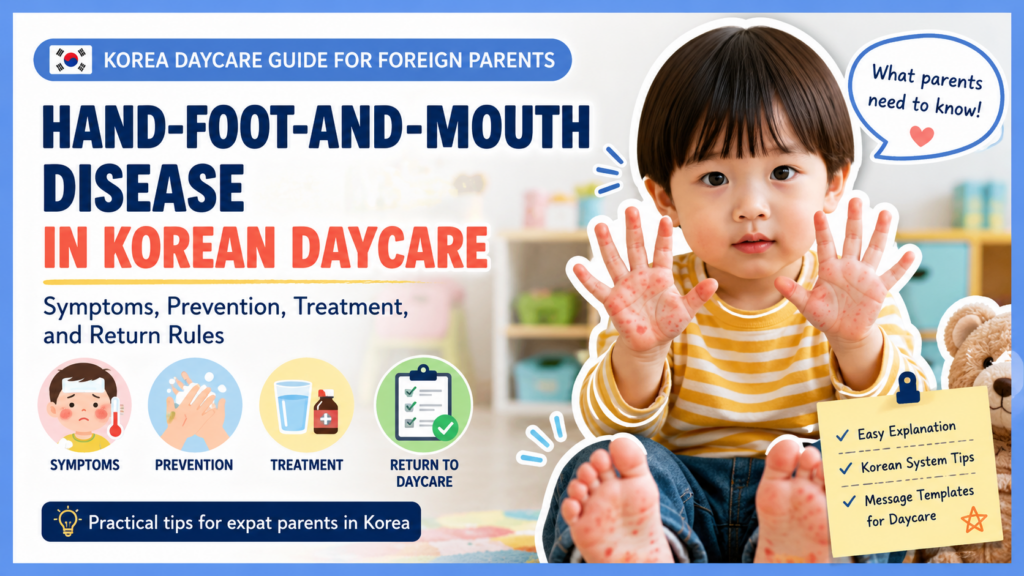
Hand-Foot-and-Mouth Disease and Daycare in Korea: What Foreign Parents Should Know
If your child attends daycare in Korea, you may eventually receive a notification through a daycare communication app such as Kids Note (키즈노트):
“A case of hand-foot-and-mouth disease has been reported in the class. Please check your child for fever, mouth sores, or rash.”
For parents who are new to Korea, this can sound scary. The Korean name is 수족구병, which literally means hand-foot-mouth disease. It is a common viral illness among young children, especially in daycare centers, kindergartens, and other places where children share toys, touch surfaces, and play closely together.
The key point is simple:
Hand-foot-and-mouth disease is usually mild, but it spreads very easily.
According to the U.S. CDC, most children with hand-foot-and-mouth disease recover on their own in about 7 to 10 days, often with little or no medical treatment. In Korea, the Korea Disease Control and Prevention Agency, or KDCA, describes hand-foot-and-mouth disease as an enterovirus infection characterized by fever, mouth blisters or ulcers, and blister-like rashes on the hands and feet.
This article explains what foreign parents in Korea should know: symptoms, prevention, home treatment, daycare communication, and when a child can return to daycare.
1. What Is Hand-Foot-and-Mouth Disease?
Hand-foot-and-mouth disease, often shortened to HFMD, is a viral illness caused by enteroviruses. Common causes include Coxsackievirus A16 and Enterovirus A71, among others. KDCA lists Coxsackievirus A16 as a major cause and also notes Enterovirus A71 and several other Coxsackievirus types as possible causes.
Despite the name, it is not related to the animal disease called “foot-and-mouth disease.” HFMD affects humans, especially infants and young children.
In simple terms, HFMD is a contact-network illness.
It spreads well in places where many small children:
- touch the same toys
- put hands or objects in their mouths
- need diaper changes
- share tables, mats, cups, towels, or classroom space
- are still learning proper handwashing
That is why Korean daycare centers can experience sudden HFMD outbreaks.
From an “Engineer Dad” point of view, HFMD is not just “bad luck.” It is what happens when a virus enters a high-contact system with many shared surfaces and repeated close contact.
2. Why Does HFMD Spread So Easily in Korean Daycare?
In Korea, daycare is called 어린이집. Kindergarten is called 유치원.
Both can be places where HFMD spreads, but 어린이집 often includes younger children, including toddlers who are still in diapers. This matters because HFMD can spread not only through saliva and respiratory droplets, but also through stool and contaminated surfaces.
KDCA lists the main transmission routes as direct contact, droplets, contaminated water, and high-risk shared environments such as homes, childcare facilities, playgrounds, hospitals, and summer camps.
HFMD can spread through:
- saliva, drool, or nasal discharge
- respiratory droplets
- fluid from blisters
- stool, especially during diaper changes
- contaminated toys, tables, door handles, cups, towels, or shared surfaces
- close contact such as hugging, touching, or playing together
This is why one case in a daycare classroom can quickly become a class-wide notice on Kids Note.
Daycare is not one single contact point. It is a network of contact points:
child → toy → table → teacher’s hand → another child → diaper area → sink → mat
The goal of prevention is not to make the system perfect. That is impossible. The goal is to reduce the number of transmission links.
3. Common Symptoms of Hand-Foot-and-Mouth Disease
The typical symptoms are:
- fever
- sore throat
- reduced appetite
- tiredness or irritability
- painful mouth sores or ulcers
- rash or small blisters on the hands and feet
- rash on the buttocks, legs, arms, or diaper area
- sometimes vomiting or diarrhea
The CDC explains that HFMD commonly causes fever, mouth sores, and a skin rash on the hands and feet. It also notes that most children have mild symptoms for 7 to 10 days. KDCA also lists fever, loss of appetite, weakness, diarrhea, vomiting, and rash or blisters mainly around the mouth, hands, feet, and diaper area in infants and young children.
The incubation period is usually 3 to 7 days, meaning symptoms may appear several days after exposure. KDCA gives this 3–7 day incubation period in its disease overview.
A typical timeline may look like this:
- A child is exposed at daycare.
- After several days, fever or low energy appears.
- Mouth pain, drooling, or refusal to eat may follow.
- Small spots or blisters appear on the hands, feet, around the mouth, or diaper area.
- Symptoms gradually improve over several days.
Not every child follows the textbook pattern. Some children only have mouth sores. Some have mild fever. Some develop a rash after the fever improves.
If you are unsure, it is better to visit a pediatric clinic.
4. When Should You Visit a Doctor in Korea?
In Korea, parents usually visit a local 소아청소년과, meaning pediatric clinic, when HFMD is suspected.
A doctor can usually diagnose HFMD based on the child’s symptoms, age, and the appearance of the rash or mouth sores. The CDC also notes that healthcare providers can usually identify HFMD by examining the rash and considering the child’s symptoms and age.
You should seek medical care if your child has:
- fever that lasts more than 3 days
- poor drinking or signs of dehydration
- very little urine
- repeated vomiting
- severe mouth pain
- unusual sleepiness, weakness, or confusion
- stiff neck, severe headache, or severe irritability
- breathing difficulty
- symptoms that do not improve after about 10 days
- symptoms in a very young infant, especially under 6 months
- an underlying immune problem
The CDC recommends seeing a healthcare provider if a child cannot drink well, may be dehydrated, has fever longer than 3 days, has severe symptoms, has symptoms that do not improve after 10 days, has a weakened immune system, or is very young, especially under 6 months.
Most cases are mild, but rare complications such as viral meningitis or encephalitis can occur. These are uncommon, but parents should not ignore severe neurological symptoms such as stiff neck, severe headache, unusual drowsiness, seizure, or confusion.
5. Treatment: What Actually Helps?
There is no special antiviral medicine that cures ordinary HFMD.
Antibiotics do not work because HFMD is caused by viruses, not bacteria.
Treatment is usually supportive care, which means helping the child stay comfortable and hydrated while the body clears the virus. KDCA describes treatment as symptom relief with fever or pain medicine and fluid replacement if dehydration occurs.
1) Control fever and pain
Use fever or pain medicine only according to your child’s age, weight, and medical advice.
In Korea, pediatric clinics commonly prescribe or recommend fever reducers when needed. Do not give aspirin to children. The CDC also warns not to give aspirin to children for HFMD symptom relief.
2) Focus on fluids
Mouth sores can make swallowing painful. A child may refuse food, but hydration is more important than eating a normal meal for a few days.
Helpful options may include:
- cool water
- milk or formula, if the child still drinks it
- oral rehydration solution if recommended
- soft, cool foods such as yogurt or porridge
- avoiding spicy, salty, or acidic foods that sting the mouth
The CDC emphasizes preventing dehydration because mouth sores can make drinking painful.
3) Do not pop blisters
Blister fluid can contain virus. Keep the skin clean and avoid unnecessary touching, scratching, or squeezing. The CDC advises keeping blisters clean and avoiding touching them.
4) Let the child rest
HFMD is not a “push through it” illness.
A child who is tired, feverish, drooling, or unable to eat comfortably should stay home. This is both for the child’s recovery and for reducing spread in the daycare classroom.
5) Watch for dehydration
For young children, dehydration is often the biggest practical risk.
Contact a doctor quickly if your child:
- cannot drink
- cries without tears
- has very little urine
- seems unusually sleepy
- refuses fluids for a long time
- has dry lips or a very dry mouth
6. Prevention at Home and Daycare
There is no widely used routine HFMD vaccine for children in Korea. KDCA emphasizes personal hygiene, handwashing, cough etiquette, environmental cleaning, and isolation when HFMD is suspected.
Think of prevention as a three-layer system.
Layer 1: Handwashing
KDCA recommends washing hands with soap under running water for at least 30 seconds, especially:
- after going outside
- after using the toilet
- before and after meals
- before and after diaper changes
- after caring for a sick child
KDCA specifically highlights hand hygiene for pregnant women, pediatric and newborn-care workers, postpartum care centers, kindergarten staff, and daycare workers.
The CDC recommends washing hands often with soap and water for at least 20 seconds, especially after changing diapers, using the toilet, coughing, sneezing, or blowing the nose.
The exact number of seconds may differ by source, but the practical message is the same:
Handwashing must be long enough, frequent enough, and done at the right moments.
Layer 2: Reduce Shared Contamination
At home:
- Do not share cups, spoons, towels, or toothbrushes.
- Wash bedding, towels, and clothes used by the sick child.
- Clean toys that the child puts in the mouth.
- Wash hands after changing diapers.
- Dispose of diapers carefully.
- Clean frequently touched surfaces.
At daycare:
- Teachers should clean toys and play equipment.
- Tables, mats, door handles, and shared items should be disinfected.
- Children should wash hands after toileting and before meals.
- Sick children should stay home until they meet return criteria.
KDCA advises childcare centers, kindergartens, and schools to keep toys, play equipment, furniture, door handles, and shared items clean and disinfected.
Layer 3: Stay Home When Symptomatic
This is the hardest part for working parents, but it is one of the most effective steps.
If a child has fever, mouth sores, heavy drooling, poor condition, vomiting, diarrhea, or active symptoms, daycare attendance can spread the illness to other children.
KDCA advises that when HFMD is suspected, the child should receive medical care and self-isolate.
This can feel frustrating for parents because it often means sudden home care, missed work, or asking grandparents for help. But in daycare, one symptomatic return can restart the transmission chain.
From a system perspective, keeping a symptomatic child home is not just an individual decision. It is a circuit breaker.
7. When Can a Child Return to Daycare in Korea?
This is one of the most confusing questions for foreign parents.
The answer may feel different depending on:
- the country you come from
- the daycare center’s internal policy
- the pediatrician’s judgment
- the local outbreak situation
- whether the child still has fever, drooling, diarrhea, or active blisters
The CDC says children with HFMD can usually continue going to childcare or school if they have no fever, feel well enough to participate, and have no uncontrolled drooling with mouth sores. It also notes that local health departments may require children to stay home during outbreaks.
Korea is usually more cautious in daycare settings.
KDCA’s 2026 HFMD management guideline gives a return standard for children who were stopped from attending school or daycare: return after there is no fever and the blisters have dried. It also says hand hygiene should continue after return, fecal-oral transmission risk activities such as group water play should be avoided, and extension should be considered if the child’s condition is still poor even after meeting the return criteria.
So, in Korea, a practical return-to-daycare checklist is:
- fever has resolved
- blisters have dried or clearly improved
- the child has enough energy to participate normally
- mouth sores have improved enough that the child can drink and eat reasonably
- there is no uncontrolled drooling due to painful mouth sores
- vomiting or diarrhea has resolved
- the child’s overall condition is good
- the pediatrician says daycare return is acceptable if you are unsure
- the daycare center agrees with the return timing
- a doctor’s note is prepared if the daycare requests one
Some Korean daycare centers may ask for a 진료확인서 or 의사소견서, meaning a medical confirmation or doctor’s note. This is not always the same everywhere, so it is best to ask the daycare directly through Kids Note or by message.
8. Useful Korean Message for Daycare
Here is a practical Korean message you can copy and send to the daycare teacher.
아이가 수족구병 진단을 받아 당분간 가정 보육하겠습니다.
발열이 없고 수포가 마른 뒤, 컨디션이 회복되면 등원하겠습니다.
등원 시 진료확인서나 의사소견서가 필요한지 알려주세요.
English meaning:
My child was diagnosed with hand-foot-and-mouth disease, so we will keep the child at home for now.
We will return after there is no fever, the blisters have dried, and the child’s condition has recovered.
Please let us know if a medical confirmation or doctor’s note is required for returning to daycare.
If your child has symptoms but has not yet been diagnosed, you can write:
아이가 열과 발진 증상이 있어 오늘 병원 진료 후 결과를 공유드리겠습니다.
수족구병 가능성이 있어 오늘은 가정 보육하겠습니다.
English meaning:
My child has fever and rash symptoms, so we will visit the clinic today and share the result.
Since hand-foot-and-mouth disease is possible, we will keep the child at home today.
This kind of message is useful because Korean daycare communication often values early notice and clear return timing.
9. What If the Daycare Has an Outbreak?
If HFMD is spreading in your child’s class, do not assume that every small rash is HFMD. But you should monitor carefully for fever, mouth pain, drooling, appetite loss, and rash.
What parents can do:
- Check the mouth, palms, soles, and diaper area.
- Take temperature if the child seems tired or warm.
- Keep the child home if symptoms appear.
- Inform daycare if a doctor diagnoses HFMD.
- Wash hands carefully after daycare pickup.
- Wash daycare clothes and towels.
- Clean cups, bottles, and frequently used toys.
- Avoid kids cafés, indoor playgrounds, and crowded children’s spaces while symptoms are present.
This is not about blaming one family.
HFMD spreads easily even when parents are careful. The goal is to reduce the number of transmission links in the system.
If your child’s class has several cases, the daycare may become more cautious about return timing. That may feel strict, but it is usually an attempt to prevent the classroom from becoming a repeated outbreak loop.
10. Korean Vocabulary for Foreign Parents
| Korean | Meaning | Notes |
|---|---|---|
| 수족구병 | Hand-foot-and-mouth disease | Commonly used in daycare notices |
| 어린이집 | Daycare / childcare center | Usually for younger children |
| 유치원 | Kindergarten | Usually for older preschool children |
| 키즈노트 | Kids Note | Common daycare communication app |
| 알림장 | Daycare communication note | Often digital in Korea |
| 등원 | Going to daycare/kindergarten | “Return to daycare” = 등원 |
| 등원 자제 | Refrain from attending daycare | Often used in illness guidance |
| 가정 보육 | Home care | Keeping the child at home |
| 진료확인서 | Medical visit confirmation | Some centers may request it |
| 의사소견서 | Doctor’s note/opinion | May be requested before return |
| 수포 | Blister | Important for HFMD return timing |
| 발열 | Fever | Fever status is important |
| 소독 | Disinfection | Important during outbreaks |
| 자가 격리 | Self-isolation at home | Used broadly for staying home while infectious |
11. Parent Checklist
If HFMD is reported at daycare
- Check for fever, mouth sores, drooling, and rash.
- Look at the hands, feet, mouth area, and diaper area.
- Wash hands after daycare pickup and before meals.
- Clean bottles, cups, and toys.
- Avoid sharing utensils or towels.
- Watch symptoms for about a week after possible exposure.
- Read daycare notices carefully, especially Kids Note announcements.
If your child is diagnosed with HFMD
- Keep your child home.
- Inform the daycare.
- Focus on hydration.
- Use fever or pain medicine only as advised.
- Do not pop blisters.
- Avoid kids cafés, playgrounds, daycare, and crowded children’s spaces while symptomatic.
- Ask the daycare what document is needed for return.
- Return only after fever is gone, blisters have dried, and the child’s condition has recovered.
FAQ
Is hand-foot-and-mouth disease serious?
Usually, no. Most children recover in 7 to 10 days with supportive care. The CDC says HFMD is usually not serious and most people recover with minimal or no medical treatment. However, dehydration can occur if mouth sores make drinking painful, and rare complications such as viral meningitis or encephalitis can happen.
Can adults get hand-foot-and-mouth disease?
Yes. Adults can get HFMD, although it is more common in infants and young children. Adults may have mild symptoms, but they can still spread the virus. Parents should wash hands carefully after diaper changes and after contact with saliva, stool, or blisters.
Does my child need antibiotics?
Usually, no. HFMD is viral, so antibiotics do not treat the cause. Treatment usually focuses on fever control, pain relief, fluids, and rest.
Is there a vaccine for HFMD in Korea?
There is no routine HFMD vaccine widely used for children in Korea. KDCA emphasizes prevention through handwashing, cough etiquette, environmental cleaning, and self-isolation when HFMD is suspected.
How long is HFMD contagious?
HFMD is usually most contagious during the first week of illness, but the virus can continue to be shed after symptoms improve, especially through stool. KDCA notes that even after recovery, pathogen shedding may continue and that this should be considered for at least 8 weeks. This does not mean a child must stay home for 8 weeks, but it does mean handwashing after toilet use and diaper changes remains very important.
Can my child return to daycare if the rash is still visible?
It depends on the child’s condition, daycare policy, and medical advice. KDCA’s 2026 return standard says children can return after there is no fever and the blisters have dried. A visible but drying rash may be acceptable in some cases, but fever, poor condition, uncontrolled drooling, vomiting, diarrhea, or wet/open blisters are reasons to stay home and ask a doctor or daycare before returning.
Should I disinfect everything at home?
You do not need to panic-clean the entire house, but you should focus on high-contact items: toys, cups, spoons, towels, bedding, toilet areas, diaper-changing surfaces, tables, and door handles. Use disinfectants safely according to product instructions, ventilate the room, and never mix bleach with other cleaners.
Why does Korean daycare seem stricter than CDC guidance?
The CDC gives general return guidance that allows childcare attendance when the child has no fever, feels well enough to participate, and has no uncontrolled drooling with mouth sores. Korean daycare centers may be more cautious because group childcare for toddlers involves close contact, diaper changes, shared toys, and pressure to prevent class-wide outbreaks. KDCA’s 2026 guideline specifically uses the return standard of no fever and dried blisters for children who were stopped from attending school or daycare.
Should pregnant women be careful?
Yes. Most cases are mild, but pregnant women should be cautious around infectious illnesses and contact a doctor if they think they may have been exposed or infected, especially if symptoms appear.
Final Thoughts
Hand-foot-and-mouth disease is one of those daycare illnesses that feels dramatic because the rash is visible and the daycare response can be strict.
But the medical principle is simple:
Control symptoms, prevent dehydration, reduce contact, and return to daycare only when the child has recovered enough to participate safely.
For foreign parents in Korea, the key is to understand both sides.
Medically, HFMD is usually mild.
Socially, daycare outbreaks require careful cooperation.
In the Korean childcare system, a Kids Note notification is not just an announcement. It is part of the infection-control network. When parents, teachers, and clinics respond early, the chain of transmission becomes shorter.
That is the real goal: not panic, but system control.
Disclaimer
This article is for general educational purposes only and is not a medical diagnosis or treatment plan. For personal medical advice, consult a licensed doctor or pediatric clinic in Korea. If your child has severe symptoms, signs of dehydration, difficulty breathing, unusual drowsiness, stiff neck, seizure, confusion, or a rapidly worsening condition, seek urgent medical care or call emergency services in Korea.
Sources Checked
- Korea Disease Control and Prevention Agency, 2026 Enterovirus Infection and Hand-Foot-and-Mouth Disease Management Guideline.
- U.S. CDC, About Hand, Foot, and Mouth Disease.
- U.S. CDC, HFMD Symptoms and Complications.