
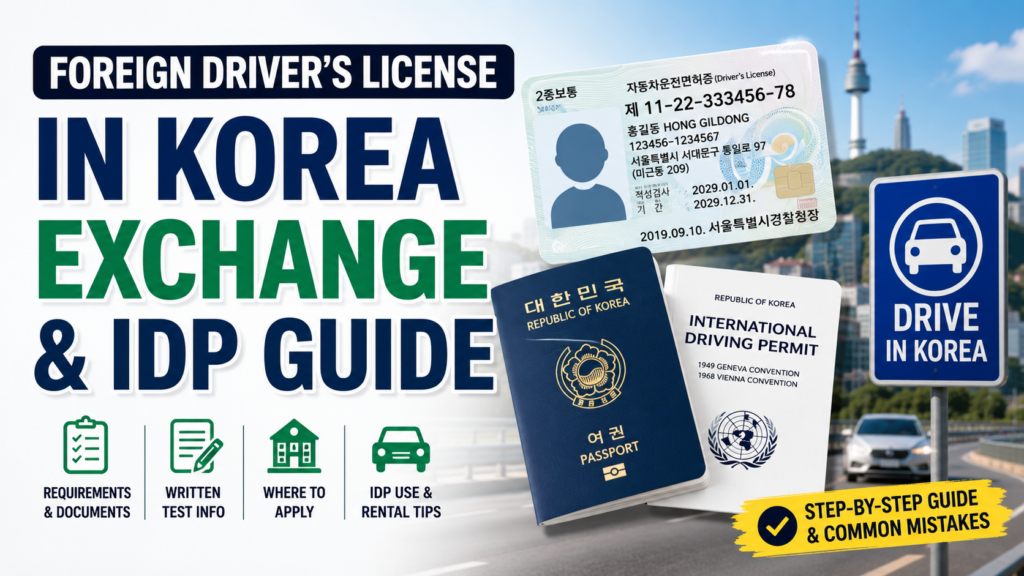
Driving in Korea is relatively straightforward once you have the right license. The confusing part is deciding which license you actually need.
If you are visiting Korea for a short period, a valid International Driving Permit may be enough.
If you are living in Korea long term, exchanging your foreign driver’s license for a Korean license may be more practical.
But the exchange process depends on several details that are easy to miss, including the country or state that issued your license, how long you lived there, and whether Korea recognizes that jurisdiction.
This guide explains the process without turning it into a legal manual.
Quick Answer: IDP or Korean License?
For most foreign drivers, there are two practical routes.
| Your situation | Usually relevant option |
|---|---|
| Tourist or short-term visitor | Valid IDP + original foreign license |
| Long-term resident | Foreign-license exchange, if eligible |
| Foreign license only | Usually not enough to drive in Korea |
| Unofficial “International Driving License” | Not accepted |
| Foreign license not eligible for exchange | Standard Korean licensing process may be required |
Under Korea’s Road Traffic Act, a qualifying International Driving Permit or mutually recognized foreign license may be used for up to one year from the date of entry into Korea, subject to the applicable license’s own validity and vehicle category. 법제처
For long-term residents, however, obtaining a Korean license is usually the more practical option.
1. Can You Drive in Korea with an International Driving Permit?
Korea recognizes valid International Driving Permits issued under the relevant international conventions and agreements.
The Korea Road Traffic Authority states that Korea generally accepts valid Geneva Convention IDPs and has also permitted valid Vienna Convention IDPs since 2002. The Korean driving period is generally limited to one year from entry. 안전운전 통합민원
In practical terms, bring your:
International Driving Permit, original foreign driver’s license, and passport.
Do not assume that the IDP replaces your domestic license.
Watch Out for Unofficial “International Driving Licenses”
An International Driving Permit (IDP) is an official document issued by an authorized organization.
An online document marketed as an “International Driving License” is not automatically valid.
The Korea Road Traffic Authority specifically warns that unofficial documents marked INTERNATIONAL DRIVING LICENSE, including those issued by non-authorized organizations, cannot be used as valid IDPs in Korea. 안전운전 통합민원
If you plan to drive in Korea as a visitor, obtain your IDP from the authorized issuing organization in your home country before traveling.
Renting a Car Is a Separate Question
Having a legally valid IDP does not guarantee that a rental company will give you a car.
Rental companies can impose their own rules concerning age, driving experience, payment method, insurance, and additional drivers.
Check those requirements directly with the rental company before booking.
2. Can You Exchange Your Foreign License for a Korean License?
Many foreign residents can exchange a valid foreign license for a Korean license.
However, not every foreign license qualifies.
Your license must normally be a valid full license.
Temporary, learner, provisional, probationary licenses and similar permits are not eligible for the exchange process. The Korea Road Traffic Authority explicitly limits exchange to valid full licenses. 안전운전 통합민원
The process also differs depending on whether your issuing country or jurisdiction recognizes Korean licenses.
Licenses from Recognized Jurisdictions
If your license comes from a jurisdiction that Korea currently classifies as recognizing Korean licenses, you generally complete the document review and physical examination without the written test. 안전운전 통합민원
Licenses from Non-Recognized Jurisdictions
If the issuing jurisdiction does not qualify for that treatment, you generally need both a physical examination and a 40-question written test.
The test can currently be taken in:
Korean, English, Chinese, or Vietnamese. 안전운전 통합민원
3. Check the State or Province, Not Just the Country
This is particularly important for countries where individual states or provinces issue driver’s licenses.
Do not check only your nationality.
Check the exact jurisdiction printed on your license.
For example, the Korea Road Traffic Authority’s April 6, 2026 guidance specifically states that licenses from the U.S. states of Oregon, Idaho, Utah, and Nevada require the written test despite their reciprocal status. 안전운전 통합민원
Recognition lists can change, so avoid relying on an old blog post or saved screenshot.
Check the current Korea Road Traffic Authority list before preparing your application.
4. The 90-Day Residence Rule
This is one of the easiest requirements to overlook.
Having a valid foreign license is not enough by itself.
Korean authorities use your passport and Certificate of Entry and Departure to confirm that you were actually present in the country or jurisdiction that issued the license and that the required residence history can be verified.
The Korea Road Traffic Authority states that a foreign license cannot be exchanged when the applicant cannot prove the required more-than-90-day stay connected with the issuing jurisdiction. 안전운전 통합민원
This can become especially important if you:
received the license while studying overseas, renewed it after moving to another country, have multiple passports, changed nationality, or have incomplete entry and departure records.
Before spending money on authentication documents, check whether your residence history can be proven.
5. Documents You Need for a Foreign-License Exchange
For a typical foreign resident, the core documents are as follows. Individual cases may require additional documents.
| Document | What to Check |
|---|---|
| Original foreign driver’s license | Must generally be a valid full license |
| Passport | Bring the relevant passport history if needed |
| Korean Residence Card | Original |
| Photos | Three recent 3.5 × 4.5 cm color photos |
| Apostille or embassy confirmation | Used to verify the foreign license |
| Certificate of Entry and Departure | Records should cover the required period |
| Additional identity documents | May be needed if names or birth dates differ |
The official exchange instructions currently require foreign residents to present the original foreign license, passport, Residence Card, three recent photos, license authentication, and an entry/departure certificate covering the relevant history. 안전운전 통합민원
Apostille or Embassy Confirmation
A translation is not the same thing as authentication.
The Korea Road Traffic Authority generally requires either an appropriate embassy confirmation or an Apostille confirming the foreign license.
The authentication document generally must have been issued within one year of the application date. 안전운전 통합민원
Some embassies may not provide this service, so check with your embassy before assuming which route you can use.
Also avoid separating or damaging an Apostille or embassy certification that has been physically attached or sealed to another document. The authority notes that signs of separation can lead to requests for additional documentation or rejection. 안전운전 통합민원
6. How to Exchange Your License in Korea
The process is easier to understand as five steps.
Step 1: Check Your Eligibility
Before preparing documents, confirm that:
your license is a valid full license, your residence history satisfies the exchange requirement, and your exact issuing country, state, province, or territory has been checked.
Also determine whether you will need the written test.
Step 2: Authenticate the Foreign License
Obtain the required Apostille or embassy confirmation.
Do this before visiting the Korean licensing office.
Step 3: Prepare the Korean Documents
Gather your Residence Card, passport, photos, and Certificate of Entry and Departure.
If the spelling of your name or your date of birth differs between documents, prepare evidence explaining the difference.
Step 4: Visit a Driver’s License Examination Office
Foreign-license exchanges are handled at Korea’s Driver’s License Examination Offices (운전면허시험장).
This is important:
Do not assume that your local police station handles foreign-license exchanges.
The Korea Road Traffic Authority currently lists nationwide Driver’s License Examination Offices as the application locations, and applications generally must be made in person. 안전운전 통합민원
At the office, your documents will be reviewed and you will complete the required physical examination.
If your issuing jurisdiction requires it, you will also take the written test.
Step 5: Receive Your Korean License
Foreign-license exchanges normally result in a Korean Class 2 Ordinary License (2종 보통).
There are exceptions for certain countries with separate reciprocal arrangements. The official 2026 guidance names Belgium, Poland, Spain, Italy, and Ireland as jurisdictions for which the equivalent class may be issued under the applicable agreement. 안전운전 통합민원
7. Fees, Tests, and Timing
Current Korea Road Traffic Authority fees should always be checked shortly before you apply.
As of the latest September 2026 review:
| Item | Current official fee |
|---|---|
| Standard Korean license issuance | ₩10,000 |
| Mobile IC license issuance | ₩15,000 |
| Written test, when required | ₩10,000 |
| Physical exam — ordinary licenses | ₩7,000 |
| Physical exam — Class 1 Large/Special | ₩8,000 |
These amounts come from the current Korean-language Korea Road Traffic Authority exchange guide. 안전운전 통합민원
Not every examination office has an on-site physical examination facility. The authority currently notes that several locations, including Mungyeong, Gangneung, Taebaek, Gwangyang, Chungju, and Chuncheon, require applicants to obtain the medical examination elsewhere. 안전운전 통합민원
Do Not Arrive Too Late
Foreign-license exchanges can take time.
The official guidance recommends that exchange applications be submitted by 5:00 p.m., and applicants who need the written test should arrive before 4:00 p.m. 안전운전 통합민원
For a first visit, earlier is better.
8. What Happens to Your Original Foreign License?
Do not assume you will automatically leave the office with both licenses.
Korea distinguishes between jurisdictions for which the original foreign license is retained and those for which it is not.
The Korea Road Traffic Authority maintains a current list for this purpose, so check the official rule for your issuing jurisdiction before applying.
If your original license is important for an upcoming overseas trip, confirm the procedure before you exchange it.
9. What If Your License Cannot Be Exchanged?
If your foreign license does not qualify for exchange, you may need to obtain a Korean license through the regular licensing process.
That can involve Korea’s standard written, skills, and road-testing requirements rather than the simpler foreign-license exchange procedure.
At that point, use the Korea Road Traffic Authority’s standard licensing guide rather than trying to force the exchange process.
Common Mistakes to Avoid
The five mistakes worth remembering are simple:
- Using an unofficial “International Driving License” instead of a valid IDP.
- Checking only the country and ignoring the issuing state or province.
- Bringing only a translation instead of the required license authentication.
- Failing to prove the required residence history in the issuing jurisdiction.
- Going to a police station instead of a Driver’s License Examination Office for the exchange.
Those five checks prevent most of the avoidable confusion in this process.
Engineer Dad Note: Check Eligibility Before Collecting Documents
Korean administrative procedures often look more complicated than they actually are because several documents have similar names.
For this process, I would confirm eligibility first rather than immediately collecting paperwork.
The order matters.
First, check the exact country, state, province, or territory that issued your license.
Then check whether you need the written test.
Then confirm that your 90-day residence history can be proven.
Only after those checks would I spend time obtaining an Apostille, embassy confirmation, photos, and certificates.
Two Korean terms are especially useful:
운전면허시험장
Driver’s License Examination Office
출입국에 관한 사실증명
Certificate of Entry and Departure
If you recognize those two terms, navigating the Korean side of the procedure becomes much easier.
Frequently Asked Questions
Can I drive in Korea with only my foreign driver’s license?
Generally, a standard foreign license by itself is not enough.
Short-term foreign drivers commonly use an eligible International Driving Permit together with their original foreign license and passport. The Korea Road Traffic Authority explicitly states that a foreign license alone does not authorize driving in Korea under the ordinary exchange system. 안전운전 통합민원
How long can I drive in Korea with an IDP?
Korean law allows qualifying International Driving Permits or mutually recognized foreign licenses to be used for up to one year from the date of entry.
The permit’s own expiration date and other applicable conditions can shorten that period. 법제처
Do I need a written test to exchange my license?
It depends on the exact jurisdiction that issued your license.
Licenses from recognized jurisdictions generally receive the written-test exemption, while licenses from non-recognized jurisdictions generally require a 40-question test.
There are also jurisdiction-specific exceptions. 안전운전 통합민원
Do I need an Apostille?
You generally need either an acceptable Apostille or qualifying embassy confirmation verifying the foreign license.
The exact authentication route depends on the issuing country and the available embassy service. 안전운전 통합민원
Where do I exchange a foreign license?
At a Driver’s License Examination Office.
Foreign-license exchange applications are handled at nationwide examination offices rather than as a normal local-police-station service. 안전운전 통합민원
Will Korea keep my original foreign license?
It depends on the issuing jurisdiction.
Check the Korea Road Traffic Authority’s current foreign-license retention list before applying.
Related Guides
After you sort out your Korean driving license, the most useful next guides on Engineer Dad Korea are:
Cost of Owning a Car in Korea — for insurance, fuel, maintenance, parking, and other ongoing costs.
Car Insurance Renewal in Korea: Tips for Foreign Drivers — for understanding Korean vehicle insurance after you begin driving regularly.
How to Use Government24 in Korea — useful when obtaining Korean administrative certificates such as the Certificate of Entry and Departure.
This gives the site a natural path from license → government documents → insurance → actual car ownership.
Official Sources Checked
This article was reviewed against three primary official sources.
Korea Road Traffic Authority — Foreign Driver’s License Exchange
Used for eligibility, required documents, recognition status, the 90-day rule, written-test requirements, fees, examination offices, and current application timing. 안전운전 통합민원
Korea Road Traffic Authority — International Driving Permit
Used for Korea’s recognition of Geneva and Vienna Convention IDPs and the warning against unofficial “International Driving Licenses.” 안전운전 통합민원
Korean Road Traffic Act, Article 96
Used for the statutory rule allowing qualifying international or mutually recognized foreign licenses for up to one year from entry. 법제처
Administrative rules, recognition lists, embassy services, and fees can change. Check the current Korea Road Traffic Authority guidance before applying.