
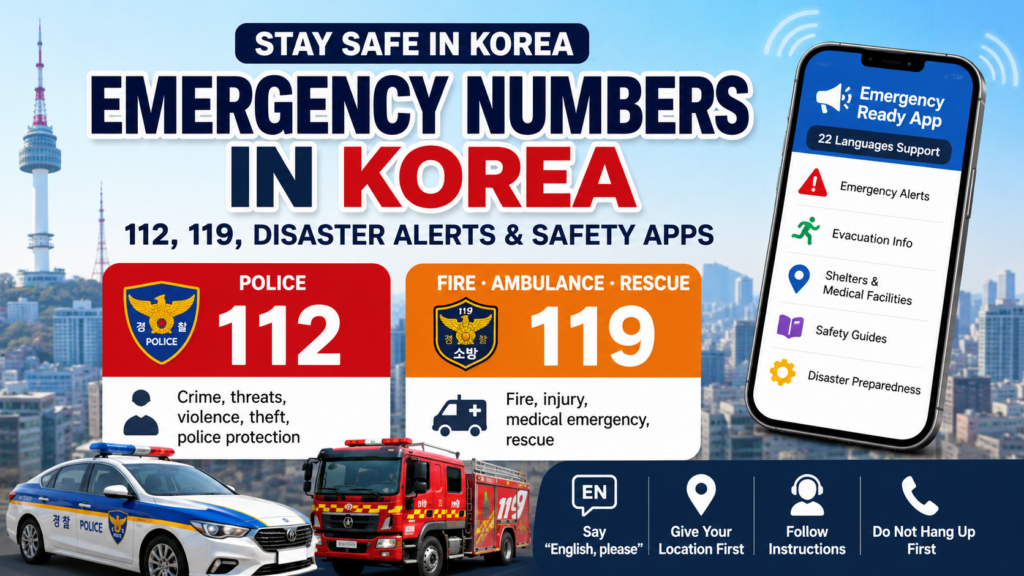
South Korea does not use one universal emergency number for every situation.
Instead, remember these two numbers:
🔴 112 = Police
🟠 119 = Fire, ambulance, and rescue
Call 112 when you need police protection because of a crime, threat, violence, stalking, theft, or another dangerous situation.
Call 119 when there is a fire, serious injury, medical emergency, or rescue situation.
The Korean National Police Agency officially identifies 112 as the crime-reporting number and 119 as the number for fires, accidents, and rescue.
Last reviewed: July 25, 2026
Quick Guide to Emergency Numbers in Korea
| Number | Service | Call When |
|---|---|---|
| 🔴 112 | Police | Crime, violence, threats, stalking, burglary, theft in progress, dangerous disputes, or immediate police protection |
| 🟠 119 | Fire, ambulance, rescue | Fire, serious illness, injury, unconsciousness, breathing difficulty, rescue, or a hazardous accident |
| 1330 | Korea Travel Helpline | Travel assistance and interpretation support for foreign visitors |
| 182 | Police information | Non-emergency police inquiries and missing-person information |
| 110 | Government Call Center | Non-emergency questions involving government services |
The most important distinction is:
Danger caused by a person or crime → 112
Fire, medical emergency, or physical rescue → 119
If a situation requires both police and medical assistance, explain the entire situation to the first operator. Korea’s emergency agencies have procedures for sharing information and arranging joint responses.
What to Do in the First 30 Seconds
During an emergency, long explanations are less useful than clear information.
Give information in this order:
- Language
- Location
- Type of emergency
- Current condition
A useful opening is:
“English, please. I am at [location]. I need [police/an ambulance].”
Do not begin with a long story about how the situation started. Your exact location is usually the most important information for dispatching help.
Emergency Call Flow: Four Steps
Step 1: Request English
As soon as the call connects, say:
“English, please.”
For 112 calls, the Korean National Police Agency operates a foreign-language interpretation center, including 24-hour interpretation support.
Interpretation arrangements and waiting times may vary depending on the language, location, and operational situation. While assistance is being arranged, continue using short words or simple sentences.
Step 2: State Your Exact Location
Say your location before giving a detailed explanation.
Useful location information includes:
- Road-name address
- Building name
- Building number and floor
- Apartment complex and building number
- Hotel name and room number
- Subway station and exit number
- Store or restaurant name
- Nearby intersection or landmark
For example:
“Hongdae Station, Exit 3.”
“ABC Hotel, room 805, near Seoul Station.”
“Building 102, Misa Riverside Apartment.”
Emergency systems may use mobile location information, but GPS and network-based positioning can be inaccurate, especially inside buildings, underground spaces, high-rise apartments, or areas with weak reception. Korea’s official 119 reporting app also warns that GPS location may not work properly indoors.
Therefore:
Do not rely only on automatic location tracking. Say the address or landmark aloud whenever possible.
Step 3: Explain What Happened
Use one short sentence.
For police:
“I need the police. Someone is following me.”
“A man is threatening people with a knife.”
For an ambulance:
“I need an ambulance. One person is unconscious.”
“My child is having difficulty breathing.”
For a fire:
“There is a fire in the kitchen.”
“There is smoke on the fifth floor.”
Step 4: Follow the Dispatcher’s Instructions
Remain on the line unless continuing the call would put you in danger or the dispatcher tells you that you may hang up.
A 119 dispatcher may provide CPR, first-aid, or safety instructions while responders are traveling to your location. The National Fire Agency advises callers to follow emergency medical guidance and continue appropriate first aid until the ambulance arrives.
What Is 112 in Korea?
112 is Korea’s police emergency number.
Call 112 when there is an immediate crime, threat, or need for police protection.
Examples include:
- Physical assault
- Domestic violence
- Sexual violence
- Stalking or being followed
- Threats involving a weapon
- Burglary or attempted entry
- Theft that is happening now
- A missing child or vulnerable person
- A violent or dangerous dispute
- A hit-and-run accident
- Dangerous or suspected drunk driving
- Suspicious criminal activity
You do not need to collect perfect evidence before calling.
If you believe someone may be injured or placed in danger, move to a safer location and contact 112.
Example 112 Call
“English, please. I am inside a convenience store at Gangnam Station Exit 10. A man followed me inside and is threatening me. He is wearing a black jacket.”
This report gives the dispatcher four useful pieces of information:
- Language needed
- Exact location
- Type of danger
- Description of the person
What Information Does 112 Need?
Try to provide:
- Exact location
- What is happening now
- Whether anyone is injured
- Whether a weapon is involved
- Description of the person, vehicle, or danger
- Direction in which the person moved
- Your phone number
The Korean police recommend including three core elements in a text-based report: the location, the situation, and identifying features of the suspect or vehicle.
What Is 119 in Korea?
119 is Korea’s number for fires, emergency medical services, ambulances, and rescue operations.
Official 119 services include firefighting, emergency treatment, patient transportation, disaster response, and human rescue.
Call 119 when:
- A building, vehicle, or appliance is on fire.
- Someone is unconscious.
- Someone is not breathing normally.
- A person has severe chest pain.
- You suspect a heart attack or stroke.
- Someone is bleeding heavily.
- A person has suffered a serious fall.
- A child is choking.
- Someone has a severe allergic reaction.
- A person is trapped.
- Someone needs mountain or water rescue.
- You smell gas and suspect an immediate hazard.
- A patient requires urgent ambulance transportation.
Example 119 Call for an Ambulance
“English, please. I need an ambulance. A man is unconscious but breathing. We are at ABC Hotel, room 805, near Seoul Station.”
Example 119 Call for a Fire
“English, please. There is a fire in an apartment kitchen. The address is 25 Teheran-ro, Gangnam-gu. Everyone is leaving the building.”
When reporting a medical emergency, tell the operator:
- The patient’s approximate age
- Whether the patient is conscious
- Whether the patient is breathing
- Main symptoms or injuries
- When the problem began
- Number of patients
- Any immediate hazard nearby
Where to Find Your Korean Address Quickly
Many foreigners know their apartment or hotel name but do not remember the full Korean road-name address.
You may be able to find it in:
- A saved delivery address
- A hotel booking confirmation
- Your rental agreement
- A map application pin
- A business listing on your phone
- The blue road-name address plate near a building entrance
- An apartment lobby or elevator notice
- A residence card or other document showing your registered address
When possible, save your home address in both English and Korean.
A simple emergency note could look like this:
Home address: 경기도 하남시 ○○로 00, ○○아파트 101동 1001호
Building: 101
Unit: 1001
Nearest landmark: Misa Station Exit 5
Emergency responders may understand a Korean address more quickly when it is shown or read exactly as written.
What If You Call the Wrong Number?
Do not panic.
Explain the situation clearly rather than immediately hanging up.
For example, a serious traffic accident may require:
- 119 for injured people
- 112 for traffic control, dangerous driving, or a hit-and-run investigation
A domestic violence incident may also require both police officers and emergency medical personnel.
Korea’s emergency-reporting system allows police, fire, rescue, and related agencies to coordinate or transfer information when joint action is necessary.
Can Foreigners Get Interpretation?
For a 112 police report, begin by saying:
“English, please.”
The Korean police operate a dedicated foreign-language interpretation center for 112 reports.
For other emergencies, language support may depend on the local response center and available personnel. Use simple English first:
- “Police.”
- “Ambulance.”
- “Fire.”
- “One person unconscious.”
- “My address is…”
- “Child cannot breathe.”
Foreign visitors may also contact the 1330 Korea Travel Helpline for interpretation assistance. The Korea Tourism Organization advises people in immediate danger to call 112 or 119 first and notes that 1330 may assist when interpretation is needed.
However:
Do not call 1330 instead of 112 or 119 when someone is in immediate danger.
Emergency dispatch should come first.
What Are Disaster Text Messages in Korea?
Korean government emergency alerts are commonly called 재난문자, meaning disaster messages or emergency safety alerts.
They may warn residents about:
- Heavy rain
- Flooding
- Typhoons
- Earthquakes
- Wildfires
- Landslides
- Heavy snow
- Heat waves
- Extreme cold
- Road closures
- Evacuation orders
- Major accidents
- Civil defense situations
- Missing persons
- Local safety hazards
These alerts may look like normal text messages, but many are distributed through location-based emergency broadcast systems to compatible phones in an affected area.
The sender may be:
- A city or district office
- The Ministry of the Interior and Safety
- The Korea Meteorological Administration
- A provincial government
- Another responsible public agency
The Three Main Disaster Alert Levels
1. Critical Emergency Alert — 위급재난문자
This is the highest warning level.
It is reserved for exceptionally serious situations requiring immediate attention or protective action.
Depending on the phone and operating system, the alert may produce a strong warning sound even when the device is set to silent.
Read the affected location and action instruction immediately.
2. Emergency Disaster Alert — 긴급재난문자
This category is used for urgent disasters and dangerous situations.
Examples may include:
- Severe flooding
- Earthquakes
- Large wildfires
- Major evacuations
- Serious regional hazards
The exact category depends on the disaster type and the issuing authority.
3. Safety Information Message — 안전안내문자
This category provides preventive information and local safety guidance.
Examples include:
- Avoid a flooded road.
- Do not enter a riverside park.
- Use a traffic detour.
- Avoid outdoor activities during extreme heat.
- Prepare for heavy snow.
- Stay away from a wildfire area.
- Be aware of a missing-person report.
These alerts may be less urgent than critical or emergency alerts, but they can still contain important location-specific instructions.
What Changed in 2026?
In May 2026, the Ministry of the Interior and Safety announced a nationwide expansion of longer safety information messages.
The previous 90-character limit was expanded to as many as 157 characters for this category, allowing authorities to include more detailed information about:
- The affected location
- The nature of the danger
- Evacuation instructions
- Recommended actions
The expansion applied specifically to safety information messages, not automatically to every alert category.
This matters because a longer alert can explain not only what happened, but also where people should go and what they should avoid.
Are Disaster Alerts Available in English?
Do not assume that every Korean emergency alert will include a complete English translation.
Since 2024, Korea has included English labels for key information in critical and emergency-level alerts, such as the disaster type and important earthquake information. However, the full instructions may still appear mainly in Korean.
For broader multilingual information, foreign residents should install the official Emergency Ready App.
Emergency Ready App for Foreigners
The Emergency Ready App is an official disaster-safety application provided by Korea’s Ministry of the Interior and Safety.
As of June 2026, the app provides emergency alerts in 22 languages. It also offers disaster-response guidance and information about evacuation facilities and public medical facilities.
Main Features
- Emergency alerts in 22 languages
- Natural-disaster safety guides
- Social-disaster response guides
- Evacuation facility information
- Public medical facility information
- Location-based safety information
- Regional notification settings
How to Set It Up
- Search for Emergency Ready App in your phone’s app store.
- Confirm that it is the Korean government safety application.
- Select your preferred language.
- Allow notifications.
- Allow location access.
- Register the regions where you live, work, or travel.
- Check that battery-saving settings are not blocking alerts.
The Ministry of the Interior and Safety specifically instructs users to enable location and notification permissions during installation.
How to Read a Korean Disaster Alert
A typical alert contains four elements:
- Sender
- Danger
- Affected location
- Required action
Do not try to translate every word first.
Look for the location and action.
For example:
[○○구청] 집중호우로 하천 수위가 상승하고 있습니다. 하천변과 지하차도 출입을 금지하고 안전한 곳으로 이동하시기 바랍니다.
Practical meaning:
[District Office] River levels are rising because of heavy rain. Do not enter riverside areas or underground roads. Move to a safe place.
Essential Korean Safety Words
| Korean | English Meaning |
|---|---|
| 재난 | Disaster |
| 긴급 | Emergency |
| 대피 | Evacuate |
| 대피소 | Shelter |
| 침수 | Flooding |
| 집중호우 | Torrential rain |
| 하천 | River or stream |
| 지하차도 | Underground road or underpass |
| 산사태 | Landslide |
| 산불 | Wildfire |
| 지진 | Earthquake |
| 통제 | Closed or restricted |
| 우회 | Detour |
| 접근 금지 | Do not approach |
| 출입 금지 | Do not enter |
| 외출 자제 | Avoid going outside |
| 안전한 곳 | Safe place |
| 고지대 | Higher ground |
| 해제 | Alert lifted |
| 실종 | Missing person |
What to Do When an Alert Arrives
Ask three questions:
- Does the alert apply to my current location?
- What is the danger?
- What action is required?
Then follow the official instruction.
During Flooding
Avoid:
- Underground roads
- Basement parking areas
- Rivers and streams
- Flooded roads
- Low-lying pedestrian paths
- Areas behind safety barriers
Move to a higher or safer location when instructed.
During a Wildfire
- Move away from the fire area.
- Keep roads clear for emergency vehicles.
- Follow official evacuation routes.
- Do not return until authorities say it is safe.
During an Earthquake
- Protect your head.
- Move away from windows and falling objects.
- Do not use an elevator during evacuation.
- Check official guidance before returning to a damaged building.
During Heavy Snow
- Avoid unnecessary driving.
- Check road closures and public transportation information.
- Stay away from roofs or structures carrying heavy snow.
- Follow local government safety instructions.
Should You Turn Emergency Alerts Off?
Receiving frequent alerts can be inconvenient, but disabling every category is not recommended.
Depending on your phone, you may be able to adjust:
- Critical emergency alerts
- Emergency disaster alerts
- Public safety alerts
- Safety information messages
- Alert sounds
- Vibration
- Regional notifications
Menu names differ by phone manufacturer and operating-system version.
Search your settings for:
- Emergency alerts
- Wireless emergency alerts
- Government alerts
- Public safety alerts
- 재난문자
Critical alerts may not offer the same controls as lower-level safety messages.
After changing your phone, SIM card, operating system, or notification settings, check the emergency-alert settings again.
Useful Korean Phrases for Emergency Calls
Please Provide English Interpretation
영어 통역 부탁드립니다.
Yeongeo tongyeok butakdeurimnida.
“Please provide English interpretation.”
I Need the Police
경찰이 필요합니다.
Gyeongchari piryohamnida.
“I need the police.”
I Need an Ambulance
구급차가 필요합니다.
Gugeupchaga piryohamnida.
“I need an ambulance.”
There Is a Fire
불이 났습니다.
Buri natseumnida.
“There is a fire.”
Someone Is Injured
사람이 다쳤습니다.
Sarami dachyeotseumnida.
“Someone is injured.”
The Person Is Unconscious
의식이 없습니다.
Uisigi eopseumnida.
“The person is unconscious.”
The Person Is Not Breathing
숨을 쉬지 않습니다.
Sumeul swiji anseumnida.
“The person is not breathing.”
The Address Is…
주소는 ___입니다.
Jusoneun ___ imnida.
“The address is…”
You do not need perfect Korean pronunciation. A clear building name, address, subway exit, or landmark may be more valuable than a long sentence.
Common Emergency Scenarios
Someone Is Following You
Move to a staffed, well-lit place such as:
- Convenience store
- Hotel lobby
- Subway station office
- Police station
- Busy restaurant
Call 112.
Say:
“English, please. I am at [location]. A man is following me. I am inside a convenience store.”
Someone Is Unconscious
Call 119.
Check whether the person is breathing and follow the dispatcher’s instructions.
Say:
“English, please. I am at [location]. One person is unconscious and breathing.”
Someone Has Chest Pain or Breathing Difficulty
Call 119 immediately.
Tell the operator:
- Age, if known
- Main symptom
- Whether the person is conscious
- Whether the person is breathing normally
- When the symptoms began
You See Smoke in Your Building
Leave the dangerous area when it is safe to do so.
Use stairs rather than an elevator during a fire evacuation.
Call 119 from a safe location and report:
- Building address
- Floor
- Suspected source of the smoke
- Whether anyone may still be inside
A Traffic Accident Injures Someone
Call 119 for medical assistance.
Call 112 when police are also needed because of:
- Dangerous traffic
- Hit-and-run
- Drunk driving
- Violence or disputes
- Suspected criminal conduct
Explain the complete situation to the first operator.
Prepare Before an Emergency
Save the following information on your phone:
- Home address in Korean and English
- Apartment building and unit number
- Workplace address
- Childcare center or school address
- Hotel address when traveling
- Important medical conditions
- Current medications
- Emergency contact information
- 112, 119, and 1330
Also identify the nearest:
- Police station
- Fire station
- Emergency room
- Subway exit
- Civil defense shelter
- Flood evacuation route
Preparing this information reduces the number of decisions you must make during a stressful situation.
Frequently Asked Questions
What is the police emergency number in Korea?
Call 112 for crimes, violence, threats, stalking, theft in progress, dangerous driving, or situations requiring immediate police protection.
What is the ambulance number in Korea?
Call 119 for an ambulance or emergency medical response.
Is 119 also the fire department?
Yes. Korea uses 119 for firefighting, emergency medical services, patient transportation, and rescue operations.
Should I call 112 or 119 after a traffic accident?
Call 119 when someone is injured.
Call 112 when police assistance is needed for traffic control, a hit-and-run, suspected drunk driving, a dangerous dispute, or another possible crime.
Many serious accidents require both services.
What happens if I call the wrong number?
Explain the situation clearly. Police and fire agencies can transfer information or arrange a joint response when necessary.
Can I speak English when calling 112?
Yes. Say “English, please.” The Korean police operate a foreign-language interpretation center for 112 calls.
Can 1330 send an ambulance?
1330 is primarily a travel information and interpretation service. It does not replace emergency dispatch.
Call 112 or 119 first when someone is in immediate danger.
Can I report an emergency without speaking?
The Korean police support phone, text, app, photo, audio, and video-based reporting methods. The official 112 reporting app can transmit location information and multimedia files.
However, a direct phone call is usually the clearest method when it is safe and possible to speak.
Why is the emergency alert so loud?
Higher-level alerts are designed to attract immediate attention. The exact sound and volume depend on the alert category, phone model, operating system, and user settings.
Why did I receive an alert for another neighborhood?
Mobile network coverage does not always follow administrative boundaries exactly. People near a district border may receive alerts intended for a nearby area.
Read the named location carefully before deciding whether the instruction applies to you.
Why is the message mostly in Korean?
Critical and emergency alerts include some key English information, but complete translations are not guaranteed. Install the Emergency Ready App for multilingual emergency information in 22 languages.
Can I disable Korean disaster alerts?
Some categories can be adjusted depending on the phone, but disabling all alerts may cause you to miss an evacuation order or urgent warning.
Engineer Dad’s Practical Summary
Think of Korea’s emergency system as a two-channel control system:
🔴 112 sends police response.
🟠 119 sends fire, medical, or rescue response.
A disaster alert is the warning signal.
During an emergency, do not try to explain everything at once. Transmit the most important data first:
Language → Location → Emergency → Condition
For example:
“English, please. Hongdae Station Exit 3. I need police. Someone is following me.”
Or:
“English, please. ABC Hotel room 805. I need an ambulance. One person is unconscious.”
The system can respond faster when the input is short, accurate, and given in the correct order.
Save your Korean address, remember 112 and 119, and install the Emergency Ready App before an emergency happens.
Official Sources
- Korean National Police Agency
- National Fire Agency
- 119 Safety Reporting Center
- Ministry of the Interior and Safety
- Korea Tourism Organization
- Seoul Metropolitan Government
Disclaimer
This article provides general information for foreign residents and visitors in South Korea. Emergency procedures, interpretation availability, mobile alert functions, application features, and regional services may change.
During an immediate threat to life, health, or property, call 112 or 119 and follow the instructions of Korean emergency authorities.