
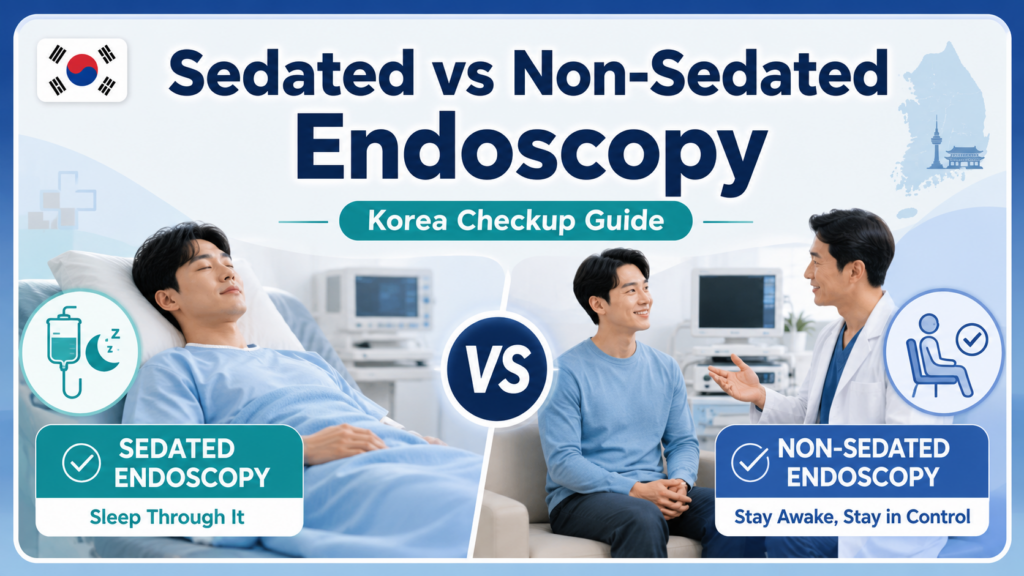
If you book a health checkup in Korea, you may quickly face one confusing question:
“Do you want sedated endoscopy or non-sedated endoscopy?”
In Korean, people usually say:
- 수면내시경 = “sleep endoscopy,” usually meaning endoscopy with sedation
- 비수면내시경 = endoscopy without sedation
For many foreigners, the phrase “sleep endoscopy” sounds like full general anesthesia. In most routine Korean health checkups, however, it usually means sedation — medication given through an IV to make you relaxed, sleepy, and less aware of the procedure.
The endoscope itself is the same camera system. The difference is not the camera. The difference is how your body and brain experience the test.
From an engineering point of view:
Sedation does not change the inspection tool. It changes the operating condition of the user.
Quick Answer: Which One Should You Choose?
For many people, the practical answer is this:
Choose sedated endoscopy if you are very anxious, have a strong gag reflex, are doing both gastroscopy and colonoscopy, or want the procedure to feel easier.
Choose non-sedated endoscopy if you want faster recovery, need to return to normal activities sooner, want to avoid sedation-related restrictions, or cannot arrange someone to accompany you afterward.
But this is not only a comfort decision. It also depends on your age, medical history, medication, pregnancy possibility, sleep apnea, heart or lung condition, and the policy of the hospital or checkup center.
What Is Endoscopy?
Endoscopy is a medical test that uses a thin flexible tube with a camera to look inside the body.
In Korean health checkups, the two most common types are:
1. Gastroscopy
Gastroscopy, also called upper endoscopy or EGD, checks the esophagus, stomach, and the first part of the small intestine.
In Korea, gastroscopy is commonly connected to stomach cancer screening, gastritis, ulcers, reflux, and other upper digestive problems.
2. Colonoscopy
Colonoscopy checks the large intestine, or colon.
It can detect inflammation, bleeding, polyps, and signs of colorectal cancer. If a polyp is found, the doctor may remove it during the procedure depending on your consent, the hospital policy, and your medical condition.
In Korea’s National Cancer Screening Program, stomach cancer screening is generally for men and women aged 40 or older, while colorectal cancer screening is for men and women aged 50 or older. The official basic method for stomach cancer screening is gastroscopy every two years. For colorectal cancer screening, the basic test is an annual fecal occult blood test, followed by colonoscopy if blood is detected.
Korea-Specific Point: National Screening vs Private Checkup Packages
This part often confuses foreigners.
In Korea, there are two common routes.
1. National Health Screening and National Cancer Screening
This is the government-supported screening system connected to the National Health Insurance Service, or NHIS.
If you are a foreigner enrolled in Korean National Health Insurance, NHIS explains that foreigners generally receive the same National Health Insurance coverage as Korean citizens. NHIS also provides multilingual health checkup forms.
For cancer screening, NHIS explains that:
- stomach cancer and breast cancer screening are for people aged 40 or older, once every two years
- colorectal cancer screening is for people aged 50 or older, once every year
- general health checkups are fully covered by NHIS
- cancer checkups are usually shared by NHIS and the examinee, though colorectal and cervical cancer screening are fully covered in the NHIS English guide
However, this does not mean every optional item is free.
The National Cancer Information Center states that for stomach cancer screening, extra costs such as sedated endoscopy or Helicobacter pylori testing are paid by the examinee. For colorectal screening, extra costs such as sedation or polyp removal may also be paid by the examinee.
Pro-Tip for 2026: Check the Odd/Even Birth Year System
Korean national health screening commonly follows an odd/even birth year system for two-year-cycle checkups.
In simple terms:
- If the year is odd, people born in odd-numbered years are usually selected.
- If the year is even, people born in even-numbered years are usually selected.
Since 2026 is an even-numbered year, many people whose birth year ends in an even number — for example, 1976, 1986, 1992, 2000 — may be selected for this year’s two-year-cycle health screening.
NHIS also explains this odd/even rule in its health screening guide: if the last digit of your birth year is even, you receive screening in even-numbered years; if it is odd, you receive screening in odd-numbered years.
But do not rely only on the calendar rule. Your exact eligibility can differ depending on your insurance type, workplace status, previous missed checkups, age, and cancer screening category.
The safest method is to check:
NHIS website or The건강보험 app → Health checkup eligibility inquiry
2. Private Health Checkup Center Packages
Many foreigners use private checkup centers, university hospital checkup centers, or international clinics.
These packages may include:
- gastroscopy
- colonoscopy
- abdominal ultrasound
- chest X-ray
- CT scan
- blood tests
- urine test
- thyroid ultrasound
- cancer markers
- English result consultation
In private packages, colonoscopy may be offered directly as an optional screening test, even if it is not the first step in the national colorectal cancer screening program.
Prices, sedation fees, biopsy fees, polyp removal fees, English support, and result consultation style vary widely by center.
So before booking, ask:
“Is sedation included, or is it an extra fee?”
What Is Sedated Endoscopy?
Sedated endoscopy means you receive medication to reduce anxiety, discomfort, and memory of the procedure.
The Korean Society of Gastrointestinal Endoscopy explains that appropriate sedation should make the patient feel comfortable while maintaining airway reflexes and stable spontaneous breathing. It also notes that sedation can reduce anxiety and fear, but careful screening and monitoring are important because cardiopulmonary complications can occur.
In simple terms:
Sedation lowers the discomfort signal.
The camera still enters the same route. The doctor still performs the same inspection. But your brain may register much less discomfort.
What Is Non-Sedated Endoscopy?
Non-sedated endoscopy means the procedure is done without IV sedative medication.
For gastroscopy, the center may use a local throat spray to reduce gagging. You remain awake and usually recover faster.
For colonoscopy, non-sedated colonoscopy is possible, but it can be more uncomfortable because the scope moves through the colon and air or gas may be used to expand the bowel.
In simple terms:
Non-sedated endoscopy keeps the system fully online.
You may feel more discomfort during the test, but recovery is usually simpler because there is no sedative effect to wear off.
Sedated vs Non-Sedated Endoscopy: Main Differences
| Category | Sedated Endoscopy | Non-Sedated Endoscopy |
|---|---|---|
| Korean term | 수면내시경 | 비수면내시경 |
| Comfort during procedure | Usually easier | More discomfort possible |
| Memory of procedure | Often little or no memory | You remember the procedure |
| Recovery time | Longer | Usually shorter |
| Driving afterward | Not allowed | Usually easier, if no sedative is used |
| Guardian | Often required or recommended | Usually less likely |
| Cost | Often extra fee | Usually cheaper |
| Medical risk | Sedation-related risks exist | Avoids sedation-related risks |
| Best for | Anxiety, strong gag reflex, colonoscopy, combined tests | Fast recovery, simple gastroscopy, avoiding sedation |
Why Many Koreans Choose Sedated Endoscopy
Korea has a strong health checkup culture. Many office workers, parents, and retirees get regular checkups.
Because gastroscopy is common, many people have experienced the discomfort of a non-sedated upper endoscopy.
The biggest reasons people choose sedation are:
- strong gag reflex
- fear of the tube entering the throat
- previous bad experience
- desire to complete gastroscopy and colonoscopy together
- preference for a smoother checkup day
This is especially common for colonoscopy. Since colonoscopy can take longer and may involve loops, pressure, or polyp removal, many people prefer sedation.
Why Some People Choose Non-Sedated Endoscopy
Non-sedated endoscopy also has clear advantages.
You may prefer it if:
- you need to return to work or normal activities sooner
- you came alone and cannot arrange a guardian
- you do not want sedative medication
- you have medical conditions that make sedation less ideal
- you want to reduce extra costs
- you are doing a short gastroscopy and can tolerate discomfort
For a simple gastroscopy, some people describe the procedure as unpleasant but manageable. The difficult part is usually gagging, not pain.
Important: Sedation Means You Should Not Drive
This is one of the most important practical rules.
Many Korean checkup centers clearly state that patients should not drive after sedated endoscopy. Korea Medical Foundation says patients who receive conscious sedation endoscopy are strictly prohibited from driving on the day and should use public transportation.
International guidance is similar. NHS patient guidance says sedation can affect judgment and daily activities, and many hospitals advise avoiding driving, alcohol, work, machinery, and important decisions for 24 hours after sedation.
So if you choose sedated endoscopy in Korea, plan your day like this:
- Do not drive yourself.
- Do not ride an e-scooter or bicycle afterward.
- Avoid alcohol.
- Avoid important contracts or financial decisions.
- Do not schedule intense work immediately after the checkup.
- Arrange a guardian, taxi, subway, or public transportation.
- Ask the center whether a guardian is required.
This is not just a hospital rule. It is a reaction-time and decision-quality issue.
Your body may feel awake, but the system is not fully back to normal yet.
Safety: Who Should Be Extra Careful With Sedation?
Sedation is commonly used, but it is still medication that can affect breathing, alertness, blood pressure, and reflexes.
Tell the checkup center in advance if you have:
- sleep apnea
- severe snoring with breathing pauses
- heart disease
- lung disease, asthma, or COPD
- liver or kidney disease
- previous reaction to anesthesia or sedatives
- pregnancy or possible pregnancy
- breastfeeding
- older age or frailty
- heavy alcohol use
- allergy history
- current use of sleeping pills, psychiatric medication, opioids, or sedatives
Mayo Clinic explains that upper endoscopy is generally low risk, but possible complications include reaction to sedation or anesthesia, bleeding, infection, and tearing of the gastrointestinal tract. The risk may increase when additional procedures are performed.
Medication Checklist Before Endoscopy in Korea
Before your checkup, prepare a list of your medications in English and, if possible, Korean.
Pay special attention to:
- blood thinners
- aspirin
- antiplatelet drugs
- warfarin
- diabetes medication
- insulin
- blood pressure medication
- seizure medication
- sleeping pills
- psychiatric medication
- supplements that may affect bleeding
Some Korean checkup centers advise patients taking anticoagulants, aspirin, or similar medicines to consult the prescribing doctor before colonoscopy because biopsy or polyp removal may increase bleeding risk. KOMEF also gives specific instructions for diabetes medication, blood pressure medication, and anticoagulants before checkups.
Do not stop important medication by yourself.
Ask the doctor or checkup center first.
Preparation: Gastroscopy vs Colonoscopy
Gastroscopy Preparation
Usually, you need to fast before the test.
Many Korean centers ask patients not to eat after the night before the checkup. Some also restrict water, gum, cigarettes, and candy after midnight or on the morning of the test.
Korea Medical Foundation, for example, advises fasting after midnight, including water, gum, cigarettes, and similar items, while allowing certain medications under instructions.
The details may differ by hospital, so always follow your own center’s instruction sheet.
Colonoscopy Preparation
Colonoscopy preparation is more demanding.
You usually need:
- low-residue diet for several days
- avoidance of seeds, seaweed, mixed grains, and high-fiber foods
- bowel cleansing medication
- frequent bathroom access
- careful hydration
- timing according to morning or afternoon appointment
This preparation matters because the doctor cannot see the colon clearly if stool remains inside. Korean checkup centers often emphasize that bowel cleansing is essential for accurate colonoscopy.
From an engineering perspective:
Colonoscopy is like putting a camera inside a pipe. If the pipe is not clean, the camera quality does not matter.
Actionable Tip: Ask About Pill-Form Bowel Prep
Many foreigners struggle with the large volume of salty bowel cleansing solution before colonoscopy.
In Korea, some hospitals and checkup centers offer a pill-form bowel preparation option, often known by product names such as Orapang / Orafang / 오라팡.
This does not mean you can avoid drinking water. You still need to drink a significant amount of water according to the schedule. But instead of drinking a large amount of unpleasant solution, you may be able to swallow tablets with water.
For example, Inje University Sanggye Paik Hospital’s English colonoscopy guide explains an Orapang tablet method using 28 tablets in total, taken in divided doses with water.
This can be a very practical option if the taste of liquid bowel prep is your biggest fear.
When booking, ask:
“Do you offer pill-form bowel prep for colonoscopy?”
“Is Orapang or another tablet bowel prep available?”
“Is it an extra out-of-pocket fee?”
“Is it safe for me based on my kidney function and medication?”
Important: pill-form bowel prep is not suitable for everyone. People with kidney disease, heart disease, electrolyte problems, older age, or certain medications should ask the doctor first.
Also, availability and price vary by center, so do not assume it is automatically included.
Which Is Better for Gastroscopy?
For gastroscopy, both options are common.
Sedated Gastroscopy May Be Better If:
- You have a strong gag reflex.
- You are very anxious about the tube entering your throat.
- You had a bad past experience.
- You want a smoother checkup day.
- You are also doing colonoscopy on the same day.
Non-Sedated Gastroscopy May Be Better If:
- You can tolerate short discomfort.
- You want to leave the center quickly.
- You need to avoid sedation.
- You came alone.
- You want to reduce extra cost.
- You do not want post-sedation restrictions.
Gastroscopy itself is usually short, but the sensation can be intense. If you are highly sensitive to gagging, sedation can make a big difference.
Which Is Better for Colonoscopy?
For colonoscopy, sedation is more commonly preferred because the test can be longer and more uncomfortable.
Sedated Colonoscopy May Be Better If:
- You are anxious about pain.
- You are doing your first colonoscopy.
- You expect possible polyp removal.
- You had abdominal surgery before.
- You had a painful colonoscopy before.
- You want to complete the test with less discomfort.
Non-Sedated Colonoscopy May Be Better If:
- You want to avoid sedation.
- You cannot arrange a guardian.
- You have a sedation-related medical concern.
- You want faster recovery.
- The doctor thinks it is suitable for you.
The final decision should be made with the medical team, especially if you have medical risk factors.
Cost: Is Sedated Endoscopy More Expensive in Korea?
Usually, yes.
Sedation is often charged separately, especially in national screening or basic checkup packages.
The National Cancer Information Center states that additional costs such as sedated endoscopy are paid by the examinee for stomach cancer screening. For colorectal cancer screening, additional costs such as sedation or polyp removal may also be charged separately.
Because fees vary by center, do not rely on one fixed price from a blog post.
Ask before booking:
“Is sedation included in the package price?”
“If biopsy is needed, is it included?”
“If a polyp is removed during colonoscopy, how much is the additional cost?”
“Is pill-form bowel prep available, and is it an extra fee?”
“Can I pay by foreign credit card?”
Useful English Phrases to Ask a Korean Checkup Center
You can copy and use these when booking:
“Do you offer sedated gastroscopy?”
“Do you offer non-sedated gastroscopy?”
“Is the sedation fee included in the package?”
“Do I need a guardian after sedated endoscopy?”
“Can I take public transportation after the procedure?”
“How long should I avoid driving after sedation?”
“If a biopsy is needed, is it included?”
“If you find a polyp during colonoscopy, can you remove it on the same day?”
“Do you offer pill-form bowel prep for colonoscopy?”
“Can I receive the results in English?”
“Do you have an English-speaking coordinator?”
Common Misunderstanding: “Sleep Endoscopy” Does Not Always Mean Deep Sleep
The Korean phrase 수면내시경 can be misleading.
It sounds like you will be completely asleep. But in many routine cases, it means conscious or moderate sedation, not full general anesthesia.
You may not remember the test clearly. You may feel like you slept. But medically, the goal is often to make you comfortable while maintaining breathing and protective reflexes.
The exact level depends on the medication, dose, patient condition, and center protocol.
So when a Korean checkup center says “sleep endoscopy,” understand it as:
“Endoscopy with sedation,” not necessarily “full anesthesia.”
Suggested Image Placement and Alt Text
Suggested Image 1: Near the Introduction
Image idea: A calm Korean health checkup center reception desk or endoscopy waiting area.
Alt text: Korean health checkup center for gastroscopy and colonoscopy
Suggested Image 2: Near the Comparison Table
Image idea: Simple illustration comparing sedated and non-sedated endoscopy.
Alt text: sedated vs non-sedated endoscopy in Korea
Suggested Image 3: Near the Colonoscopy Preparation Section
Image idea: Colonoscopy preparation checklist with water bottle, instruction sheet, and calendar.
Alt text: colonoscopy preparation in Korea with bowel prep instructions
Suggested Image 4: Near the National Screening Section
Image idea: Korean National Health Insurance health checkup document or calendar reminder.
Alt text: Korea national health screening odd even birth year system
My Logical Recommendation
For most foreigners doing a Korean health checkup for the first time:
If you are doing only gastroscopy and you are not very anxious, non-sedated gastroscopy can be a reasonable option.
If you are doing colonoscopy, or gastroscopy and colonoscopy together, sedated endoscopy is often more comfortable and easier to complete.
If you choose sedation, treat the rest of the day as a recovery day.
Do not schedule a business meeting, long-distance travel, rental car driving, contract signing, or childcare-heavy plan right after sedated endoscopy.
The procedure may be finished in minutes, but your decision-making system may need more time to reboot.
FAQ
Is sedated endoscopy in Korea safe?
It is commonly performed, but no sedation is risk-free. Korean endoscopic sedation guidelines emphasize screening high-risk patients and careful monitoring because cardiopulmonary complications can occur, although most are temporary.
Can I drive after sedated endoscopy in Korea?
No. You should not drive after sedated endoscopy. Korean checkup centers commonly prohibit driving on the day of sedated endoscopy, and international guidance often recommends avoiding driving for 24 hours after sedation.
Can I take the subway or taxi after sedated endoscopy?
Usually, public transportation or taxi is recommended instead of driving. However, some centers require or strongly recommend a guardian. Ask your center before the appointment.
Is non-sedated gastroscopy painful?
It is usually not sharp pain, but it can be very uncomfortable because of gagging, throat pressure, bloating, and the feeling of the tube. The procedure is usually short.
Is colonoscopy harder than gastroscopy?
For many people, yes. Colonoscopy usually requires bowel preparation and may cause more abdominal pressure or discomfort. That is why sedation is commonly preferred for colonoscopy.
Is sedation included in Korea’s national cancer screening?
Not always. Official information states that additional costs such as sedated endoscopy are generally paid by the examinee. Always confirm with the hospital or checkup center before booking.
What is the difference between gastroscopy and colonoscopy?
Gastroscopy checks the upper digestive tract: esophagus, stomach, and duodenum. Colonoscopy checks the large intestine. In Korea, gastroscopy is commonly connected to stomach cancer screening, while colorectal screening usually starts with a stool blood test in the national program.
Can foreigners get endoscopy in Korea?
Yes. Many hospitals and private checkup centers offer endoscopy to foreigners. If you are enrolled in Korean National Health Insurance, NHIS says foreigners generally receive the same coverage as Korean citizens. Larger hospitals and international checkup centers may provide English support, but the level of interpretation and English documentation varies.
Who is eligible for Korean national screening in 2026?
For many two-year-cycle health screenings, 2026 is an even-numbered year, so people born in even-numbered years are usually selected. However, exact eligibility depends on age, insurance type, workplace status, previous missed checkups, and screening category. Check the NHIS website or The건강보험 app for your exact eligibility.
Can I choose pill-form bowel prep in Korea?
Sometimes, yes. Some Korean hospitals offer pill-form bowel prep such as Orapang / Orafang / 오라팡. But it may cost extra, may not be available everywhere, and may not be suitable for everyone. You still need to drink enough water according to the instructions.
Should I choose sedation if I have sleep apnea?
Do not decide alone. Sleep apnea can affect sedation risk. Tell the checkup center in advance and follow medical advice.
Can I work after sedated endoscopy?
It is better not to plan important work after sedated endoscopy. Sedatives can affect memory, judgment, and reaction time even if you feel awake. Many medical instructions recommend avoiding work, driving, machinery, alcohol, and important decisions for 24 hours after sedation.
Disclaimer
This article is for general educational purposes only and is not medical advice. Endoscopy choice depends on your medical history, current medications, pregnancy possibility, symptoms, age, and the policy of the hospital or health checkup center. Korean National Health Insurance and national screening rules may also vary depending on insurance status, age, work category, and previous screening history. Always follow the instructions of your doctor, hospital, or health checkup center in Korea.