
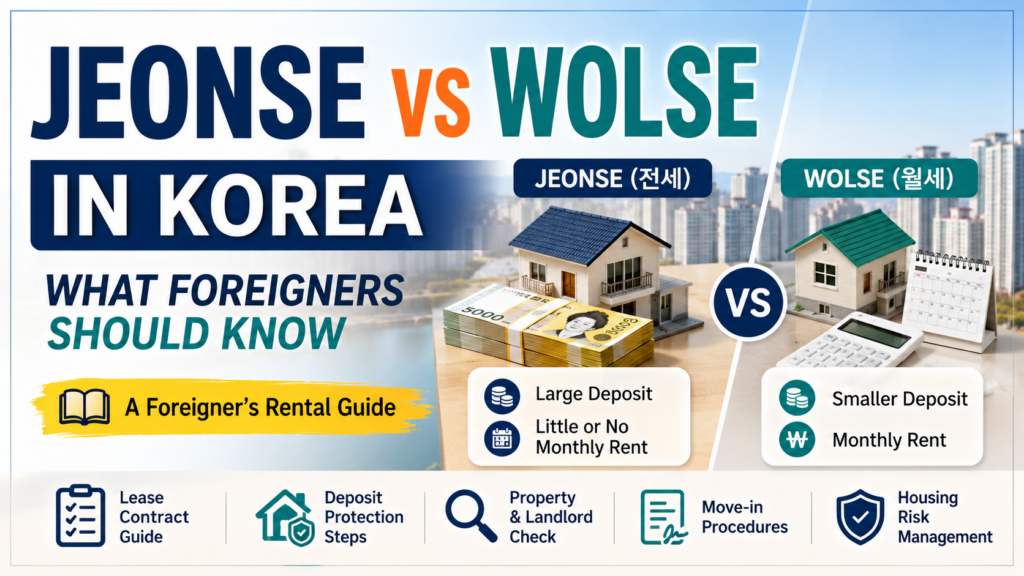
Renting a home in Korea can feel unfamiliar even if you have rented property in another country.
The main reason is jeonse, a Korean rental arrangement in which the tenant pays the landlord a very large refundable deposit instead of ordinary monthly rent.
Korea also has wolse, which is closer to the monthly rental system used in many other countries. However, Korean wolse contracts usually require both a deposit and monthly rent.
A third option, banjeonse, combines elements of both systems.
In simple terms:
- Jeonse: Large deposit, usually no monthly rent
- Wolse: Smaller deposit plus monthly rent
- Banjeonse: Medium or large deposit plus reduced monthly rent
The payment structure is only the first difference.
Foreign tenants also need to understand property records, landlord debt, deposit protection, lease reporting, address registration, fixed dates, and deposit return guarantees.
This guide explains the Korean rental system step by step.
Quick Answer: What Is the Difference Between Jeonse and Wolse?
| Category | Jeonse | Wolse |
|---|---|---|
| Korean term | 전세 | 월세 |
| Upfront deposit | Very large | Usually smaller |
| Monthly rent | Usually none | Paid every month |
| Deposit returned | Normally returned when the lease ends | Normally returned when the lease ends |
| Main financial burden | Upfront capital or loan interest | Monthly cash flow |
| Main risk | Failure to recover a large deposit | Deposit loss and continuing rent payments |
| Common use | Longer stays and tenants with sufficient funds | Shorter stays and tenants who need flexibility |
Neither system is automatically better.
The right choice depends on:
- How long you expect to live in Korea
- How much cash you can safely lock into a deposit
- Whether you need a loan
- The property’s debt and market value
- Whether deposit protection is available
- How certain your employment and visa plans are
Essential Korean Rental Vocabulary
Before comparing the systems, it helps to understand the words used in Korean property listings and lease contracts.
| Korean | Romanization | Meaning |
|---|---|---|
| 전세 | jeonse | Large-deposit lease with little or no monthly rent |
| 월세 | wolse | Monthly rent with a security deposit |
| 반전세 | banjeonse | Mixed system with a larger deposit and lower monthly rent |
| 보증금 | bojeunggeum | Refundable rental deposit |
| 월세 | wolse | Monthly rental payment |
| 임대인 | imdaein | Landlord |
| 임차인 | imchain | Tenant |
| 임대차계약서 | imdaechagyeyakseo | Lease contract |
| 계약금 | gyeyakgeum | Initial contract payment |
| 잔금 | jangeum | Remaining balance |
| 관리비 | gwanlibi | Management or maintenance fee |
| 확정일자 | hwakjeong-ilja | Official fixed date on a lease |
| 등기부등본 | deunggi-bu-deungbon | Real estate registry record |
| 건축물대장 | geonchungmul-daejang | Building register |
| 전입신고 | jeonip singo | Move-in registration for Korean residents |
| 체류지 변경신고 | cheryuji byeongyeong singo | Change-of-place-of-stay report for registered foreigners |
What Is Jeonse?
Jeonse, written as 전세, is a lease in which the tenant gives the landlord a large lump-sum deposit.
During the lease period, the tenant normally pays no monthly rent or only a very small amount. When the lease ends, the landlord is expected to return the deposit.
A simplified example might look like this:
Jeonse deposit: KRW 300 million
Monthly rent: KRW 0
Management fee and utilities: Paid separately
Actual deposits vary significantly according to:
- City and neighborhood
- Property type
- Size and age of the building
- Access to transportation
- Local sale prices
- Current rental-market conditions
Does Paying a Jeonse Deposit Mean You Own Part of the Home?
No.
The landlord remains the legal owner of the property. The tenant receives the right to occupy the home under the lease contract but does not acquire ownership.
The jeonse deposit is also not protected in the same way as money held in your own bank account.
The landlord receives and controls the money during the lease period. That is why the landlord’s ability to repay it matters.
Why Would a Landlord Accept Jeonse?
From the landlord’s perspective, a jeonse deposit functions like a large amount of interest-free financing.
The landlord may use the money to:
- Repay a mortgage
- Purchase another property
- Fund a business or investment
- Return the previous tenant’s deposit
- Cover other personal financial needs
This does not mean every landlord is financially irresponsible. However, it explains why a tenant cannot assume that the full deposit is being held safely and separately.
The Most Important Jeonse Question
The most important question is not:
“Can I afford the deposit today?”
It is:
“How likely am I to recover the full deposit at the end of the lease?”
That question should guide every property check, contract clause, and payment decision.
Jeonse Deposit vs Contract Deposit
The English word deposit can describe two different payments in Korea.
Jeonse Deposit or Security Deposit
This is the total refundable amount written in the lease.
For example:
Total jeonse deposit: KRW 300 million
Contract Deposit
The contract deposit, called 계약금 in Korean, is the initial amount paid when the contract is signed.
A typical payment schedule may be:
- Pay the contract deposit when signing.
- Pay an intermediate amount if the contract requires one.
- Pay the remaining balance on the move-in date.
- Receive possession and the keys.
The contract deposit is often around 10% of the total deposit, but this is a common market practice rather than an automatic legal rule.
The contract must clearly explain:
- How much is paid at each stage
- When each payment is due
- What happens if the tenant cancels
- What happens if the landlord cancels
- When previously paid money must be returned
Do not send an informal “reservation deposit” before confirming the property owner and cancellation conditions.
What Is Wolse?
Wolse, written as 월세, means monthly rent.
A typical wolse tenant pays:
- A refundable security deposit
- Monthly rent
- A management fee, when applicable
- Household utilities
For example:
Deposit: KRW 10 million
Monthly rent: KRW 800,000
Management fee: KRW 100,000
Electricity and gas: Paid separately
Unlike monthly rentals in some countries, the security deposit may be much larger than one or two months of rent.
Depending on the property, a wolse deposit may range from a few million won to tens or even hundreds of millions of won.
Is the Management Fee Included in Wolse?
Usually not.
The monthly rent advertised in a property listing may exclude:
- Building management fees
- Electricity
- Gas
- Water
- Heating
- Internet
- Parking
- Elevator or common-area expenses
A listing that appears inexpensive may become less attractive after these charges are added.
Ask the agent to explain the average monthly total, not only the advertised rent.
What Is Banjeonse?
Banjeonse, written as 반전세, is a mixed rental arrangement.
The tenant pays a larger deposit than in an ordinary wolse contract but still pays monthly rent.
For example:
Deposit: KRW 100 million
Monthly rent: KRW 500,000
There is no universal deposit-to-rent ratio that legally defines banjeonse. The term is generally used to describe a contract positioned between jeonse and wolse.
Can the Deposit and Monthly Rent Be Negotiated?
Sometimes.
A landlord may offer:
- A higher deposit with lower monthly rent
- A lower deposit with higher monthly rent
When comparing offers, calculate the actual financial value of the extra deposit.
For example, suppose a landlord asks for an additional KRW 50 million in exchange for reducing rent by KRW 200,000 per month.
The annual rent saving would be:
KRW 200,000 × 12 = KRW 2.4 million
The effective annual return on the additional deposit would be:
KRW 2.4 million ÷ KRW 50 million = 4.8%
You should then compare that figure with:
- Your loan interest rate
- The return you could earn by keeping the money elsewhere
- Currency conversion costs
- The additional deposit risk
- Your expected length of stay
How to Read Korean Rental Listing Numbers
Korean listings frequently shorten deposit and rent figures.
You may see:
1,000 / 80
This often means:
- Deposit: KRW 10 million
- Monthly rent: KRW 800,000
Another listing may show:
10,000 / 50
This often means:
- Deposit: KRW 100 million
- Monthly rent: KRW 500,000
The figures are commonly written in units of KRW 10,000.
However, formats can vary between websites and agents. Never transfer money based only on abbreviated listing numbers.
Ask for the full amounts in both words and numerals:
Deposit: KRW 100,000,000
Monthly rent: KRW 500,000
Is Jeonse Really Cheaper Than Wolse?
Jeonse can look free because there is no monthly rent.
It is not economically free.
The real cost of jeonse may include:
- Interest on a jeonse loan
- Lost interest or investment return
- Deposit guarantee fees
- Currency conversion costs
- Brokerage fees
- Moving expenses
- Deposit recovery risk
Simple Jeonse Cost Formula
A basic estimate is:
Annual loan interest or lost investment return
- guarantee fees
- management fees
- transaction costs
Suppose you place KRW 300 million into a jeonse deposit.
If the money could otherwise earn 3% annually, the opportunity cost would be:
KRW 300 million × 3% = KRW 9 million per year
That is equivalent to:
KRW 750,000 per month
If the deposit is financed through a loan at 4%, annual interest would be:
KRW 300 million × 4% = KRW 12 million per year
That is equivalent to:
KRW 1 million per month
These are only calculation examples, not current market rates.
Simple Wolse Cost Formula
A basic wolse estimate is:
Annual monthly rent
- opportunity cost of the deposit
- management fees
- transaction costs
The correct comparison is not:
Jeonse rent: zero
Wolse rent: KRW 800,000
It is:
Total annual financial cost of jeonse
versus
total annual financial cost of wolse
What Does Housing Risk Mean?
Housing risk is the possibility that a tenant will lose money or legal protection because of the property, landlord, contract, or registration process.
Common risks include:
- The landlord cannot return the deposit
- The property has a large mortgage
- The landlord has unpaid taxes
- The person signing is not the registered owner
- The property is already subject to seizure
- The deposit is too high compared with the property’s value
- The building has unauthorized alterations
- The home enters foreclosure or auction
- The contract is not properly reported
- The tenant does not complete the required address procedures
- The property cannot qualify for a deposit return guarantee
These risks are most serious in jeonse because the deposit is large, but wolse tenants can also lose substantial deposits.
The Biggest Risk: The Landlord Cannot Return the Deposit
A landlord may fail to return a deposit because:
- The deposit was used for another investment
- The landlord relied on a new tenant’s deposit
- A replacement tenant cannot be found
- Property prices have fallen
- The landlord has too much debt
- The property enters foreclosure
- The landlord owns multiple highly leveraged properties
- The transaction involved fraud
A home can look modern and well maintained while having serious financial problems.
You must inspect both:
- The physical home
- The legal and financial records
Five Checks to Complete Before Signing
1. Check the Real Estate Registry
Ask for a current copy of the real estate registry, called 등기부등본.
It can show:
- The registered owner
- Mortgages
- Secured claims
- Seizures
- Provisional seizures
- Trust registrations
- Other registered rights
The registered owner’s name should match:
- The landlord’s identification
- The lease contract
- The bank account receiving the deposit
Do not rely only on a registry copy provided by the agent.
Obtain or review a newly issued copy and check it again immediately before paying the final balance.
A new mortgage or seizure can be registered between the contract date and the move-in date.
2. Check the Building Register
The building register, called 건축물대장, describes the building’s approved status and use.
Check whether:
- The address matches the lease
- The unit actually exists
- The registered use is residential
- The floor and unit information are correct
- The building has unauthorized additions
- The property has recorded violations
This is especially important for:
- Villas
- Multi-family houses
- Rooftop rooms
- Subdivided units
- Converted commercial spaces
- Residential officetels
A physically separate room is not necessarily a legally separate registered home.
3. Compare the Deposit With the Property Value
Check:
- Recent sale transactions
- Recent jeonse transactions
- Similar local properties
- Existing mortgage debt
- Other tenants’ deposits when relevant
A high deposit compared with the realistic sale value increases risk.
A useful concept is:
Property value
minus senior debts and claims
equals the amount potentially available to repay junior claimants
This is a simplified model. Actual auction distributions can be more complicated and may include taxes, expenses, and claims with different priorities.
Be particularly cautious when:
- A new villa has little reliable transaction data
- The agent relies on an optimistic appraisal
- The jeonse deposit is close to the advertised sale price
- The owner purchased the property using the incoming deposit
- Several homes in the building have similar high deposits
4. Check the Landlord Through HUG’s Ansim Jeonse Services
HUG, the Korea Housing and Urban Guarantee Corporation, operates the Ansim Jeonse Portal and Ansim Jeonse App.
These services may provide information related to:
- Property market values
- Jeonse safety checks
- Deposit guarantee eligibility
- Landlord guarantee history
- Repeated deposit non-return cases
- Other warning indicators
Since June 23, 2025, prospective jeonse tenants have been able to check certain HUG-held landlord information before signing without first receiving the landlord’s consent, subject to identity verification and service rules. Some information, including particular tax or credit records, may still require the landlord’s consent or cooperation.
To access the service, start from the official HUG website and look for Ansim Jeonse Portal or Ansim Jeonse App. The website and app interface may change, so using the official HUG entry point is safer than relying on an old third-party link.
A clean search result does not prove that the landlord is financially safe. It is one part of a larger review.
5. Check Deposit Return Guarantee Eligibility
A jeonse deposit return guarantee may cover an eligible tenant when the landlord fails to return the deposit after the lease ends.
Available products and eligibility rules may depend on:
- Property type
- Deposit amount
- Property valuation
- Existing mortgage debt
- Contract duration
- Registration status
- Application timing
- Landlord history
- Tenant documentation
- Immigration or identity-verification requirements
HUG specifically recommends looking for homes that can qualify for a jeonse deposit return guarantee.
Do not rely on an agent saying:
“This home should be insurable.”
Ask the guarantee provider directly or request a preliminary eligibility review when available.
A useful special clause may allow cancellation and refund if the property fails the agreed guarantee review. The wording should be reviewed carefully because the legal result depends on the clause and the reason for rejection.
Risk Levels by Property Type
The legal form of the property can affect how easily its value and debt can be evaluated.
Apartment
Apartments often have:
- More transaction data
- Clearer unit registration
- Easier price comparison
- Standardized layouts
This does not make every apartment safe. Mortgages, seizures, tax debt, and overpriced deposits remain possible.
Villa or Multi-Family Building
The word villa in Korea commonly refers to a low-rise multi-unit building, not a luxury detached home.
Risks may include:
- Limited transaction data
- Optimistic appraisals
- Small differences between sale price and deposit
- Complex ownership
- Illegal extensions
- Difficulty estimating auction value
Daga-gu House
A daga-gu, or 다가구주택, is generally owned as one property even though several households live inside it.
This can make risk analysis difficult because:
- Multiple tenants may have deposits
- Their priority order matters
- The building may not have separate ownership registration for each unit
- The owner’s total deposit obligations may be unclear
Ask for professional assistance before placing a large deposit in a multi-tenant building.
Officetel
An officetel can be used as an office, a residence, or both depending on the building and unit.
Check:
- The registered use
- Whether residential protection applies to your actual use
- Management fees
- Tax and utility treatment
- Address registration eligibility
- Guarantee eligibility
Officetels often have higher management fees than similarly sized apartments.
What Must Be Written in the Lease Contract?
A Korean lease contract should clearly identify:
- The landlord
- The tenant
- The property
- The deposit
- The monthly rent
- The payment schedule
- The lease period
- Each party’s responsibilities
Check the following items carefully:
- Full legal name of the landlord
- Full legal name of the tenant
- Identification details
- Exact registered property address
- Unit number
- Total deposit
- Contract deposit
- Intermediate payments
- Final balance
- Monthly rent
- Rent payment date
- Management fee
- Items included in the management fee
- Utilities paid separately
- Lease start date
- Lease end date
- Move-in date
- Repair responsibilities
- Existing property damage
- Parking rights
- Pet rules
- Smoking rules
- Subleasing restrictions
- Early termination conditions
- Deposit return date
- Brokerage fee
- Special contract clauses
The Ministry of Justice provides a standard residential lease contract that highlights pre-contract checks, deposit protection, and landlord–tenant responsibilities.
Foreign-Language Standard Lease Contracts
In March 2026, the Ministry of Justice released translated versions of the Korean standard residential lease contract in:
- English
- Chinese
- Vietnamese
These translations can help foreign tenants understand the standard form and major legal notices.
However, the signed Korean contract and its specific clauses remain critically important.
A translated standard form may not include:
- Additional handwritten clauses
- Changes made by the landlord
- Special conditions added by the agent
- Separate agreements concerning repairs or cancellation
Compare the translation with the exact Korean document you are asked to sign.
Do Not Sign Because Someone Says It Is “Standard”
Many Korean leases are based on common templates.
That does not make every contract identical or safe.
Pay particular attention to the special clauses, called 특약사항.
They can affect:
- Repairs
- Cleaning charges
- Restoration duties
- Early termination
- Brokerage fees
- Mortgage removal
- Guarantee enrollment
- Deposit repayment
- Responsibility for defects
When the deposit is large, professional translation or legal review may be worth the cost.
Special Clauses to Discuss
Depending on the property, payment schedule, and existing debt, ask a qualified professional whether the contract should address:
- No new mortgage or security right before tenant protection takes effect
- Removal of an existing mortgage before or at final payment
- Cancellation if ownership information is false
- Cancellation if deposit guarantee enrollment is rejected
- Return of all payments after a qualifying cancellation
- The landlord’s cooperation with guarantee applications
- Disclosure of tax arrears
- Disclosure of existing tenant deposits
- Responsibility for unauthorized building alterations
- Repair of major defects before move-in
- A specific deposit return date
- Compensation for delayed move-in
- Items included in management fees
One important timing issue is that legal protection against third parties may not begin at the exact moment you receive the keys. HUG explains that possession and the required registration create opposability from the following day under the relevant housing lease rules.
This is why a clause restricting new mortgages around the move-in date may be important.
Do not copy legal clauses from a random blog without checking whether they fit your transaction.
Should You Use a Licensed Real Estate Agent?
Most Korean rental transactions are arranged through a licensed real estate office.
A licensed agent, called 공인중개사, can help with:
- Finding properties
- Communicating with the landlord
- Reviewing basic records
- Preparing the lease
- Explaining payments
- Coordinating the move-in date
- Filing certain reports
However, using an agent does not eliminate housing risk.
Confirm:
- The office is registered
- The person handling the transaction is licensed or properly employed
- The office details match official records
- You receive a written property explanation
- The brokerage fee is explained
- You receive a receipt
Do not assume the agent will personally reimburse you if the landlord cannot return the deposit.
Brokerage Fees
Korean brokerage fees are generally subject to legal maximum rates.
The applicable ceiling can depend on:
- Transaction type
- Deposit
- Monthly rent
- Property type
- Local regulations
For wolse contracts, the deposit and rent may be converted into a calculated transaction value for fee purposes.
Ask for:
- The calculated transaction amount
- The applicable maximum rate
- The agreed brokerage fee
- Whether value-added tax is separate
- A written receipt
Agree on the fee before signing, not after moving in.
Verify the Bank Account Before Sending Money
The safest arrangement is normally to transfer the deposit to an account held by the registered property owner.
Stop and verify the transaction if:
- The bank account belongs to a relative
- An agent asks you to pay the agency
- The landlord is overseas
- A representative signs the contract
- A company owns the property
- The payment instructions change suddenly
- You are asked to use cash
- You are pressured to transfer immediately
When a representative acts for the owner, check:
- The owner’s identification
- The representative’s identification
- The power of attorney
- The owner’s seal certificate or supporting authorization
- Direct confirmation from the owner
- Written payment instructions
Keep all bank records and messages.
What Foreign Tenants Should Do After Moving In
Signing the lease is not the final protection step.
A tenant’s legal position may depend on completing several procedures correctly and promptly.
Step 1: Take Actual Possession
You should actually receive and occupy the home.
Keep evidence such as:
- Key handover records
- Move-in photos
- Moving-company receipts
- Utility applications
- Written confirmation from the landlord
Actual possession works together with the required registration procedures.
Step 2: Report Your New Place of Stay
A registered foreigner who changes residence must generally report the new place of stay within 15 days of moving in.
The report may be made through the competent:
- City, county, or district office
- Eup, myeon, or dong office
- Immigration office
The required identification and supporting documents should be confirmed in advance.
For Korean citizens, the corresponding process is commonly called jeonip singo, or move-in registration.
For registered foreign residents, the relevant procedure is normally the change-of-place-of-stay report.
Korean legal guidance and court decisions recognize a properly completed foreign registration or change-of-place-of-stay report as having an effect equivalent to resident registration for residential lease protection.
The exact name and process may differ for registered foreigners, overseas Koreans, and people with other residence documents.
Step 3: Obtain a Fixed Date
A fixed date, called 확정일자, provides official evidence of the date on which the lease document existed.
When combined with the required legal conditions, it can help establish priority for deposit repayment if the property enters auction or foreclosure.
A fixed date is not the same as:
- Signing the lease
- Reporting your new address
- Receiving the keys
- Filing a rental contract report
- Purchasing a deposit return guarantee
These procedures are related but serve different functions.
Step 4: File the Residential Lease Report When Required
For homes and locations covered by Korea’s residential lease reporting system, a report is generally required when:
- The deposit exceeds KRW 60 million, or
- The monthly rent exceeds KRW 300,000
The report must generally be filed within 30 days of the contract date. Foreign landlords and tenants are also subject to the reporting obligation when the contract falls within the rules.
The report can generally be filed:
- At the local administrative office with jurisdiction over the property
- Through the Ministry of Land’s Real Estate Transaction Management System
Although the parties are formally joint reporting parties, one party can often complete the report by submitting the signed contract and required documents.
When a copy of the lease contract is submitted with the residential lease report, a fixed date is generally deemed to have been granted under the reporting system.
Do not assume the agent or landlord has filed it.
Ask for the official filing confirmation.
Late or false reporting may result in an administrative fine. The previous grace period ended on May 31, 2025, so tenants signing contracts in 2026 should not treat the system as optional.
Step 5: Apply for Deposit Protection Promptly
A deposit return guarantee has:
- Application deadlines
- Document requirements
- Property-value requirements
- Debt limits
- Contract requirements
Do not wait until the lease is almost over.
Check eligibility before signing and complete the application as soon as the product allows.
A fixed date does not replace a return guarantee, and a return guarantee does not replace proper address and possession procedures.
Basic Residential Tenant Rights
Minimum Lease Period
If a residential lease has no stated term or states a term shorter than two years, it is generally treated as a two-year lease for tenant protection.
The tenant may still choose to rely on the shorter agreed period.
This does not mean every early move-out is automatically penalty-free. The contract and the tenant’s legal position still matter.
Contract Renewal Request
A qualifying residential tenant can generally exercise the statutory contract renewal request once.
The renewed term is treated as two years.
For most modern contracts, the request should be made between:
- Six months before expiration
- Two months before expiration
A landlord can reject the request only for legally recognized reasons, such as serious rent arrears, unauthorized subleasing, major damage, qualifying demolition, or genuine occupancy by the landlord or certain close family members.
Do not wait until the final month to request renewal.
Make the request in writing and keep evidence that the landlord received it.
Five Percent Increase Limit
For an increase claim during an existing lease or a statutory renewal, the increase is generally limited to 5% of the agreed rent or deposit. A local ordinance may set a lower ceiling.
The 5% figure is a maximum, not an automatic increase that the tenant must accept.
The legal treatment can be different when:
- The old contract has fully ended
- The parties voluntarily negotiate a new contract
- The deposit and rent are converted between jeonse and wolse
- The contract is not a statutory renewal
Obtain advice before assuming the 5% rule applies to every renegotiation.
Jeonse May Be Suitable When
Jeonse may be reasonable when:
- You plan to remain in Korea for several years
- You have sufficient capital
- You can obtain affordable financing
- The deposit is reasonable compared with the property value
- The property has limited senior debt
- The owner and registry information are clear
- The property qualifies for deposit protection
- You understand the move-in procedures
- The contract has been professionally reviewed
Jeonse should not be chosen only because the monthly payment looks low.
Wolse May Be Suitable When
Wolse may be more practical when:
- You recently arrived in Korea
- Your visa or employment plans may change
- You expect to move within one or two years
- You do not want to lock most of your savings into one property
- You cannot obtain a suitable jeonse loan
- You prefer predictable monthly costs
- The property’s value is difficult to verify
- You value flexibility
Wolse still carries deposit risk. The deposit, owner, registry, and contract must still be checked.
A Practical Starting Point for New Foreign Residents
For many first-time foreign residents, a moderate-deposit wolse contract is easier to understand and manage.
It allows time to:
- Learn the Korean housing system
- Establish banking and administrative records
- Compare neighborhoods
- Understand commuting conditions
- Confirm long-term visa and employment plans
- Avoid exposing a very large amount of capital immediately
This is not a universal rule.
A carefully checked and properly protected jeonse contract may be financially better than an expensive or poorly written wolse contract.
The system matters, but the individual property matters more.
Five-Stage Rental Safety Checklist
Stage 1: Before Searching
- Set your maximum deposit
- Set your maximum monthly rent
- Include management fees and utilities
- Estimate your expected stay
- Check loan availability
- Consider currency risk
- Decide how much money you can safely lock away
Stage 2: Before Signing
- Confirm the registered owner
- Check the latest real estate registry
- Check mortgages and seizures
- Check the building register
- Confirm the legal unit and address
- Compare recent market prices
- Estimate total senior debt
- Review HUG landlord information where available
- Check guarantee eligibility
- Verify the real estate office
- Read all special clauses
- Confirm the payment account
- Write every amount in full
- Keep a copy of every document
Stage 3: Before Final Payment
- Check the registry again
- Confirm promised mortgage removal
- Confirm the property is vacant
- Inspect the home
- Photograph existing damage
- Test major appliances and utilities
- Confirm the key handover
- Keep the transfer receipt
- Receive the landlord’s contact information
Stage 4: Immediately After Moving In
- Take actual possession
- Complete the change-of-place-of-stay report
- Obtain a fixed date
- File the residential lease report when required
- Apply for the deposit return guarantee
- Save proof of every procedure
- Register utilities and keep payment records
Stage 5: Before the Lease Ends
- Review the notice deadline
- Notify the landlord in writing
- State clearly whether you will renew or leave
- Confirm the exact deposit return date
- Ask whether a new tenant is required
- Keep all communications
- Seek help early if the landlord predicts a repayment delay
Do not surrender possession or remove your protected address registration while a large deposit remains unpaid without first obtaining appropriate legal advice.
Frequently Asked Questions
Can foreigners sign a jeonse contract?
Yes.
Foreigners can enter into jeonse and wolse contracts.
However, access to loans, guarantees, online systems, and identity-verification services may depend on:
- Visa or residence status
- Income
- Length of stay
- Korean credit history
- Required identification
- The property
- The financial institution
Is jeonse safe?
Jeonse is not automatically safe or unsafe.
Its safety depends on:
- Property value
- Existing debt
- Landlord finances
- Deposit amount
- Legal priority
- Contract quality
- Registration procedures
- Guarantee coverage
A properly reviewed apartment with a moderate deposit and guarantee coverage may be relatively well protected.
An overpriced villa with large debts and no guarantee eligibility may be extremely risky.
Is wolse safer than jeonse?
Wolse usually exposes less capital because the deposit is smaller.
However, a wolse tenant can still lose the deposit.
The same owner, registry, building, and contract checks remain necessary.
Does wolse always require a deposit?
Most Korean wolse contracts require a deposit.
The amount varies widely according to the property and the negotiated rent.
Is banjeonse legally different from wolse?
Banjeonse is primarily a market term describing a larger-deposit, lower-rent arrangement.
The actual legal rights depend on the written residential lease, not the label used in the advertisement.
Is management fee included in monthly rent?
Usually not.
Ask for:
- The fixed management fee
- Variable charges
- Included utilities
- Parking charges
- Internet fees
- Average summer and winter totals
Make sure the contract separately states management fees and their components.
Can I negotiate a lower monthly rent by increasing the deposit?
Sometimes.
Calculate the annual rent saving and compare it with:
- Loan interest
- Lost investment return
- Additional deposit risk
- Expected stay
A lower monthly payment is not necessarily a better deal.
Can I leave the lease early?
Early termination depends on:
- The contract
- The landlord’s agreement
- Whether a replacement tenant is found
- The reason for leaving
- Applicable law
A tenant leaving early may be asked to cover brokerage costs or continue paying rent until a replacement tenant begins a new lease.
Discuss this before signing.
Can the landlord deduct money from my deposit?
The landlord may claim legitimate amounts such as:
- Unpaid rent
- Unpaid utilities
- Contractually valid charges
- Damage beyond ordinary wear
Ordinary aging or normal use should not automatically justify major deductions.
Take dated photographs and videos at both move-in and move-out.
What if the landlord does not return my deposit?
Preserve:
- The signed lease
- Bank transfer records
- Address-registration evidence
- Fixed-date evidence
- Residential lease report
- Guarantee certificate
- Messages and notices
- Registry copies
Contact the guarantee provider immediately if the deposit is covered.
Depending on the situation, legal procedures may include:
- A leasehold registration order
- Payment demand
- Mediation
- A deposit return lawsuit
- Auction-related claims
The correct procedure depends on whether the lease has ended, whether you still possess the home, and whether foreclosure has begun.
Can I move out before receiving the deposit?
Doing so can affect your legal protection.
Do not give up possession, keys, or protected address status while a major deposit remains unpaid without receiving situation-specific legal advice.
Is a fixed date the same as deposit insurance?
No.
A fixed date helps establish repayment priority when combined with other legal requirements.
A deposit return guarantee is a separate financial protection product.
One does not replace the other.
Is the residential lease report the same as the address report?
No.
The residential lease report records contract information.
The change-of-place-of-stay report records where a registered foreigner lives.
They serve different purposes.
Does filing the residential lease report give me a fixed date?
When the signed lease contract is submitted as part of a qualifying residential lease report, a fixed date is generally deemed to have been granted.
Keep the filing confirmation and confirm that the contract was properly attached.
Do foreigners have the same deposit protection as Korean tenants?
Registered foreign tenants can receive protection when they satisfy the relevant requirements, including possession and the appropriate foreign registration or change-of-place-of-stay procedure.
Because the administrative documents differ from Korean resident registration, confirm your procedure with the local office or the Immigration Contact Center.
Where can I ask immigration-related questions?
The Immigration Contact Center can be reached at 1345 inside Korea.
Ask specifically about:
- Change-of-place-of-stay reporting
- Required documents
- Online eligibility
- Residence-card updates
- Reporting deadlines
Should I use HUG’s Ansim Jeonse App before signing?
Yes, when considering a jeonse property.
Use it as one risk-checking tool, not as a replacement for:
- Registry review
- Building-register review
- Market-price research
- Contract review
- Guarantee confirmation
Which is better for foreigners: jeonse or wolse?
Wolse is often easier for short-term residents and people who need flexibility.
Jeonse may be suitable for longer-term residents with enough capital, reliable financing, a carefully reviewed property, and strong deposit protection.
The better choice depends on the total financial cost and the probability of recovering your deposit.
Final Thoughts
Jeonse and wolse are not simply two different ways to pay rent.
They create different financial systems.
Jeonse exchanges monthly rent for deposit exposure.
Wolse reduces the upfront deposit but creates a continuing monthly expense.
Banjeonse moves between the two.
Before choosing, answer three questions:
- Can I afford the full cost of this payment structure?
- Is the property financially safe enough for this deposit?
- Have I completed every contract and registration step needed to protect myself?
A low monthly payment has little value if the deposit cannot be recovered.
Check the owner, registry, building status, market value, debt, contract terms, landlord information, reporting requirements, and guarantee eligibility before transferring money.
Disclaimer
This article provides general information about residential rental systems in South Korea and reflects official information reviewed in July 2026.
It is not legal, financial, immigration, tax, insurance, or real estate advice.
Housing laws, reporting requirements, guarantee products, administrative procedures, thresholds, and financial eligibility rules may change. They may also differ according to:
- Property type
- Location
- Contract date
- Deposit amount
- Visa or residence status
- Individual financial circumstances
Before signing a lease or transferring a significant deposit, confirm the current requirements with the relevant local administrative office, the Korea Immigration Service, HUG or another guarantee provider, a licensed Korean real estate agent, and a qualified legal professional when necessary.