
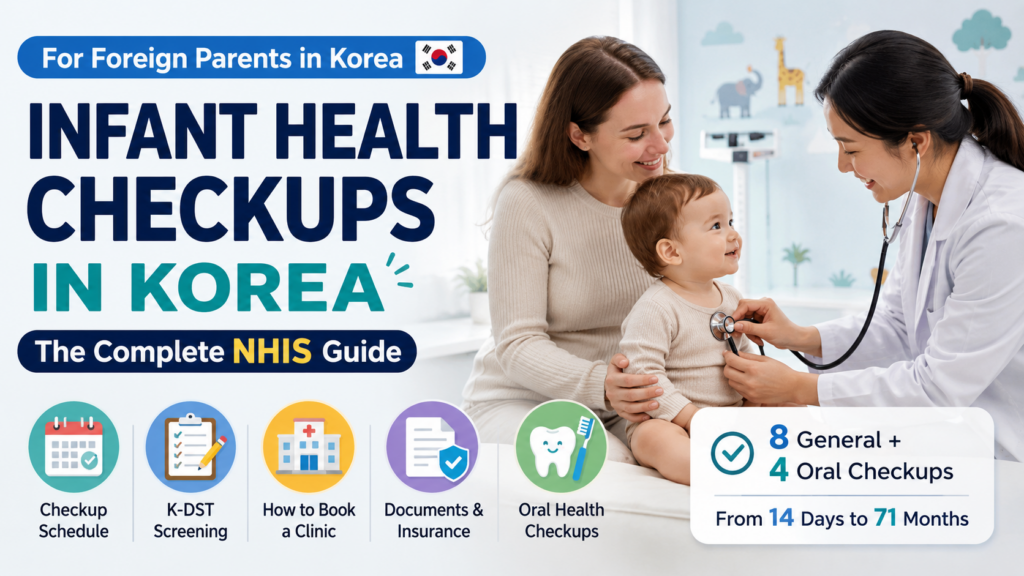
If you are raising a child in Korea, you may receive a notice about 영유아 건강검진, Korea’s national infant and child health screening program.
The Korean term 영유아 (yeongyua) covers more than newborn babies. In this program, it includes infants, toddlers, and preschool-aged children up to 71 months old.
The system can be summarized in one sentence:
Eligible children can receive eight general health checkups and four separate oral health checkups during specific age windows, usually without a patient copayment.
The examinations monitor growth, physical health, vision, hearing, development, nutrition, safety, dental health, and age-appropriate parenting concerns. They are preventive screenings, not appointments for diagnosing or treating an active illness. Korea’s Ministry of Health and Welfare currently lists eight general screening rounds from 14 days through 71 months and four oral health screening rounds. (보건복지부 대표홈페이지)
Last reviewed: July, 2026
Quick Answer for Foreign Parents
To use Korea’s infant health checkup system:
1. Check the child’s official NHIS screening window
↓
2. Find a designated infant screening clinic
↓
3. Call the clinic and make a reservation
↓
4. Complete the health questionnaire and K-DST, if required
Do not wait until the final days of the screening period. Participating clinics may limit the number of national checkups they perform each day, and a pediatric clinic that treats children is not automatically an NHIS-designated screening institution.
Key Terms You Should Know
Infant Health Checkup
An infant health checkup in this article means Korea’s national preventive screening program for babies and young children.
Its Korean name is:
영유아 건강검진
Yeongyua geongang geomjin
It is different from an ordinary pediatric appointment for fever, coughing, vomiting, rashes, or other symptoms.
Child Development Screening
A child development screening is a structured questionnaire used to identify children who may benefit from closer observation or a more detailed evaluation.
Korea uses the K-DST, or Korean Developmental Screening Test for Infants and Children.
A screening result is not the same as a medical diagnosis.
Pediatric Clinic
A Korean pediatric clinic is usually marked:
소아청소년과
Soa cheongsonyeongwa
This literally means “pediatrics and adolescent medicine.” Pediatric clinics treat children, but not every pediatric clinic participates in the national infant health screening program.
NHIS
NHIS stands for the National Health Insurance Service, or:
국민건강보험공단
NHIS manages health insurance eligibility, national screening records, designated screening institutions, questionnaires, and screening results.
Vaccination Record
A vaccination record is the official history of vaccines a child has received.
The vaccination system and the infant health screening system are connected in some practical ways, but they are separate programs. Attending a health checkup does not automatically mean that the child will receive vaccinations during the same appointment.
Who Can Receive the Checkups?
The program generally covers children under six who are officially recorded as eligible through:
- National Health Insurance
- An insured parent’s dependent coverage
- Medical Aid, where applicable
Foreign residents who are enrolled in Korean National Health Insurance generally receive the same categories of insurance coverage as Korean citizens. However, the child must actually appear in the NHIS system as an eligible person. (국민건강보험공단)
Do Not Assume a Residence Card Automatically Completes NHIS Registration
Receiving a foreign registration number or Residence Card does not necessarily confirm that every family relationship and insurance record has already been connected correctly.
Check the child’s NHIS status after:
- A birth registration
- The issuance of a foreign registration number
- A recent arrival in Korea
- A change of visa or residence status
- A parent’s employment change
- A new dependent-registration application
- A move from overseas insurance to Korean NHIS
If the child does not appear as an insured dependent, contact NHIS. Foreign-issued family relationship documents, authentication, translation, or additional dependent-registration documents may be required depending on the family’s situation. (국민건강보험공단)
Are Infant Health Checkups Free?
For an eligible child, the national infant health screening package is funded by NHIS or the relevant public program. The screening itself has no patient copayment when it is completed:
- During the child’s official screening period; and
- At an institution designated to perform that screening.
Current health screening rules state that NHIS bears the full screening cost for insured subscribers and dependents. (국민건강보험공단)
However, “no copayment” applies to the official screening package. Additional charges may arise for services such as:
- Treatment for an illness
- Prescription medicine
- Additional laboratory or imaging tests
- A separate specialist consultation
- Detailed developmental testing outside the standard screening
- Tests requested by the parent but not included in the national program
For example, if the screening identifies a possible vision problem, the health checkup may be free, while the later ophthalmology appointment follows normal insurance and billing rules.
Korea’s Infant Health Checkup Schedule
The current schedule contains eight general health screening rounds. The exact screening dates are calculated from the child’s registered date of birth. (보건복지부 대표홈페이지)
| Round | Official Age Window | Typical Focus |
|---|---|---|
| 1st | 14–35 days | Newborn examination, growth measurements, vision and hearing questions, nutrition, sleep, and safety |
| 2nd | 4–6 months | Growth, physical examination, feeding, sleep, safety, and media-exposure guidance |
| 3rd | 9–12 months | Growth, physical examination, first K-DST developmental screening, nutrition, oral health, and social development |
| 4th | 18–24 months | Developmental screening, growth, nutrition, safety, toilet-training guidance, media use, and social development |
| 5th | 30–36 months | Developmental screening, growth and BMI review, toilet training, social development, and preschool preparation |
| 6th | 42–48 months | Developmental screening, vision testing, home whisper hearing test, growth, safety, and social development |
| 7th | 54–60 months | Developmental screening, vision testing, growth and BMI review, nutrition, safety, and media-use guidance |
| 8th | 66–71 months | Developmental screening, vision testing, growth and BMI review, nutrition, safety, and school-readiness guidance |
The precise examination and counseling items vary by age. The national program includes questionnaires, physical examination, body measurements, vision and hearing assessment, development evaluation, and health education appropriate to each stage.
Does the Standard Checkup Require Fasting?
The standard infant health screening does not normally include routine blood or urine testing, and fasting is generally not required.
Follow the clinic’s instructions if the doctor has separately ordered another test or if the child has a medical condition requiring special preparation. NHIS notes that routine urine and blood tests are not generally recommended as part of the national infant screening program.
Oral Health Checkup Schedule
Oral health screenings use different age windows from the general health checkups.
| Oral Checkup | Official Age Window |
|---|---|
| 1st oral checkup | 18–29 months |
| 2nd oral checkup | 30–41 months |
| 3rd oral checkup | 42–53 months |
| 4th oral checkup | 54–65 months |
The oral screening usually includes:
- Examination of the teeth and mouth
- Questions about dental symptoms and habits
- Assessment of tooth-decay risk
- Toothbrushing and oral hygiene guidance
- Dental health education for the child and guardian
The oral and general screening windows do not match exactly. Always check them separately. (보건복지부 대표홈페이지)
Can General and Oral Checkups Be Done on the Same Day?
Possibly, but only when the facility provides both services or the medical and dental appointments can be coordinated.
Many pediatric clinics do not have a dental department, so families often visit a pediatric clinic for the general screening and a designated dental clinic for the oral screening.
What Is K-DST Child Development Screening?
Starting with the third general checkup at 9–12 months, parents complete a developmental screening questionnaire.
The official tool is called:
K-DST: Korean Developmental Screening Test for Infants and Children
K-DST covers six developmental areas:
- Gross motor skills
- Fine motor skills
- Cognition
- Language
- Social development
- Self-help skills
The official test is designed for children from 9 to 71 months. It is completed by a parent or guardian, and each developmental area contains multiple questions appropriate to the child’s age group. (보건복지부 대표홈페이지)
Questions may ask whether the child can normally perform age-appropriate actions involving movement, communication, problem-solving, interaction, or daily routines.
K-DST Is a Screening Tool, Not a Diagnosis
A result recommending additional evaluation does not automatically mean that the child has a developmental disorder.
It means the screening identified a reason for:
- Additional observation
- A pediatric consultation
- A specialist referral
- A formal developmental evaluation
The Ministry of Health and Welfare specifically describes K-DST as a screening assessment and states that detailed testing is needed to confirm developmental delay. (보건복지부 대표홈페이지)
How Should Parents Answer K-DST Questions?
Answer based on what you have personally observed the child doing naturally and repeatedly.
Do not mark an item as completed simply because:
- The child performed it once by chance
- The child can do it only with substantial help
- Another person says the child probably can do it
- A general milestone checklist says children of that age usually can do it
It is better to answer honestly and discuss uncertainty with the doctor.
Are English K-DST Forms Available?
Yes. NHIS currently provides an English K-DST download and multilingual infant and child health screening forms. Other languages include Chinese, Japanese, Vietnamese, Tagalog, Thai, Uzbek, Cambodian, and additional languages for general screening forms. (국민건강보험공단)
Ask the clinic whether it:
- Accepts the English form directly
- Wants the information entered through the NHIS system
- Requires a Korean paper form
- Provides interpretation or English consultation
An English questionnaire does not guarantee that the doctor will conduct the consultation in English.
Support for a Detailed Developmental Evaluation
When an official screening result states 심화평가 권고, meaning that an in-depth evaluation is recommended, financial support for detailed developmental testing may be available.
As of the latest Ministry of Health and Welfare guidance, the maximum support is generally:
- Up to KRW 400,000 for eligible Medical Aid recipients and near-poverty groups
- Up to KRW 200,000 for eligible National Health Insurance subscribers and dependents
Applications are generally handled through the public health center responsible for the child’s registered residence. Eligibility, accepted clinics, deadlines, and required documents should be confirmed with the local public health center before testing. (보건복지부 대표홈페이지)
How to Book an Infant Health Checkup in Korea
Step 1 — Check the Official Screening Window
Confirm the child’s current round and exact eligibility dates through NHIS. Do not rely only on a rounded age such as “12 months old.”
The period is calculated from the registered date of birth. A child near the end of a screening window may become ineligible sooner than a parent expects.
You can check through:
- The NHIS website
- The The건강보험 mobile app
- An NHIS branch office
- The NHIS call center
- A participating screening clinic
A private date calculator can be useful for planning, but the dates displayed in the NHIS system should be treated as final—especially for children born near the end of a month.
Step 2 — Find a Designated Clinic
Search for an institution registered as an 영유아 검진기관, not simply the nearest pediatric clinic.
Useful Korean terms include:
- 영유아 검진기관 — infant and child screening institution
- 영유아 건강검진 — infant and child health checkup
- 소아과 영유아검진 — pediatric infant health screening
- 영유아 구강검진 — infant and child oral screening
- 검진기관 찾기 — find a screening institution
NHIS provides an official screening-institution and hospital search service. A designated institution can generally be used regardless of the family’s residential district. (국민건강보험공단)
Step 3 — Call and Make a Reservation
Confirm the appointment directly with the clinic before visiting.
Ask the clinic:
- Do you perform my child’s current screening round?
- Is a reservation required?
- What is the earliest available appointment?
- Do you accept foreign children registered with NHIS?
- Is an English questionnaire available?
- Should I complete the questionnaire online?
- Which identification documents should I bring?
- Can you also provide the oral health screening?
NHIS recommends making a reservation because screening appointments may fill early.
Korean Phrase for Booking
영유아 건강검진 예약하고 싶어요.
Yeongyua geongang geomjin yeyak-hago sipeoyo.
I would like to book an infant health checkup.
To ask whether the child is within the correct period:
아이의 영유아 검진 기간을 확인해 주실 수 있나요?
A-ui-ui yeongyua geomjin giganeul hwaginhae jusil su innayo?
Could you check my child’s infant health screening period?
To ask for an English questionnaire:
혹시 영어 문진표도 있나요?
Hoksi yeongeo munjinpyodo innayo?
Do you happen to have an English questionnaire?
Step 4 — Complete the Questionnaire
Complete the general health questionnaire and K-DST before the appointment when possible.
The general health questionnaire is available from the first screening round. The developmental questionnaire begins with the third round.
The clinic may refer to the forms as:
- 문진표 — health questionnaire
- 발달선별검사지 — developmental screening questionnaire
- K-DST — Korean Developmental Screening Test
Completing the forms in advance reduces waiting time and gives you time to answer carefully.
What If the NHIS App Is Difficult to Use?
The relevant website and app menus may appear mainly in Korean or may change after an update.
If you cannot complete the forms online:
- Call the clinic before the appointment.
- Ask whether it provides paper forms.
- Arrive earlier than the normal appointment time.
- Request a written health questionnaire and K-DST form.
- Ask whether an English version is available.
NHIS confirms that families who have difficulty using the online service can complete paper questionnaires supplied by the screening institution.
The Child Is Insured, but I Cannot Open the Online Questionnaire
Foreign parents should separate two different administrative issues.
Issue 1: The Child Is Not Registered as NHIS-Eligible
The child does not appear as an insured person or dependent.
In this situation, contact NHIS and ask about:
- Dependent registration
- Family relationship documents
- Foreign-issued documents
- Translation or authentication requirements
- The child’s current insurance eligibility date
Issue 2: The Child Is Eligible, but the Parent Cannot Access the Form
The child appears in NHIS, but the parent or legal guardian cannot open the questionnaire online.
This can happen when the online system has not confirmed the relationship between the guardian and child.
NHIS provides a guardian-relationship confirmation process. After approval by the relevant NHIS branch, the guardian may be able to use the online questionnaire service. A paper questionnaire remains a practical alternative.
Engineer Dad’s System Check
Think of this as two separate database connections:
Child ↔ NHIS eligibility
Confirms whether the child can receive the national screening.Guardian ↔ Child online relationship
Confirms whether that adult can complete the child’s online forms.
Fixing one connection does not always fix the other.
What Should You Bring?
Requirements vary by clinic, so confirm them when making the reservation.
A practical checklist includes:
- The child
- A parent or legal guardian
- The guardian’s passport or Residence Card
- The child’s passport, Residence Card, or registration information
- Any NHIS screening notice
- The completed questionnaire, if using paper
- The child’s vaccination record
- A baby health handbook, if available
- Previous growth, vision, hearing, or developmental reports
- A list of current medicines
- Glasses or hearing devices used by the child
- A written list of questions for the doctor
Also bring normal feeding, diaper, and comfort items for babies and toddlers.
Is the Vaccination Record Part of the Checkup?
A vaccination record shows which vaccines the child received and when they were administered.
The national health checkup and the national vaccination program are separate systems.
During a checkup, the doctor may review vaccination history or ask whether the child is following the recommended schedule. However, vaccines are not automatically administered simply because the child is attending an infant health screening.
A vaccination may be possible during the same visit only when:
- The clinic provides vaccination services
- The vaccine is due
- The doctor confirms that it is appropriate
- The clinic has the vaccine available
- A separate vaccination registration or appointment is completed
Children Vaccinated Outside Korea
Bring the original overseas vaccination record when:
- The child recently moved to Korea
- The Korean electronic record is incomplete
- Vaccine names differ between countries
- Dates need to be reviewed
- A Korean vaccination certificate is required
The KDCA vaccination portal allows parents to view registered vaccination records and request Korean or English vaccination certificates. Records not shown electronically may need to be registered by the original vaccination provider or through a public health center using acceptable supporting documents. (예방접종도우미)
Do not discard the original foreign vaccination documents after registration.
What Happens During the Appointment?
A typical visit may include:
- Registration and eligibility confirmation
- Review of the health questionnaire
- Height, weight, and head-circumference measurements
- Physical examination
- Vision and hearing review
- Developmental screening, when applicable
- Discussion of nutrition, sleep, safety, media use, dental care, behavior, or toilet training
- Explanation of the results
- Issuance of a screening result form
The doctor may ask about:
- Feeding and appetite
- Sleep
- Bowel movements
- Walking and movement
- Speech and communication
- Eye contact and social interaction
- Hearing responses
- Screen exposure
- Daycare adjustment
- Toothbrushing
- Safety at home
Mention any concern even when it is not directly covered by the questionnaire.
What Happens After the Checkup?
The clinic provides a screening result document.
Parents may also be able to review or issue the child’s screening results through NHIS after logging in. The result document can be useful for:
- Daycare or kindergarten records
- A future pediatric appointment
- Developmental follow-up
- A specialist referral
- Moving to another area
- Returning to the family’s home country
NHIS notes that the infant health screening result can be used as a health document for daycare or kindergarten submission.
If follow-up is recommended, ask:
- What type of specialist should we visit?
- Is a referral document required?
- How soon should the evaluation be completed?
- Will normal NHIS coverage apply?
- Is developmental testing support available?
- Which documents should we bring?
What If You Miss the Screening Window?
Each screening round must be completed during its designated age period.
Once the period closes, NHIS will generally no longer process that round as the national infant health screening. You can still make an ordinary pediatric appointment to discuss growth or development, but it may be billed as a normal medical consultation.
The screening periods are established as separate age-specific rounds under Korea’s health screening rules. (보건복지부 대표홈페이지)
To avoid missing the deadline:
- Check eligibility early
- Reserve before the final month
- Confirm the appointment is for the national screening
- Leave time to solve registration problems
- Reschedule quickly if the child becomes sick
Using an Online Checkup Calculator or Milestone Tool
An online calculator can make month-based screening periods easier to understand, but it should be treated as a planning tool.
Always confirm the final eligibility dates through NHIS because:
- NHIS uses the child’s officially registered birth date
- Month-end dates can be calculated differently by simple online tools
- Registration changes may affect what appears in the system
- The clinic must verify eligibility on the appointment date
A milestone preview is also not the official K-DST. It should not diagnose development, calculate a medical score, or tell parents to mark every official question “Yes.”
Complete the official K-DST honestly, one question at a time, based on the child’s actual behavior.
Common Mistakes Foreign Parents Should Avoid
Assuming Every Pediatric Clinic Provides National Screening
A clinic may treat children without being an NHIS-designated screening institution.
Confusing a Preventive Checkup with a Sick Visit
The screening is not designed to replace treatment for fever, coughing, vomiting, pain, or other active symptoms.
Missing the Exact Date Window
The system uses specific date boundaries rather than the child’s approximate age.
Waiting Until the Final Week
Clinic schedules may be full, leaving no time to make another reservation.
Forgetting the K-DST
Developmental screening begins with the third general checkup.
Guessing on Developmental Questions
Answer according to observed behavior rather than what children of the same age are generally expected to do.
Assuming Vaccination Is Included
Vaccination review and vaccine administration are separate processes.
Checking Only the General Screening Schedule
Oral health checkups have different age windows.
Confusing NHIS Eligibility with Online Guardian Access
A child can be insured even when the parent cannot yet access the online questionnaire.
Useful Korean Vocabulary
| Korean | Pronunciation | Meaning |
|---|---|---|
| 영유아 건강검진 | yeongyua geongang geomjin | Infant and child health checkup |
| 국민건강보험공단 | gukmin geongang boheom gongdan | National Health Insurance Service |
| 검진기관 | geomjin gigwan | Designated screening institution |
| 소아청소년과 | soa cheongsonyeongwa | Pediatric clinic |
| 예약 | yeyak | Reservation |
| 문진표 | munjinpyo | Health questionnaire |
| 발달선별검사지 | baldal seonbyeol geomsaji | Developmental screening questionnaire |
| 발달평가 | baldal pyeongga | Developmental assessment |
| 심화평가 권고 | simhwa pyeongga gwongo | In-depth evaluation recommended |
| 구강검진 | gugang geomjin | Oral health checkup |
| 예방접종 | yebang jeopjong | Vaccination |
| 예방접종증명서 | yebang jeopjong jeungmyeongseo | Vaccination certificate |
| 검진 결과 | geomjin gyeolgwa | Screening result |
| 정밀검사 | jeongmil geomsa | Detailed examination |
| 보호자 관계 확인 | bohoja gwangye hwagin | Guardian-relationship confirmation |
Engineer Dad’s Practical Summary
For foreign parents, the safest workflow is:
- Confirm that the child is registered with NHIS.
- Check the official screening dates.
- Find an NHIS-designated clinic.
- Reserve early by phone.
- Complete the questionnaire and K-DST honestly.
- Use a paper form if the app is difficult.
- Bring identification and vaccination records.
- Keep the result document.
- Follow up when the doctor recommends additional evaluation.
The most important rule is simple:
Do not miss the official screening window while trying to solve the online paperwork.
FAQ
Are infant health checkups free for foreign children in Korea?
They are generally provided without a patient copayment when the child is registered as eligible, the checkup occurs within the official period, and the clinic is designated to perform the screening. Treatment and additional testing outside the screening package may be billed separately. (국민건강보험공단)
Does my child need an NHIS card?
Physical health insurance cards are not always required, but the child must be identifiable and confirmed as eligible in the NHIS system. Ask the clinic which identification documents it requires.
Can I visit any pediatric clinic?
No. The clinic must be registered as a designated infant and child screening institution. Confirm through NHIS and call the clinic before visiting.
Can I use a clinic outside my residential district?
Designated screening institutions can generally be used nationwide. You are not normally restricted to the district listed on your Residence Card. (국민건강보험공단)
Is an appointment required?
The national program does not use one universal reservation system for every clinic. Each clinic controls its own schedule, and many require advance booking.
Can I complete K-DST in English?
NHIS provides an official English K-DST form. Ask the clinic how it wants the answers submitted. (국민건강보험공단)
What should I do if I cannot use the NHIS app?
Ask the clinic for a paper questionnaire and arrive early enough to complete it before the examination.
Does a concerning K-DST result mean my child has a disorder?
No. K-DST is a screening tool. A detailed professional evaluation is required to diagnose a developmental condition. (보건복지부 대표홈페이지)
Can my child receive vaccinations during the same visit?
Possibly, but vaccination is not automatically included. Confirm the vaccine schedule, service availability, and reservation requirements with the clinic.
Does my child need to fast?
The standard infant health screening does not normally require fasting. Follow different instructions only when the clinic is also performing a separate test.
What happens if the child is sick on the appointment date?
Call the clinic. The doctor may recommend rescheduling the preventive screening or handling the illness as a separate medical visit. Check how much time remains before the screening deadline.
Can general and dental screening be completed together?
They may be completed on the same day when suitable medical and dental services are available, but families often need separate appointments.
What happens if I miss the deadline?
The expired round generally cannot be completed later as the same national screening. You may still arrange an ordinary pediatric consultation.
Where can I get help in English?
NHIS provides foreign-language consultation in English, Chinese, Uzbek, and Vietnamese through:
- 1577-1000, extension 6
- 033-811-2000
- +82-33-811-2001 from overseas
The official service hours are listed as 9:00 a.m. to 6:00 p.m. (국민건강보험공단)
Official Sources
This guide was reviewed against information published by:
- The Korean Ministry of Health and Welfare, including the current infant health screening schedule, examination items, K-DST structure, and developmental evaluation support program. (보건복지부 대표홈페이지)
- The National Health Insurance Service, including screening costs, designated institutions, questionnaires, guardian verification, multilingual forms, and screening results. (국민건강보험공단)
- The Korea Disease Control and Prevention Agency, including vaccination records, overseas vaccination registration, and Korean or English vaccination certificates. (예방접종도우미)
Disclaimer
This article provides general information about Korea’s national infant and child health screening system. Eligibility, age windows, clinic participation, online menus, document requirements, financial support, and language services may change.
An infant health checkup is a preventive screening and does not replace diagnosis or medical treatment. Confirm your child’s official eligibility dates through NHIS and verify reservation requirements directly with the screening clinic.
Seek prompt medical attention when your child has urgent symptoms or when you are concerned about the child’s health, hearing, vision, growth, or development.